Hiring Polish IT Specialists in 2026: A Founder's Guide (No Polish Entity Required)

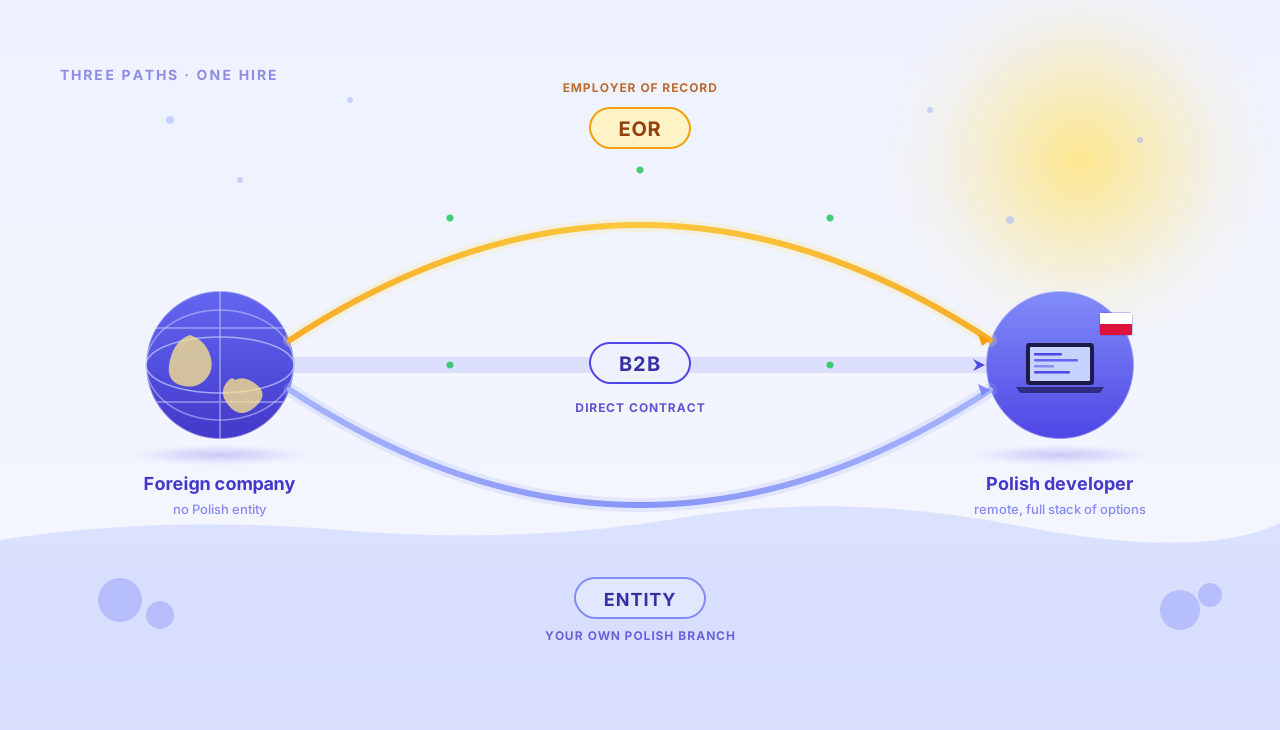
You decided you want to hire a Polish developer. Maybe a senior backend for your Series A startup, maybe a DevOps lead, maybe two full-stack hires for a growing scale-up. The talent question is settled. What you're missing is the operational answer — how, exactly, do you put a Polish person on payroll when your company sits in Berlin, London, Stockholm, or San Francisco and doesn't have a single legal presence in Poland? The short answer: you don't have to. There are three working paths — a direct B2B contract (the standard Polish self-employed model and by far the most common setup for senior IT specialists), Employer of Record (EOR), or eventually your own Polish entity — and which one fits depends on team size, candidate preference, and how long you plan to keep the person.
This guide walks through all three from a founder's perspective: real costs, contract shape, time-to-start, and the gotchas that actually bite. It assumes you're at 5-50 people, you're remote-first or remote-friendly, and you want a single Polish hire to work — not a dissertation on labor law.
Hiring Polish specialists for remote roles?
HiddenJobs is a verified job board for international companies hiring Polish remote specialists — across IT, sales, marketing and more.
Table of contents9 sections
Why hire from Poland?
The honest answer: Poland is one of the best risk-adjusted places in Europe to hire senior IT talent, and the cross-border infrastructure is already built. Time-zone overlap with the rest of the EU is essentially free. English fluency is high. The market for foreign-employer roles is thick — Polish developers are used to the model.
Poland sits in Central European Time, which means a Berlin or Stockholm team gets full overlap, a London team is an hour off in summer, and a US East Coast team gets four to five hours of working overlap before lunch. That's enough for daily standups, real-time pairing, and incident response.
English proficiency is consistently among the strongest in non-native EU markets — Polish IT professionals working internationally are typically at B2-C1 level for written and conversational English. The technical talent pool is deep across backend, frontend, DevOps, data engineering, and cybersecurity. Polish developers regularly place in the top tier of competitive programming and HackerRank country rankings, and Poland is one of the top developer hubs in the EU by sheer headcount.
What this guide isn't going to do is sell you on Poland as if you were still deciding. You already are. Let's talk mechanics.
Can you hire without a Polish entity?
Yes. Three legal paths exist, and you don't need to register anything in Poland for two of them. This is the question every foreign founder asks first, and the answer almost always surprises them — the bureaucracy is real, but it's not yours to handle.
The three paths in increasing order of overhead:
-
B2B contract with a Polish sole proprietor (JDG) — the most common setup. The developer is registered as a self-employed business owner in Poland (JDG is the Polish acronym for sole proprietorship). You sign a service agreement (think: a contractor agreement), they invoice you monthly, you pay. No payroll, no benefits, no Polish tax filings on your side. The developer handles their own ZUS (social security) and PIT (income tax). VAT is reverse-charged in EU B2B with valid VAT IDs, so it usually nets out. This is the dominant model for senior Polish IT specialists working with foreign companies — most have run their JDG for years and prefer it.
-
Employer of Record (EOR). A Polish company — Deel, Remote, Multiplier, Borderless AI, or a local provider — formally employs the developer on your behalf. The developer signs a Polish employment contract with the EOR. You pay the EOR a monthly invoice covering the developer's gross salary, employer-side social contributions, and the EOR's fee. The developer gets full Polish labor protections: paid leave (20-26 days), sick pay, notice periods, statutory benefits. You get a payslip-free relationship.
-
Your own Polish entity (Sp. z o.o. or branch). You register a Polish company. You handle Polish payroll, accounting, HR, ZUS, PIT-4R, statutory filings — directly or through a Polish accountant. This makes sense once you're hiring 5-10+ people in Poland and EOR fees start to outweigh the overhead of running a local entity. For a single hire, almost never worth it.
Most foreign startups end up using B2B for senior developers who prefer it (the majority of the senior pool in Poland), EOR for mid-level or junior hires who want labor protections, and only consider their own entity at scale. The choice is rarely about your preference — it's about what the candidate will sign.
B2B, EOR, or Polish entity: which fits a 5-50 person startup?
For a 5-50 person foreign startup hiring a single Polish developer, the realistic shortlist is B2B vs EOR — and B2B is the more popular default in the Polish market. Pick based on candidate preference first, cost structure second.
Here's the trade-off matrix:
| Factor | B2B (direct contract) | EOR | Your Polish entity |
|---|---|---|---|
| Setup time on your side | 1-3 days (contract template) | 1-2 weeks (vendor onboarding) | 3-6 months (registration, accountant, payroll) |
| Time to candidate's start | 3-7 days | 2-4 weeks | 4-8 weeks |
| Your monthly admin | Pay one invoice | Pay one invoice | Run payroll, file ZUS, file PIT |
| Cost on top of net pay | Roughly the developer's gross invoice | Gross salary + employer social ~20% + EOR fee | Gross salary + employer social ~20% + accountant |
| Candidate gets | Higher take-home, no labor protections | Lower take-home, full Polish employment rights | Lower take-home, full Polish employment rights |
| IP assignment | Contractual, must be explicit in agreement | Through EOR, usually solid template | Through Polish employment contract |
| Termination | Per contract — typically short notice | Polish labor law — 2 weeks to 3 months | Polish labor law — 2 weeks to 3 months |
| Best for | Senior independent operators | Mid-level, junior, or those who want stability | 5+ Polish hires, long horizon |
The decision usually goes like this:
- Senior developer (5+ years), already running their own JDG, wants high take-home → B2B. Lower friction, faster start, the math favors them. They've optimized for this.
- Mid-level or someone who hasn't been a contractor before, values labor protections, asks about paid leave → EOR. They want a payslip, they want sick pay, they don't want to deal with monthly ZUS filings. Pay the EOR fee.
- Polish hires have grown into a meaningful share of headcount and EOR fees are a real budget line → start evaluating your own entity. Earlier than that, EOR overhead almost always wins on simplicity, and the entity setup time eats months you'd rather spend hiring.
Don't let cost be the only input. The candidates you want most are the ones with options, and they'll pick the structure that suits them.
How much does a senior Polish developer cost in 2026?
Total cost of employment, not gross salary, is the number that matters. Sticker prices on Polish job boards are in PLN and usually quote either gross monthly salary (employee path) or net B2B daily/monthly rate (contractor path). The gap can be 40-50%, depending on which side you're reading.
Polish IT job boards publish salary ranges by stack and seniority. Pull up senior backend roles for foreign companies, look at the medians, and you'll have a calibrated sense of the market in under ten minutes. The boards worth using for this are the ones that separate B2B rates from employment-contract gross salaries — that's the distinction that matters most for budgeting on your side. For a role-by-role breakdown — B2B rates, employer ZUS, and EOR fees in one place — see our Polish developer salary and cost guide.
When budgeting:
-
B2B path. The developer's monthly invoice is roughly the total cost. VAT is reverse-charged in EU B2B with valid VAT IDs (article 196 of the EU VAT Directive), so you book it but don't pay it net. For non-EU buyers, the developer typically doesn't charge VAT on services to a foreign business.
-
EOR path. Take the developer's gross monthly salary. Add ~20% for employer-side social contributions (employer-side ZUS, accident insurance, labor fund, FGSP — all bundled by the EOR). Add the EOR's monthly fee per employee — typically a flat rate per head, often in the few-hundred-euro range, varying by provider and seniority of the role. That's your total monthly cost. Ask any EOR for a transparent breakdown before signing — they all provide one.
-
Your own entity. Same as EOR on the social-contribution side, but instead of the EOR fee you pay a Polish accountant (a few hundred euros per month for a small payroll), payroll software, and your own time on filings. Below 5 hires, this almost never wins on cost.
A common founder mistake is comparing net on EOR vs gross on B2B and concluding B2B is dramatically cheaper. It's not — the developer's gross B2B invoice already includes the equivalent of their own ZUS and tax. The right comparison is total cost on your side vs the developer's net take-home on each path. Run both numbers before you make an offer.
Hiring Polish specialists for remote roles?
HiddenJobs is a verified job board for international companies hiring Polish remote specialists — across IT, sales, marketing and more.
What contract should you sign?
For B2B: a service agreement governed by Polish Civil Code, with explicit IP assignment. For EOR: the EOR supplies a template, but you sign a separate service agreement with the EOR — that's the one to read carefully.
The non-negotiable clauses for a B2B contract with a Polish developer:
- Scope of services — be specific enough that the relationship doesn't get reclassified as employment by Polish tax authorities. The "is this really a B2B?" test in Poland looks at: does the contractor have other clients (or could they), do they set their own hours, do they bear business risk? Templates that look like a disguised employment contract are a real audit risk for the developer (and a reputational one for you).
- IP assignment — Polish copyright law does not auto-transfer IP under a B2B contract. You need an explicit clause assigning all economic copyright to your company, including derivative works, with the right to modify. Without this clause, the developer technically retains ownership of what they wrote.
- Confidentiality and non-compete — non-competes for B2B contractors in Poland are enforceable but only with compensation during the post-contract period. Most foreign companies skip the post-contract non-compete and rely on confidentiality plus reasonable client/employee non-solicit.
- Governing law and jurisdiction — you can specify your home jurisdiction, but a Polish judge will still apply Polish mandatory consumer/labor protections where they apply. For B2B between two businesses, this is rarely an issue. Default to your home jurisdiction unless your lawyer says otherwise.
- Termination — typical: 30 days' notice for either side, immediate for material breach. Avoid extreme imbalances (e.g., immediate termination for you, 90 days for the contractor) — Polish courts can void clauses they consider abusive.
- Currency and payment terms — EUR or USD is standard. Specify the exchange-rate reference for invoices and payment within 7-14 days of invoice.
For EOR, the developer's employment contract is supplied by the EOR provider and is in Polish (with an EN translation). Read the service agreement between you and the EOR instead — that's where IP flows up to you, where termination of the developer is mechanically handled, and where the EOR's liability sits.
For a deeper walkthrough of EOR specifically — how vendors compare in Poland, total monthly cost, onboarding timeline, and the IP/exit considerations to flag before signing — see the EOR guide for foreign employers in Poland.
Get a Polish employment lawyer to review your B2B template once. After that, you can reuse it indefinitely. Budget €500-1,500 for the review.
How long does it take?
B2B is typically 3-7 days from signed offer to first day of work. EOR is 2-4 weeks. Your own entity is 3-6 months before you can hire anyone through it. The bottleneck is rarely you — it's Polish onboarding paperwork.
What actually happens between offer and start:
- B2B: developer reviews and signs the contract, sets up the invoice template, you do KYC if your bank requires it. If they already run a JDG, this is a same-week affair. The only common delay is the developer's notice period at their current employer or contract — Polish notice on employment contracts is 2 weeks to 3 months by tenure, and B2B contracts vary.
- EOR: vendor selection (1-2 weeks if you haven't picked one), service agreement signing, developer onboarding via the EOR's portal (data collection, PESEL number, bank account, contract signing in the platform), ZUS registration by the EOR, first payroll cycle alignment. Most EOR providers quote 14-21 days for a Polish hire.
- Polish entity: Sp. z o.o. registration takes 4-12 weeks via S24 e-registration, longer for traditional notary route. Then VAT registration, ZUS payer registration, opening a Polish bank account, hiring an accountant, picking payroll software. Realistically 3-6 months before you can run a clean first payroll.
Two things accelerate everything: pick the EOR before you make the offer (so you can quote a real start date in the offer letter), and write the offer with a target start date that includes the candidate's notice period plus EOR onboarding buffer.
Where to source Polish developers
Polish IT job boards index thousands of remote roles for foreign companies. That's where active candidates look. For passive candidates, LinkedIn outbound and developer communities work — but expect lower response rates than for local roles unless your offer is positioned for the foreign-company segment.
HiddenJobs is purpose-built for this exact shape: an EN-language job board where international companies post roles for Polish remote specialists, with foreign-only verification, B2B/EOR/employment surfaced upfront so candidates self-qualify, and automated matching of specialists to relevant roles. Browse current listings at hiddenjobs.pl/jobs; to list a role for this audience, email contact@hiddenjobs.pl with the brief — role, stack, contract path, salary range, and time-zone expectation.
For a deeper breakdown of all the channels foreign employers actually use to reach Polish IT specialists — the trade-offs, expected response rates, and when each one wins — see where to post tech jobs for Polish developers in 2026.
Beyond that, several PL-language Polish IT job boards reach a wider audience and have strong filters on remote and contract type. Posting in PL on one of them — translated and clearly framed as a foreign-company role — is a reasonable second channel for senior roles, though expect more inbound from candidates also targeting Polish-domestic employers.
LinkedIn works for outbound sourcing — Polish IT specialists are active on LinkedIn, especially senior and lead roles. The key for outbound: be explicit in the first message that the role is for a foreign company, mention the path (B2B or EOR), and quote the budget range. Generic "Hi, I have an opportunity" templates get ignored. Polish developers receive a lot of outbound and reward concrete openers.
Niche communities — Polish developer Slacks, Discord servers, Devpolska, regional meetup networks — yield slower but higher-quality candidates. Worth the investment if you're hiring senior or lead-level engineers and want curated referrals.
Common gotchas and how to avoid them
The pitfalls that show up most often:
- Quoting net to the candidate, gross to your finance team. Always anchor offers in the monthly invoice amount for B2B or gross monthly salary for EOR. Convert to net once for the candidate's calibration, but contract on invoice/gross. Net-quoted offers blow up the moment Polish tax brackets shift.
- Forgetting employer social contributions on EOR. The "gross salary" the developer sees is not what hits your bill — add ~20% employer-side social on top, plus the EOR fee. New founders sometimes budget 100% of the gross and discover the actual outflow is 130%+ at the end of month one.
- Skipping IP assignment in B2B contracts. Without an explicit Polish-law copyright assignment clause, the developer technically owns their work. Patch your template once, reuse forever.
- Using a B2B contract that looks like an employment contract. Fixed hours, exclusive engagement, daily reporting, no business risk on the contractor — Polish tax authorities can reclassify the relationship as employment, which is a problem for the developer and a reputational issue for you. Write the contract to reflect actual independent contracting.
- Not screening for English on the first call. Senior CVs are often polished by recruiters or AI. The first 10 minutes of conversation in English are the cheapest screening you'll do — use them.
- Underestimating notice periods. A senior Polish developer on an employment contract can have a 3-month notice period. Plan offer timing accordingly.
- Choosing the cheapest EOR without checking Polish track record. Some global EORs partner with local entities that vary in quality. Ask for a Polish payroll sample, ask how they handle PIT and ZUS edge cases, and talk to one of their existing Polish hires before signing.
Quick checklist before the first offer
Before you send the offer letter, confirm:
- Path decided (B2B or EOR), aligned with the candidate's preference
- EOR vendor selected and service agreement signed (if EOR)
- B2B contract template reviewed by a Polish employment lawyer (if B2B, first time)
- IP assignment clause explicit in the contract (B2B) or service agreement (EOR)
- Total cost of employment calculated, not just gross salary
- Currency and payment terms specified (EUR/USD, 7-14 day terms)
- Realistic start date including notice period and onboarding buffer
- English fluency screened on a first call
- Target salary range cross-checked against Polish IT job boards for the role and seniority
- Offer letter quotes gross salary or invoice amount, not net
If all ten boxes are checked, you're ready. If three or more aren't, you'll be renegotiating in week two of onboarding.
Where this guide goes deeper
This pillar covers the structural decision; the operational mechanics live in dedicated deep dives:
- Sourcing channels — where to post tech jobs for Polish developers in 2026: the channel-by-channel breakdown of curated foreign-only boards, PL-language job boards, LinkedIn outbound, niche developer communities, and agencies, with cost ranges and expected response rates per channel.
- Employer of Record (EOR) specifically — the EOR guide for foreign employers in Poland: vendor selection (Deel, Remote, Multiplier, local providers), total monthly cost breakdown, 7-10 day onboarding timeline, IP assignment, and exit strategy when you eventually open your own Polish entity.
- Platform and cloud roles — hiring Polish DevOps and cloud engineers in 2026: B2B rates, the AWS/GCP/Azure certification premium, Kubernetes specialists and the sourcing channels that work for platform talent.
- Agency versus direct hire — outsourcing software to Poland in 2026: what a nearshore agency really costs, when it beats an in-house team and when hiring Polish developers directly wins.
More guides ship weekly throughout May 2026 — including a per-stack salary cost breakdown, a B2B-versus-EOR decision tree calibrated for the post-July 2026 PIP regulatory regime, and a standalone explainer of the July 2026 Polish B2B reform that's reshaping the foreign-employer hiring calculus. Bookmark the blog index or check back as each ships.
Closing
Hiring a Polish developer as a foreign founder is mechanically simpler than most people expect — the cross-border infrastructure has been mature for a decade, and the choice between B2B and EOR is genuinely a candidate-preference question rather than a hard architectural decision (with B2B being the dominant default for senior IT in Poland). The mistakes that bite are almost always cost-basis mistakes (gross vs net vs total) and contract mistakes (IP assignment, employment-mimicking B2B). Both are solved with a one-time template review and a clear offer process.
To list a role for HiddenJobs' curated foreign-only audience, email contact@hiddenjobs.pl with the brief: role title, stack, contract path (B2B / EOR / employment), salary range in EUR or USD, and the time-zone expectation. Verified listings appear on hiddenjobs.pl/jobs alongside other foreign-employer roles. I'll reply within a day or two.
Frequently asked questions
Can I hire a Polish developer without opening a company in Poland?
Yes. The most common path is a direct B2B contract with a Polish sole proprietor (JDG) — i.e., a self-employed contractor model that dominates the senior Polish IT market. The second path is an Employer of Record (EOR), a Polish entity that formally employs the developer on your behalf. Both are legal, widely used, and don't require you to register anything in Poland. Opening your own Polish entity is a third option, only worth it once you're scaling beyond 5-10 hires in the country.
Is B2B or EOR better for hiring a Polish developer as a foreign startup?
B2B gives the developer higher take-home pay and you a simpler invoice-based relationship — no Polish payroll, no benefits administration. EOR gives the developer a Polish employment contract with full labor protections (paid leave, sick pay, notice periods) and you a fixed monthly fee per employee. Senior developers in Poland often prefer B2B because the math favors them; less experienced people sometimes prefer EOR for stability. Match the structure to what the candidate wants — forcing one over the other costs you offers.
How much does a senior Polish developer cost per month in 2026?
Polish developer rates vary widely by stack, seniority, and English level. Public Polish IT job boards publish salary ranges per role and seniority — they're the fastest sanity check. Add ~10-15% on top of the developer's gross B2B invoice for VAT (reverse-charged in EU B2B with valid VAT IDs, so often a wash) and on EOR add the provider's monthly fee on top of the gross salary plus employer-side social contributions. Budget for total cost of employment, not just gross salary.
Do I need a Polish lawyer to hire a Polish B2B contractor?
For a standard B2B contract: no, but it's a good investment for the first hire. The contract is governed by Polish Civil Code regardless of where you sign it (unless you specify otherwise), so a one-time legal review of your template prevents recurring issues. For EOR: the provider supplies the contract, but you should still review the service agreement between your company and the EOR — that's where IP assignment, termination, and liability live.
Are Polish developers fluent in English?
Polish IT specialists working remotely for foreign companies are typically B2-C1 in written and conversational English — daily standups, code reviews, async writing all work fluidly. Poland ranks consistently in the top tier of EU countries on the EF English Proficiency Index. That said, English level varies by candidate and is worth screening for in the first call, especially for client-facing or staff+ engineering roles.
How long does it take to hire a Polish developer through EOR?
From signed offer to first day of work, plan for 2-4 weeks on EOR. The bottleneck is the Polish onboarding paperwork (PESEL number for the developer, employment contract signing, bank account setup, ZUS registration by the EOR provider). B2B is faster — often 3-7 days because the developer already has their JDG (sole proprietorship) registered. Add another week if the developer is currently employed elsewhere with a notice period.
Editorial note
This article is based on publicly available Polish employment law, public pricing pages of EOR providers, and industry-standard practice for foreign companies hiring Polish IT specialists (as of April 2026). It is informational and not legal, tax, or HR advice. Specific EOR fees, salary ranges, and contract terms vary by provider, role, and the individual case. Before signing any contract or selecting an EOR, consult a qualified Polish employment lawyer or a tax advisor familiar with cross-border arrangements.