Hiring Developers in Eastern Europe: Poland vs Ukraine vs Romania (2026 Buyer's Guide)

If you run a startup or scale-up in Berlin, London, Amsterdam, Stockholm, or San Francisco and you have decided to hire remote engineering talent from Eastern Europe in 2026, you are walking into a corridor that already carries thousands of foreign-employer hires every year. The question is not whether Eastern Europe works — it does — but which country fits your specific case: Poland, Romania, or Ukraine.
This guide compares the three on the dimensions that actually matter for foreign employers in 2026: senior B2B rates, time-zone fit, English fluency, EU jurisdiction, contract structure, and the operational realities of the war in Ukraine. Each section ends with the "use case where this country wins" — so by the end you can match your specific hiring need to the right corridor.
Hiring Polish specialists for remote roles?
HiddenJobs is a verified job board and matching service for international companies recruiting Polish remote talent.
Table of contents8 sections
Why is Eastern Europe the default nearshoring choice for foreign employers in 2026?
The combination is hard to find anywhere else: deep senior IT talent, real-time time-zone overlap with Western Europe, working English fluency, and (for two of three countries) full EU jurisdiction. Compared to India, you trade slightly higher rates for synchronous workdays. Compared to Latin America, you trade nothing — you get tighter time-zone fit at similar cost.
The three corridors that compete for foreign-employer attention in 2026 are Eastern Europe, India, and Latin America. The trade-offs:
- India — cheapest senior rates ($30-45/h per Accelerance 2025) but 5-hour offset to Berlin and 9-12 hour offset to US West Coast. Async-first or specific late-night standups required.
- Latin America — comparable rates to Poland ($50-80/h Mexico per Stack Overflow 2025), reasonable US overlap, but limited European time-zone fit and weaker EU compliance posture.
- Eastern Europe (Poland, Ukraine, Romania) — senior rates $25-65/h depending on country, real-time WE overlap, English fluency at B2-C1 in the IT segment, and EU jurisdiction for Poland and Romania.
For European foreign employers specifically — German Mittelstand, UK SaaS, Dutch fintech, Nordic scale-ups — Eastern Europe is rarely a contest. The corridor is the default and the question reduces to which Eastern European country.
The depth of available talent backs the demand-side decision. Poland's business services sector reached 488,700 people in Q1 2025 per ABSL Sector in Numbers with significant IT concentration. Romania's ANIS reported approximately 210,000 IT specialists in 2025. Ukraine's IT Ukraine Association tracked roughly 310,000 IT specialists in 2025, including those who relocated abroad post-war. The combined pool exceeds one million technical professionals — the largest concentration of Western-aligned IT talent on the European mainland.
How do Polish, Romanian, and Ukrainian developer rates compare in 2026?
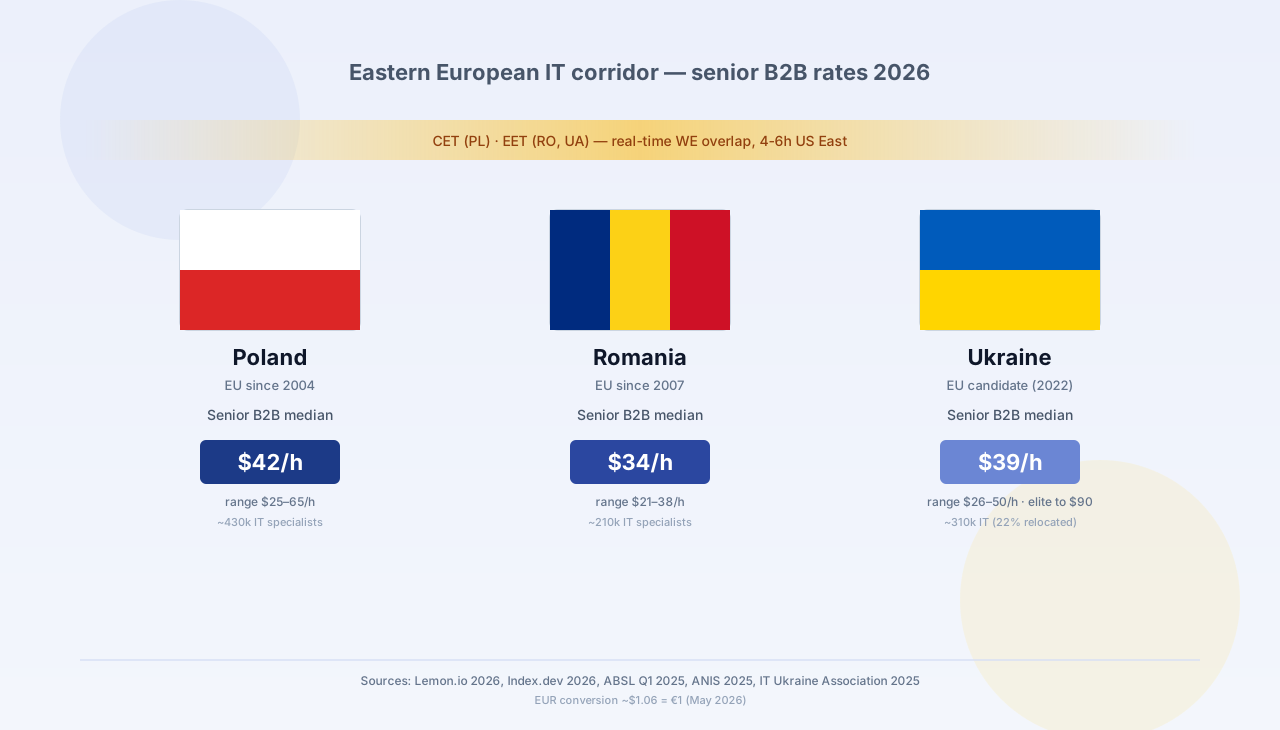
Poland highest in the dominant range, Romania lowest, Ukraine in between with a wider band reflecting the post-war discount and elite specialist premium. Mid-field comparison: Polish senior $42/h, Romanian senior $34/h, Ukrainian senior $39/h.
Senior software developer hourly rates B2B across the trio for 2026:
| Country | Range | Median | Top of band | Source |
|---|---|---|---|---|
| Poland | $25–65/h | $42/h | $65 (lead/architect) | Lemon.io 2026, Index.dev 2026 |
| Romania | $21–38/h | $34/h | $80 (senior elite) | SalaryExpert 2026, Huntly.ai |
| Ukraine | $26–50/h | $39/h | $55–90 (Python/ML/Rust elite) | Lemon.io 2026, Mobilunity |
EUR conversion (~$1.06 = €1, May 2026):
- Polish senior: €24-61/h, median €39
- Romanian senior: €20-36/h, median €32
- Ukrainian senior: €25-47/h, median €37
What the numbers tell you:
Poland sits at the top of the dominant range because three things stack: deeper senior talent pool, full EU membership (no compliance friction), and the highest aggregate English fluency among the three (EF EPI 13 vs Romania 17 vs Ukraine 35). Foreign employers pay a small premium for the lower-friction engagement.
Romania prices below Poland for similar quality — the gap reflects smaller senior pool depth and slightly less concentrated international employer presence. For a foreign employer, the practical experience is broadly comparable to Polish; the savings are real but the talent search may take a week or two longer.
Ukraine carries a post-war discount in the dominant range, but the elite Python/ML/Rust segment can reach $55-90/h — driven by global scarcity of the specialty rather than country economics. The discount reflects the operational risk premium foreign employers price in (continuity, air-raid logistics, geopolitical uncertainty).
For comparison context — Lemon.io 2026 rate calculators and Index.dev's European hourly rate guide both put senior US developers at $120-200/h, German seniors at €110-140/h (Bytefront 2025), making the Eastern European trio roughly 30-50% cheaper than Western Europe and 65-80% cheaper than US senior contractors.
Hiring Polish specialists for remote roles?
HiddenJobs is a verified job board and matching service for international companies recruiting Polish remote talent.
What's the time zone fit with Western Europe and the US?
Poland matches Germany / France / Netherlands / Nordics exactly. Romania and Ukraine sit one hour ahead. None of the three creates an async-only constraint.
Operationally, the time-zone math:
| Country | TZ | vs UK (London) | vs Germany (Berlin) | vs US East (NY) |
|---|---|---|---|---|
| Poland (Warsaw) | CET / CEST | +1h (summer same) | same | −6h |
| Romania (Bucharest) | EET / EEST | +2h | +1h | −7h |
| Ukraine (Kyiv) | EET / EEST | +2h | +1h | −7h |
What this means in practice:
- Polish developer + German team — identical workday. 9 a.m. Berlin = 9 a.m. Warsaw. Pair programming, code reviews, stand-ups, incident response all happen in real time without coordination overhead.
- Romanian / Ukrainian developer + German team — Bucharest is one hour ahead of Berlin. Romanian dev's 9 a.m. is Berlin's 8 a.m. Practical effect: Romanian afternoon (4-5 p.m. local) overlaps Berlin morning. Real-time work still natural; the developer's day starts before the Berlin team's day starts.
- Eastern European dev + UK team — UK is 1-2 hours behind. Polish 9 a.m. = London 8 a.m. Bucharest 9 a.m. = London 7 a.m. Real-time overlap from mid-morning onwards.
- Eastern European dev + US East Coast — Polish afternoon (3 p.m. CET) = US East 9 a.m. Real overlap of 4-6 hours daily for sync work. Bucharest / Kyiv afternoons (3 p.m. EET) = US East 8 a.m., similar window.
None of these scenarios require async-only operating discipline. The async constraint kicks in for India (Bangalore 5h ahead of Berlin, late-night standups required) or US West Coast pairings with Eastern Europe (only the Eastern European morning overlaps with US West afternoon — a 2-3h window).
How does English fluency and engineering culture compare?
Poland and Romania score Very High and High on the EF English Proficiency Index 2025. Ukraine scores Moderate aggregate but the IT segment in Kyiv and Lviv clusters at B2-C1 — gap shows up more in junior-mid talent.
Aggregate English fluency rankings (EF EPI 2025):
- Poland: rank 13 of 116 — Very High band — IT segment B2-C1 majority
- Romania: rank 17 of 116 — High band — IT segment B2-C1 majority
- Ukraine: rank 35 of 116 — Moderate band aggregate — IT segment in Kyiv / Lviv hubs B2-C1, less consistent in second-tier cities
For foreign employers hiring senior remote talent, all three deliver workable English in screening calls, design reviews, and stand-ups. The differentiation is more pronounced when:
- Hiring junior or mid-level — Poland and Romania pools have deeper English fluency at junior-mid levels. Ukrainian junior-mid English varies more by city.
- Hiring outside Tier 1 cities — Polish and Romanian Tier 2 cities (Łódź, Poznań, Cluj, Iași) maintain strong fluency; Ukrainian Tier 2 cities trail.
- Working in writing-heavy roles — technical writing for design RFCs, post-mortems, async documentation: all three corridors have strong B2-C1 capability in the senior remote segment.
Engineering culture is broadly similar across the three: directness in technical discussions, thoroughness in code reviews, willingness to push back on ambiguous requirements. Stylistically, Polish IT culture is somewhat more formal than the typical Berlin startup norm; Romanian culture tilts slightly closer to Mediterranean directness; Ukrainian culture sits between the two with a strong individualist streak among senior contractors. None of these are deal-breakers — they are stylistic adjustments for the foreign manager.
EU jurisdiction and compliance — which country wins for B2B contracts?
Poland and Romania are full EU members; Ukraine is an EU candidate since 2022 but not yet a member. The compliance gap manifests in DPA paperwork — Polish and Romanian engagements need a standard Article 28 DPA; Ukrainian engagements add Standard Contractual Clauses (SCCs).
The compliance picture, dimension by dimension:
| Country | EU member | GDPR direct | Schrems II concern | Currency |
|---|---|---|---|---|
| Poland | ✓ Since 2004 | ✓ | None | PLN (EUR-pegged via NBP) |
| Romania | ✓ Since 2007 | ✓ | None | RON (semi-pegged) |
| Ukraine | Candidate (2022) | Approximated via Ukrainian law | SCC needed for EU clients | UAH (volatile post-war) |
What this means for procurement and legal:
Polish or Romanian B2B contract — your standard Article 28 GDPR Data Processing Agreement applies directly. EU-based clients need no special transfer mechanism. Reverse-charge VAT applies between EU companies with valid VAT IDs (no VAT on the invoice). Currency is local (PLN, RON) but invoicing in EUR is standard practice.
Ukrainian B2B contract — your DPA needs Standard Contractual Clauses (SCCs) per the EU adequacy framework, since Ukraine is a candidate but not yet a member. Ukraine has its own data protection law that approximates GDPR, and most reputable Ukrainian dev shops have SCC templates ready. Operationally manageable but adds a procurement-side step.
For startups under 50 people, the additional Ukrainian SCC step is rarely a deal-breaker but shows up as 1-2 weeks of extra contract review on the first engagement. By contract two, it is a templated workflow.
Currency volatility is the underrated factor for Ukrainian engagements. UAH has lost roughly 40% versus EUR since February 2022. Most foreign employers invoice Ukrainian contractors in EUR or USD precisely to remove this volatility from the developer's compensation experience.
War risk in Ukraine — what has actually changed for foreign employers in 2026?
Roughly 22% of the Ukrainian IT workforce relocated abroad — primarily to Poland and the Czech Republic — and continues remote work from EU jurisdictions. For developers still based in Ukraine, build in continuity buffers: redundant deliverables, async-friendly workflows, and acceptance that air-raid sirens disrupt synchronous calls.
The picture in 2026, four years into the war, is materially different from the early-war 2022-2023 moment:
- Workforce relocation: per the IT Ukraine Association 2025 report, roughly 22% of the Ukrainian IT workforce relocated abroad — Poland received the largest share (the Polish-Ukrainian cultural and linguistic proximity made this the natural destination), followed by the Czech Republic and Germany. These developers continue remote work for foreign employers from EU jurisdictions.
- Continuity for in-Ukraine developers: power-grid attacks created rolling blackouts in 2022-2023; Ukrainian IT companies and individual contractors invested heavily in backup power, generators, and Starlink connectivity. By 2026, most operational disruption is measurable in single-digit hours per week, not full workdays. Air-raid sirens occur in major cities and disrupt synchronous calls; experienced foreign employers schedule sync work for low-risk windows or default to async-friendly tooling.
- Geopolitical uncertainty: the war's trajectory remains unpredictable. Foreign employers engaging Ukrainian developers should price the residual risk into their decision — typically through a slight discount versus Polish or Romanian rates, build contingency plans for accelerated wind-down, and understand that the developer may need to relocate again on short notice.
For a foreign employer comfortable with this operational profile, Ukrainian senior developers offer real value at a meaningful discount. For an employer prioritizing operational predictability above all else, Poland or Romania is the lower-friction choice.
The pragmatic middle ground that many Western European companies adopted: engage Ukrainian developers who relocated to EU jurisdictions (typically Poland or Czech Republic). The developer is operationally as low-risk as any other EU contractor, the contract is governed by EU law, and the developer's compensation and contract structure typically mirror those used for Polish or Romanian engagements.
Which Eastern European country is the right fit for your specific use case?
The answer depends on three variables: your team's existing time-zone (UK / WE / US East), your tolerance for engagement friction (compliance paperwork, currency volatility), and your senior versus junior-mid hiring split. Below is the decision frame I see most foreign employers use.
The decision frames that actually drive the choice:
Pick Poland if:
- Your team is in Germany, Netherlands, France, Switzerland, or the Nordics — exact time-zone match
- You want the deepest senior pool with consistent English fluency at all levels
- You want zero-friction EU compliance posture (full EU member, GDPR direct)
- You are comfortable paying a modest premium ($5-10/h vs Romania) for lower hiring friction
- Use case examples: senior backend hires for German fintech, Polish-speaking candidate desired alongside English
Pick Romania if:
- Your priority is the lowest sustainable rate among the three with EU membership intact
- Your team is in Germany or further west — one-hour TZ offset is acceptable
- You are comfortable with a slightly smaller senior pool (longer search by 1-2 weeks)
- Use case examples: cost-conscious scale-up extending engineering team, Bucharest dev hub already established
Pick Ukraine if:
- You have specialty needs in Python / ML / Rust where Ukrainian elite ($55-90/h band) is competitive globally
- Your team accepts the operational risk profile and has continuity workflows in place
- You can engage developers who relocated to EU jurisdictions (PL, CZ) for the same operational risk as a Polish hire
- Use case examples: AI / ML startup hiring senior research engineers, established offshore relationship pre-war that survived the disruption
Hybrid approach — many foreign employers run a Poland-anchored hiring strategy (default to Polish senior for new core hires) with Romanian or Ukrainian extensions for cost-sensitive or specialty roles. This gives you the procurement template (DPA, contract, payroll setup) on Polish first, and you adapt for the second country with a smaller marginal cost.
Where do you find vetted candidates per country?
Three channels work in parallel for the first hire in each country: a curated foreign-only IT job board (where one exists), large country-specific IT job boards translated to English, and LinkedIn outbound to senior individuals matching your stack. Concrete openers beat generic templates by 5-10x in response rate.
Channel mix per country:
Poland:
- HiddenJobs.eu (curated foreign-only Polish IT job board) — every listing verified for foreign-employer fit, contract path indicated upfront
- NoFluffJobs, Bulldogjob, JustJoin.it — large Polish IT job boards translated to English; broadest reach into the active job-seeker segment
- LinkedIn outbound — Polish senior developers receive 5-15 outbound messages per week; concrete openers (role, contract path, EUR salary range, time-zone expectation) get 5-10x the response rate vs templates
- Polish dev communities — niche Slacks and Discord servers, regional meetup networks; slower but high-quality flow
Romania:
- eJobs, BestJobs, hipo.ro — large Romanian IT job boards; eJobs is the most active for tech roles
- LinkedIn outbound — Romanian senior developers receive fewer outbound messages than Polish counterparts (smaller pool size); response rates trend higher per message sent
- Bucharest tech meetups — Bucharest Tech Week and Cluj Innovation Days are anchor events; foreign employers occasionally sponsor for visibility
- Local recruitment agencies — Romania has a deeper third-party recruiter ecosystem than Poland
Ukraine:
- Djinni, DOU.ua — primary Ukrainian IT job boards; Djinni dominant for international remote roles, DOU.ua broader for in-country positions
- LinkedIn outbound — Ukrainian developers actively engage with Western recruiters; response rates trend high since the war (developers seeking foreign-employer roles for income stability)
- Diaspora networks — Ukrainian developers in Polish or Czech tech communities are reachable through the local channel mix in those countries
- Specialty platforms — Toptal and Upwork carry significant Ukrainian senior representation in the post-war 2024-2026 period
To list a verified Polish role on HiddenJobs.eu, send the brief to hiddenjobs.eu or get in touch directly — role title, stack, contract path (B2B or EOR), salary range in EUR, time-zone expectation, and one paragraph about your company. You will get a response within a day or two with the live listing or a brief clarification request.
Where does this guide go from here?
Hiring developers in Eastern Europe is mechanically clean — the corridor is established, the regulatory parallels are familiar, and the operational path is well-trodden. The remaining work is the role itself, the listing copy, and the candidate evaluation.
For deeper Polish-specific guides on this site:
- Total cost of a Polish senior developer in 2026 — the salary breakdown post (just shipped) covers Polish-specific cost benchmarks with itemized EOR vs B2B math.
- Employer of Record in Poland — the EOR deep dive covers vendor selection, total cost, and the July 2026 PIP regulatory regime that's reshaping the calculus.
- Founder's guide to hiring Polish IT specialists — the pillar post covers all three contract paths (B2B, EOR, your own Polish entity) end-to-end.
The short version of Eastern European hiring 2026: Poland is the default for European foreign employers (lowest friction, deepest senior pool, exact EU compliance posture), Romania is the cost-leader within EU membership (slightly smaller senior pool, similar time-zone fit), and Ukraine offers post-war discount with operational caveats (or zero-caveat if hiring relocated developers in EU jurisdictions).
To list a verified Polish role on HiddenJobs.eu, send the brief to hiddenjobs.eu or get in touch directly. Response within a day or two.
Frequently asked questions
Why hire developers in Eastern Europe instead of India or Latin America?
Three reasons stack. First, time-zone fit: Poland is on CET (same as Germany, Netherlands, France), Romania and Ukraine are on EET (one hour ahead). Real-time pair programming with Western European teams works without async overhead — unlike India (5h offset to Berlin) or Latin America (5-7h offset). Second, EU jurisdiction: Poland and Romania are full EU members, so GDPR applies directly and there is no Schrems II concern for European clients. Third, talent pool depth: Poland has roughly 430,000 IT specialists, Ukraine roughly 310,000 (with around 22% relocated post-war), Romania roughly 210,000. The combined Eastern European pool is the largest concentrated technical workforce in any nearshoring corridor accessible to Western Europe.
How much do senior developers cost in Poland vs Ukraine vs Romania in 2026?
Senior B2B hourly rates in 2026: Poland $25-65 with median around $42 (Lemon.io 2026, Index.dev), Romania $21-38 with median around $34 (SalaryExpert, Huntly.ai), Ukraine $26-50 with median around $39 ($43-50 strong seniors per Lemon.io and Mobilunity 2026). Poland sits highest among the three — premium reflects deeper senior pool, EU stability, and stronger English fluency. Romania is the lowest median in the dominant range. Ukraine pricing reflects post-war discount, specialist Python/ML/Rust pushing $55-90/h at top of band. EU saving versus German seniors (€110-140/h per Bytefront 2026) is roughly 30-50% across the trio.
Which country has the best English fluency among IT developers?
Poland leads on aggregate fluency — ranked 13th globally on the EF English Proficiency Index 2025 (Very High band), with B2-C1 the dominant level in the IT segment. Romania is close behind at rank 17 (High band), also B2-C1 majority in tech. Ukraine ranks 35th overall (Moderate), but its top tech hubs (Kyiv, Lviv) cluster B2-C1 — the gap shows up more in second-tier cities than in the senior remote talent foreign companies typically hire. For a foreign employer hiring senior remote roles, all three deliver workable English; the differentiation is in junior-mid talent depth.
Is it still safe to hire Ukrainian developers in 2026 with the war ongoing?
Many Western companies continue to engage Ukrainian developers, but the operational picture changed materially since February 2022. Roughly 22% of the Ukrainian IT workforce relocated abroad — primarily to Poland and the Czech Republic — and continues remote work from EU jurisdictions, which removes most of the air-raid logistics concern. For developers still based in Ukraine, build in continuity buffers: redundant deliverables, asynchronous workflows where possible, and acceptance that air-raid sirens disrupt synchronous calls. Pricing reflects the discount; whether the discount compensates for the continuity risk is your call. Ukrainian developers in EU jurisdictions (PL, CZ, DE) carry no more risk than any other EU contractor.
What's the GDPR situation for Ukrainian developers compared to EU members?
Poland and Romania are EU members with direct GDPR applicability — no Schrems II concern, no extra paperwork beyond a standard Article 28 Data Processing Agreement (DPA). Ukraine is an EU candidate country since 2022 but not yet a member, so GDPR does not apply directly. For EU clients engaging Ukrainian developers, you need Standard Contractual Clauses (SCCs) per the EU adequacy framework. Ukraine has its own data protection law that approximates GDPR, and most reputable Ukrainian dev shops have SCC templates ready. Operationally manageable but adds a procurement-side step versus engaging a Polish or Romanian contractor.
Can I work with Eastern European developers in real-time despite time zones?
Yes — all three countries deliver same-day workday overlap with Western Europe and meaningful overlap with the US East Coast. Poland sits on CET (UTC+1, summer UTC+2), so it matches Germany, Netherlands, France, and Nordics exactly. Romania and Ukraine sit on EET (UTC+2, summer UTC+3), one hour ahead of Berlin. With US East Coast, the typical workday overlap is 4-6 hours (Eastern European afternoon = US morning) — enough for real-time stand-ups, code reviews, and pair programming. The async-only constraint that applies to India and most of Latin America does not apply here.
What contract types are most common for foreign employers in each country?
Poland: B2B (developer's JDG sole proprietorship invoicing the foreign client) is dominant for senior IT, with Employer of Record (EOR) becoming the safer choice from 8 July 2026 when the Polish Labour Inspectorate (PIP) reform expands reclassification authority. Romania: PFA (sole proprietor) is the equivalent of Polish JDG, similarly common for B2B. Romania's tax structure favors PFA contractors with a 10% income tax + a flat health contribution. Ukraine: FOP (Fizychna Osoba-Pidpryyemets) is the Polish JDG equivalent, the dominant structure. EOR providers cover all three countries (Deel, Remote, Velocity Global, etc.) with broadly similar pricing — base fee around \$599 per employee per month plus local employer-side contributions.
Where do I find vetted Eastern European developers as a foreign company?
Three channels work in parallel for the first hire: a curated foreign-only Polish IT job board (HiddenJobs.eu sits in this category and verifies every listing for foreign-employer fit); large country-specific IT job boards translated to English (NoFluffJobs, Bulldogjob, JustJoin.it for Poland; DjinniIT, Djinni for Ukraine; eJobs, BestJobs for Romania); and LinkedIn outbound to senior individuals matching your stack. Concrete openers (role name, contract path, EUR salary range, time-zone expectation, one specific reason) get 5-10x the response rate over generic templates across all three countries.
Editorial note
This guide cites named sources for every concrete number: Lemon.io rate calculators (Poland, Ukraine, Romania) for senior hourly rates 2026, Index.dev European Developer Hourly Rates 2026 for cross-country comparison, Huntly.ai and Alcor BPO for Romanian context, Mobilunity and MindHunt for Ukrainian context, ABSL Q1 2025 for Polish business services workforce, EF English Proficiency Index 2025 for fluency rankings, and IT Ukraine Association 2025 for post-war workforce displacement figures. Currency conversion at ~$1.06 = €1 (May 2026). Treat the ranges as ranges — actual rates vary by stack, seniority, specialization, and individual negotiation. The post is informational and does not constitute legal, tax, or HR advice; consult a qualified advisor in your jurisdiction before signing your first contract in any of the three countries.