How to Hire Remote Developers from Poland (2026 Guide)

If your company is in Berlin, London, Amsterdam, or New York and you want a strong developer without opening an office abroad, Poland is one of the most practical places to look — a deep senior talent pool, European working hours, high English proficiency, and no requirement to set up a local entity. The question is rarely whether to hire from Poland. It's how, exactly, without tripping over contracts, tax, or compliance you've never dealt with before.
This is the pillar guide: it answers the whole question end to end at a practical depth, then points you to the detailed cluster guides — cost, EOR, and where to post — when you need to go deeper on one step.
Hiring Polish specialists for remote roles?
HiddenJobs is a verified job board for international companies hiring Polish remote specialists — across IT, sales, marketing and more.
Table of contents12 sections
How do you hire a remote developer from Poland?
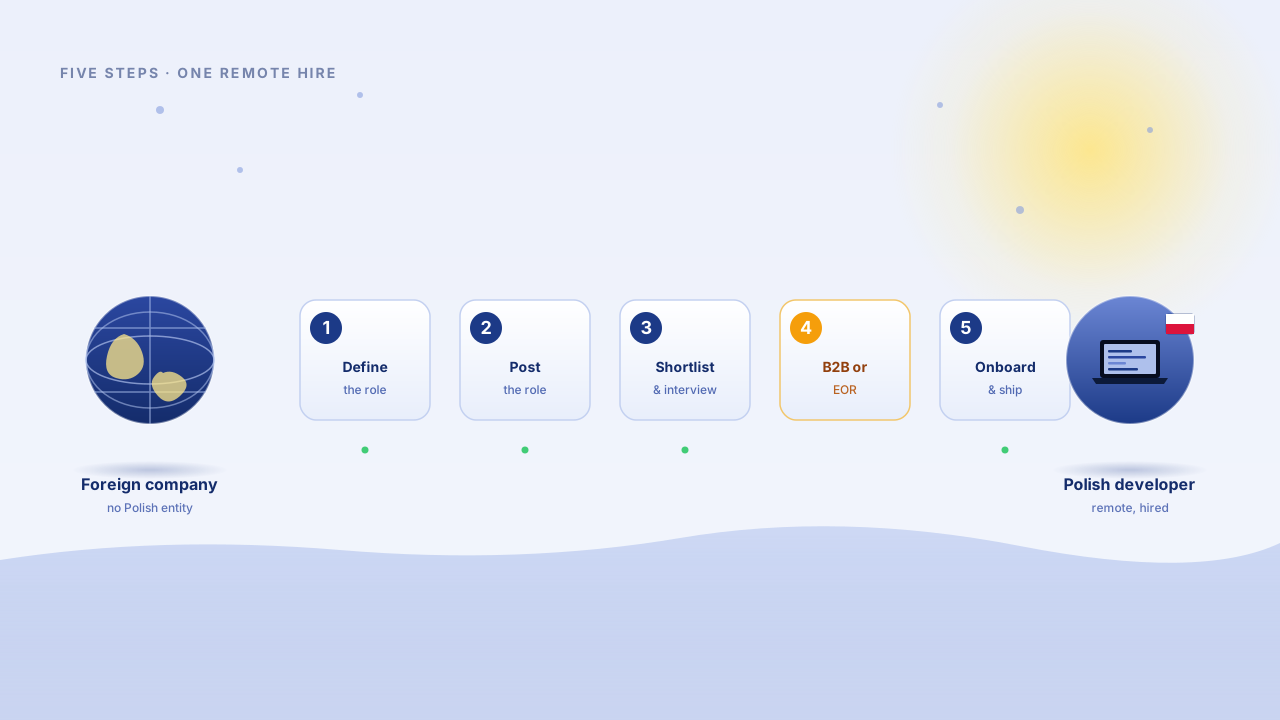
Hiring a remote developer from Poland is a five-step process: (1) define the role and budget, (2) post it where Polish specialists actually look, (3) shortlist and interview, (4) sign a B2B contract or use an Employer of Record, and (5) onboard. No Polish entity is required at any step.
The five steps in order:
- Define the role and budget. Write the role in English, state that it's a foreign-company, 100% remote position, quote the salary or rate range in EUR or USD (not PLN), and name the time-zone expectation. Polish specialists self-sort hard on all four — ambiguity costs you good applications.
- Post where Polish specialists look. This is a sourcing decision — a job board, a freelance marketplace, or your own outreach. The channel comparison is below.
- Shortlist and interview. Screen on a tight loop; move qualified candidates to a first call within a few days. English level is worth a quick sanity check on that first call, but rarely the blocker.
- Sign a B2B contract or use an EOR. This is the contracting decision — separate from sourcing. B2B for genuinely independent contractors; an EOR when you want formal employment. More on the distinction below.
- Onboard. Get equipment, access, and a first-week plan ready before day one. B2B contractors can start within days; expect 2–4 weeks to full productivity either way.
Steps 2 and 4 are where most foreign employers get stuck — they're the ones this guide spends the most time on, and each has its own deep-dive in the linked cluster.
Why hire developers in Poland? The numbers
Poland combines four things foreign employers rarely get in one market: one of the largest developer pools in Central and Eastern Europe, high-proficiency English (15th of 116 countries on the EF English Proficiency Index), full European timezone overlap on CET/CEST, and rates roughly 30–50% below Germany or the UK for the same seniority.
The facts that matter for a hiring decision, each verifiable:
- A deep senior pool. The EU employs more than 10 million ICT specialists (Eurostat), and Poland is one of the largest developer markets in Central and Eastern Europe — deep across backend, frontend, DevOps, data engineering, and cybersecurity.
- Top-tier engineering benchmarks. Polish developers regularly place in the top tier of competitive-programming and HackerRank country rankings.
- High-proficiency English. 15th of 116 countries on the EF English Proficiency Index — the senior IT segment sits at the top of that pool.
- European working hours. CET/CEST means a full-day overlap with London, Berlin, and Paris, and 3–5 live hours with US East Coast mornings.
- 30–50% lower cost at equal seniority. A senior developer lands around €5,800–6,300/month on B2B (JustJoin.it and No Fluff Jobs 2026 salary data) versus well above that in DACH or the UK.
- Fast starts. A B2B contractor can typically begin within 3–7 days of agreeing terms; an EOR adds only a few days.
If you're weighing Poland against other regions, the short version: you keep European working hours and EU legal framework, at rates closer to nearshore markets.
Do you need a company or legal entity in Poland to hire a developer?
No. You do not need a Polish company, branch, or any local registration to hire a Polish developer. Two routes both work without one: a B2B contract, where the developer's own one-person company invoices you, or an Employer of Record, which employs the person on your behalf.
On B2B, the developer runs a registered one-person business (a JDG, in Polish) and invoices you monthly for services. They handle their own Polish tax and social security. Your side is simply a business-to-business service contract between two companies — the standard model for senior Polish IT contractors.
On an EOR, a Polish provider is the legal employer of record; it runs payroll, social security, and compliance, and bills you a single monthly invoice. You direct the work; the provider carries the employment. You still hold no Polish entity.
Opening your own Polish company only starts to make sense once you're hiring several people long-term — until then, B2B or EOR keeps you out of local payroll and registration entirely.
The decision map in one glance — when each of the three models fits:
- B2B — the default for genuinely independent senior contractors; fastest start, lowest overhead. Avoid it when the day-to-day would mirror employment (fixed hours under your direction) — that is where reclassification risk lives.
- EOR — when you want formal employment, full Polish labour protections, and zero classification risk, without a local entity. Slightly slower and costlier per head.
- Your own Polish entity (Sp. z o.o.) — starts to pay off around several long-term hires, when the recurring EOR fees and the strategic value of a local presence outweigh the setup and accounting overhead. Not a first-hire tool.
Where do you post a role to reach Polish developers?
You reach Polish developers through four main channel types: Polish IT job boards (NoFluffJobs, JustJoinIT, Bulldogjob), a foreign-employer board built for candidates who specifically want to work abroad, freelance marketplaces (Upwork, Toptal, Arc), and LinkedIn or direct outreach. Most successful first hires use two or three in parallel.
Each channel reaches an overlapping but distinct slice of the market, at very different price points:
| Channel | What it is | Typical cost | Best when |
|---|---|---|---|
| Polish IT job boards (NoFluffJobs, JustJoinIT, Bulldogjob) | Large PL-audience boards, salary ranges shown | premium listings ~€250–700/role | broad reach into the whole PL market |
| HiddenJobs | A job board for Polish specialists who specifically want foreign, 100% remote employers; foreign-employer listings | promoted listing from €39 | you're a foreign company wanting candidates already looking abroad |
| Freelance marketplaces (Upwork, Arc, Toptal) | contractor/freelance matching | 10–20%+ fees/markups | short projects, fast contractor spin-up |
| LinkedIn / direct outreach | active sourcing of passive candidates | time + LinkedIn seats | you have recruiting capacity |
| EOR / staffing agencies (Remote.com, Deel, Alcor) | payroll & employment, or full recruiting | agency 15–25% of salary; EOR ~$175–600/mo/head | you want someone else to run payroll/compliance — not a place to post a role |
Two selection criteria worth checking before you pick a channel:
- Salary transparency. Polish IT boards normalized publishing salary ranges — NoFluffJobs requires them and JustJoinIT shows them on most listings, and Polish candidates increasingly skip ads without a range. Whatever channel you choose, post the range in EUR or USD.
- Audience fit. The big Polish boards reach the whole market, including candidates who only want Polish employers; a foreign-employer board like HiddenJobs pre-filters for specialists who specifically want a foreign, 100% remote employer, so the pipeline is smaller but self-selected for your kind of offer.
Note the last row: an EOR or staffing agency is a way to employ and pay someone (or, for staffing, to have them recruit for you) — it isn't a place you post a role to build your own pipeline. For a channel-by-channel breakdown of costs, response rates, and how to sequence them, see where to post tech jobs for Polish developers. When you're ready, you can post a role to reach Polish specialists already looking for foreign employers.
Do you need an Employer of Record (EOR) to hire in Poland?
No — and it helps to see why. An EOR is payroll and employment: it legally employs the person on your behalf. It does not find the person for you. Sourcing (a job board or your own search) and contracting (B2B or EOR) are two separate decisions, and conflating them is the most common mistake foreign employers make.
Here's the wedge that trips people up. "How do I hire from Poland?" quietly bundles two different questions:
- Sourcing — how do I find the candidate? Answered by a job board, a freelance marketplace, referrals, or your own LinkedIn outreach. This is where a pipeline of actual people comes from.
- Contracting — how do I pay and legally engage them? Answered by a B2B contract or an EOR. This kicks in after you've chosen someone.
An EOR sits entirely in the second column. It's an excellent answer to "how do I employ this specific person compliantly without a Polish entity?" — and no answer at all to "where do I find them?" Some EOR platforms bolt on recruiting as a separate paid service, but that's a distinct product from the employment-of-record function itself.
So the practical shape of a hire is: pick one sourcing channel and one contracting model. You might post on a job board (sourcing) and then engage the person you find on B2B (contracting). Or source the same way and place them through an EOR. The two decisions are independent — you can mix and match.
For the full EOR picture — how it works step by step, what it costs, vendor selection, and why the July 2026 reform changes the calculus — see the Employer of Record Poland guide.
Hiring Polish specialists for remote roles?
HiddenJobs is a verified job board for international companies hiring Polish remote specialists — across IT, sales, marketing and more.
How do you find vetted remote developers in Poland fast?
The fast path is a four-step loop — brief, sourcing and pre-screen, technical screen, references and decision — run on a pre-filtered channel. "Vetted" is not magic: it means four concrete checks happened before you talk to the candidate. On a B2B contract, the person you choose can start within days of agreeing terms.
The fast-track loop, step by step:
- Brief. Nail the role before anything ships: stack, seniority, remote scope, contract model, availability, and the English/communication bar. A precise brief is the single biggest accelerator — every ambiguity comes back as mismatched applications and wasted calls.
- Sourcing and pre-screen. Post on a channel whose audience is already filtered for your kind of offer, and screen applications the day they arrive. First qualified conversations typically happen within days, not weeks.
- Technical screen. One paid, role-realistic task beats a long interview chain — it tests the actual work and respects the candidate's time, which senior Polish contractors notice.
- References and decision. A short reference check or work-history verification, then a decision. Dragging this step is where fast funnels quietly die.
What "vetted" means in practice — the four checks worth requiring from any source that uses the word:
- Verified experience — real projects and roles, not just a CV claim.
- A technical check matched to the role — not a generic puzzle.
- A communication check for remote work — a conversation in the working language, because remote collaboration runs on writing and calls.
- References or another confirmation of past work.
To make your side of the funnel fast, resolve these before posting: technologies and seniority, remote scope (Poland/EU or wider), contract model (B2B, EOR, or either), expected start date, and the time-zone overlap you need. Each item you pin down up front removes one filtering round later — that is where "fast" actually comes from.
One path note: a recruiting service makes sense when you lack time to run the funnel; an EOR when you want formal employment for the person you found; outsourcing when you want a managed team rather than your own hire. For a first direct hire, the loop above on a pre-filtered board is usually the fastest and cheapest route — see the channel guide for the comparison.
How much does it cost to hire a Polish developer in 2026?
A senior Polish developer costs roughly €5,800–6,300 per month on a B2B contract in 2026 (per JustJoin.it and No Fluff Jobs 2026 salary data) — about 30–50% below the equivalent hire in Germany or the UK for the same seniority. Mid-level and junior roles scale down from there. On an EOR, add employer-side social contributions and the platform fee on top of gross salary.
Those are directional ranges, not quotes — actual rates swing with stack, seniority, and how in-demand the specialization is. The headline point for budgeting is the gap: you're reaching upper-band Polish talent while paying well under Western European rates, in EUR or USD. For bands by seniority, B2B hourly rates, EOR total-cost math, and a like-for-like comparison against DACH and UK rates, see the Polish developer cost guide for 2026.
Is it legal and compliant? B2B, VAT, IP, and the 2026 reform
Yes, hiring a Polish contractor is straightforward and legal, but three things carry real weight: contract type, VAT treatment, and intellectual-property assignment. Get those right in writing and the rest is routine. This section is a summary — not legal advice; verify your specific case with a qualified Polish adviser.
The three load-bearing facts, each with its primary source:
- B2B is the norm, and needs no Polish entity from you. Among senior Polish developers the B2B model dominates — most work through their own one-person company (a JDG). Their taxation (for example the 12% lump-sum rate or the 5% IP Box) is their concern, not yours. Foreign nationals and foreign companies can engage them directly; see the Polish government's guide for doing business in Poland as a foreigner.
- Exported services are reverse-charged — a 0% VAT invoice. When a Polish contractor supplies services to your business abroad, the place of supply generally shifts to your country, so they issue a 0% VAT invoice and your company accounts for VAT under its own rules. See the Polish government on VAT and reverse charge, and verify EU counterparties in VIES.
- IP must be assigned explicitly in writing. Under Polish copyright law, without a written transfer clause covering the specific fields of use, the developer keeps the copyright to what they build. The assignment has to be spelled out in the contract — don't assume it transfers by default. General business rules are summarized on biznes.gov.pl.
One freshness note on structure: from 8 July 2026, the Polish Labour Inspectorate (PIP) can reclassify a B2B contract as employment by administrative decision, so structure genuine contractor relationships around deliverables and real independence — not fixed 9-to-5 hours under your supervision. For the full breakdown of the reform, penalties, and how an EOR removes the risk, see the Employer of Record Poland guide.
B2B vs employment: the differences at a glance
| Dimension | B2B contract | Employment (direct or via EOR) |
|---|---|---|
| Legal relationship | Service contract between two businesses | Employment under the Polish Labour Code |
| Control over the work | Contractor works autonomously toward deliverables | Employer directs hours and method of work |
| Paid leave and sick pay | Not owed by default — only what the contract grants | Statutory leave and sick pay apply |
| Social security and tax | Contractor handles their own | Employer (or EOR) runs payroll and contributions |
| Reclassification risk | Real if the setup mimics employment in practice | None — it already is employment |
| IP and copyright | Transfers only via an explicit written clause | Employer acquires work-product within employment scope; confirm in contract |
The compliance rule behind that table is substance over label: what matters is how the work runs day to day, not what the contract is called. A B2B arrangement starts to look like employment when the contractor keeps fixed hours you set, reports like a line employee, works only for you on your equipment, and sits in your org chart. Keep genuine B2B genuinely service-like: scope and deliverables defined, autonomy over how and when the work happens, invoicing per the contract.
What a B2B contract with a Polish developer must cover — the short list worth handing to your lawyer:
- Scope and deliverables — what is being delivered, not hours attended.
- IP assignment in writing, naming the fields of use (the Polish-law default keeps copyright with the author).
- Confidentiality / NDA and any data-protection terms your product requires.
- Invoicing terms — currency, cadence, payment window.
- Communication and acceptance — how work is handed over and approved, without turning into day-to-day supervision.
- Notice terms for winding the engagement down.
Do Polish developers speak good English?
Yes. Poland ranks 15th of 116 countries on the EF English Proficiency Index, in the high-proficiency band, and the senior IT segment sits at the top of that pool. Daily standups, code reviews, design discussions, and async written communication all run fluidly in English with senior Polish specialists.
See the EF English Proficiency Index for the country ranking. It's still worth a quick English check on the first interview for client-facing or staff-plus roles, but it's rarely the thing that blocks a hire — among senior candidates applying to foreign employers, working English is the norm, not the exception.
What's the timezone overlap with Western Europe and the US?
Poland is on CET/CEST — a full working-day overlap with London, Berlin, and Paris, and roughly 3–5 live hours with US East Coast mornings. That's enough for a shared standup, real-time pairing, and incident response, with the async remainder of the day still moving work forward.
The time-zone overlap is a quiet advantage rather than a friction. A Western European team gets a full working-day overlap. A US East Coast team gets several hours every morning, and a strong-EU-overlap hire is exactly what a Polish remote developer provides by default — no special scheduling needed. Poland also runs specific programs to attract remote tech talent, such as the Poland Business Harbour initiative.
How long does it take to hire and onboard?
On a B2B contract, a developer can typically start within about 3–7 days of agreeing terms, because their sole proprietorship already exists and there's no payroll setup on your side. Through an EOR, plan roughly 7–10 days. Either way, budget 2–4 weeks from the first day to full sprint productivity.
The B2B timeline is short because the contractor is already set up to invoice — the delay is mostly signing the contract and provisioning access. An EOR adds a few days for the mandatory pre-employment steps and social-security registration that Polish employment requires.
Sourcing time sits on top of both. Finding and interviewing the right candidate for a senior role usually takes a few weeks with a couple of channels running in parallel; the 3–10 day figures above are the contracting-to-start window once you've chosen someone. Have equipment, repository access, and a first-week plan ready before day one so onboarding isn't the bottleneck.
Before day one — the checklist:
- Contract signed, with IP and confidentiality clauses in place (see the legal section above).
- Access provisioned: repositories, issue tracker, chat, CI, and any staging environments — ready, not "requested".
- Equipment or an equipment stipend agreed, if you provide either.
- Communication norms written down: which rituals are synchronous, what is async, expected response windows across time zones.
- A named onboarding buddy and a first-week plan with one small, real task that ships.
Days 0–30, in three strokes: week one is environment, codebase tour, and the first small shipped change; weeks two and three are progressively larger tickets with fast review loops; week four is normal sprint cadence with a 30-day retro on both sides. Front-loading the first shipped change matters most — it converts "new contractor" into "team member" faster than any amount of documentation. The full playbook, including the remote-specific pitfalls, is in the onboarding guide for Polish IT hires.
Bottom line
Hiring a remote developer from Poland comes down to two independent choices: one sourcing channel to find the person, and one contracting model — B2B or EOR — to pay and engage them. No Polish entity is required, cost runs 30–50% below Western Europe, English and time zone are non-issues for the senior segment, and a B2B hire can start within a week.
Start by defining the role in English with a EUR/USD range, post it on a channel that reaches the candidates you want, and decide up front whether you'll contract on B2B or through an EOR so it's ready when you pick someone. When you're ready to reach Polish specialists who are specifically looking for foreign, remote employers, you can post a role and go from there.
Frequently asked questions
What is the best way to hire Polish developers and programmers?
The fastest reliable path for a foreign company is: define the role, post it where Polish programmers actually look (curated English-language boards plus the big Polish IT boards), shortlist and interview as usual, then contract B2B with the developer's one-person company or through an Employer of Record. You do not need a Polish entity for either route, and a first hire is realistic in 4-8 weeks end to end.
Do I need a company in Poland to hire a developer?
No. You can engage a Polish developer on a B2B contract, where their one-person company invoices you, or through an Employer of Record. Neither route requires you to register a Polish entity of your own.
Is it cheaper to hire developers in Poland?
Yes. For the same seniority, Polish developers typically cost roughly 30-50% less than equivalent hires in Germany, the UK, or the US, while working in a European time zone with strong English.
Do Polish developers speak English?
Yes. Poland ranks 15th of 116 countries on the EF English Proficiency Index, in the high-proficiency band. Standups, code reviews, and async writing run smoothly in English with the senior segment of the market.
What's the timezone overlap with the US?
Poland is on CET/CEST, so you get full overlap with London, Berlin, and Paris, and roughly 3-5 hours of live overlap with US East Coast mornings — enough for standups, pairing, and incident response.
B2B or EOR — which is better?
B2B is faster and cheaper for genuinely independent contractors; an EOR gives you formal employment with full Polish labor protections. They answer a different question from sourcing — first you find the person, then you pick how to contract and pay them.
Where can I post a role to reach Polish developers?
Options include Polish IT job boards (NoFluffJobs, JustJoinIT, Bulldogjob), a foreign-employer board like HiddenJobs, freelance marketplaces (Upwork, Toptal), and LinkedIn or direct outreach. Most first hires use two or three channels in parallel.
How long does it take to hire a Polish developer?
On a B2B contract, a developer can typically start within about 3-7 days; an EOR runs closer to 7-10 days. Plan 2-4 weeks from their first day to full sprint productivity.
Do I need to charge VAT when paying a Polish contractor?
Services exported to a business in another country are generally reverse-charged, so the Polish contractor issues a 0% VAT invoice and your company accounts for VAT under its own local rules. Verify EU counterparties in VIES.
How can I find vetted remote developers in Poland fast?
Run two channels in parallel: post on a board whose audience is pre-filtered for your offer (foreign-employer boards reach candidates who already want to work for companies like yours), and screen on a tight loop — first call within days, a paid trial task instead of a long interview chain. On a B2B contract the person you choose can start within 3-7 days.
What happens if a Polish B2B contract is misclassified as employment?
From 8 July 2026 the Polish Labour Inspectorate (PIP) can reclassify a B2B contract as employment by administrative decision. The risk sits mostly with how the work is structured: genuine deliverables and real independence are fine; fixed 9-to-5 hours under your direct supervision look like employment. If you want zero classification risk, use an EOR.
Which job board should I choose to reach Polish developers who want foreign employers?
The big Polish boards (NoFluffJobs, JustJoinIT, Bulldogjob) reach the whole market, including people who only want Polish employers. A foreign-employer board like HiddenJobs reaches a smaller pool that is self-selected for foreign, 100% remote work. Many first hires combine one broad board with one pre-filtered board.
Does a Polish B2B contractor get paid leave and sick pay?
Not by default. A B2B contract is a service agreement between two businesses, so statutory employee leave and sick pay do not apply — the contractor prices time off into the rate, and the contract can grant agreed non-invoiced breaks. If statutory leave and sick pay matter to the arrangement, that is a signal to use employment via an EOR instead.
How do I secure the rights to code written by a Polish B2B contractor?
Put an explicit written IP-assignment clause in the contract, naming the fields of use. Under Polish copyright law the author keeps the copyright unless it is expressly transferred — it does not move by default just because you paid for the work. Pair the assignment with a confidentiality clause and, where relevant, terms covering pre-existing code and open-source components.
How much control over a B2B contractor's working hours is acceptable?
Agreeing on meeting windows, time-zone overlap, and delivery deadlines is normal. Setting fixed daily working hours, supervising the work like a line manager, and embedding the person in your org chart is not — that is the pattern the Polish Labour Inspectorate reads as employment in a B2B wrapper. Coordinate around outcomes and shared rituals, and leave the how and exactly-when to the contractor.
What should I prepare before a Polish remote developer's first day?
Five things: the signed contract with IP and confidentiality covered, provisioned access to repositories and tools, the equipment question settled, written communication norms (sync vs async, response windows), and a first-week plan with one small real task that ships. B2B contractors can start within days of signing, so the preparation — not the paperwork — is usually the critical path.
Editorial note
This guide is informational and reflects Polish business and tax practice as of July 2026. Costs, tax rules, and the July 2026 Polish Labour Inspectorate reform vary by case and can change. Ranges are illustrative, not quotes. It is not legal, tax, or HR advice — verify your specific situation with a qualified Polish adviser before signing any contract.