Outsourcing Software to Poland in 2026: Foreign Employer Guide

If you searched for "outsourcing of software," you are probably not asking for a definition. You are trying to decide whether to hand work to a software house, add external engineers to your team, or hire a Polish specialist directly without opening a local entity. That decision changes cost, control, delivery speed, and legal risk more than most outsourcing guides admit.
This guide is for foreign founders, CTOs, and heads of talent in companies that do not have a Polish entity but want engineering capacity from Poland. I walk through what software outsourcing actually means today, why Poland is the strongest nearshore default for DACH, UK, and Nordic teams, how B2B and EOR compare for direct hires, what the real cost picture looks like across engagement models, how Poland stacks up against other nearshore locations, and where to source Polish IT specialists directly.
Hiring Polish specialists for remote roles?
HiddenJobs is a verified job board for international companies hiring Polish remote specialists — across IT, sales, marketing and more.
Table of contents7 sections
What does outsourcing of software mean in 2026?
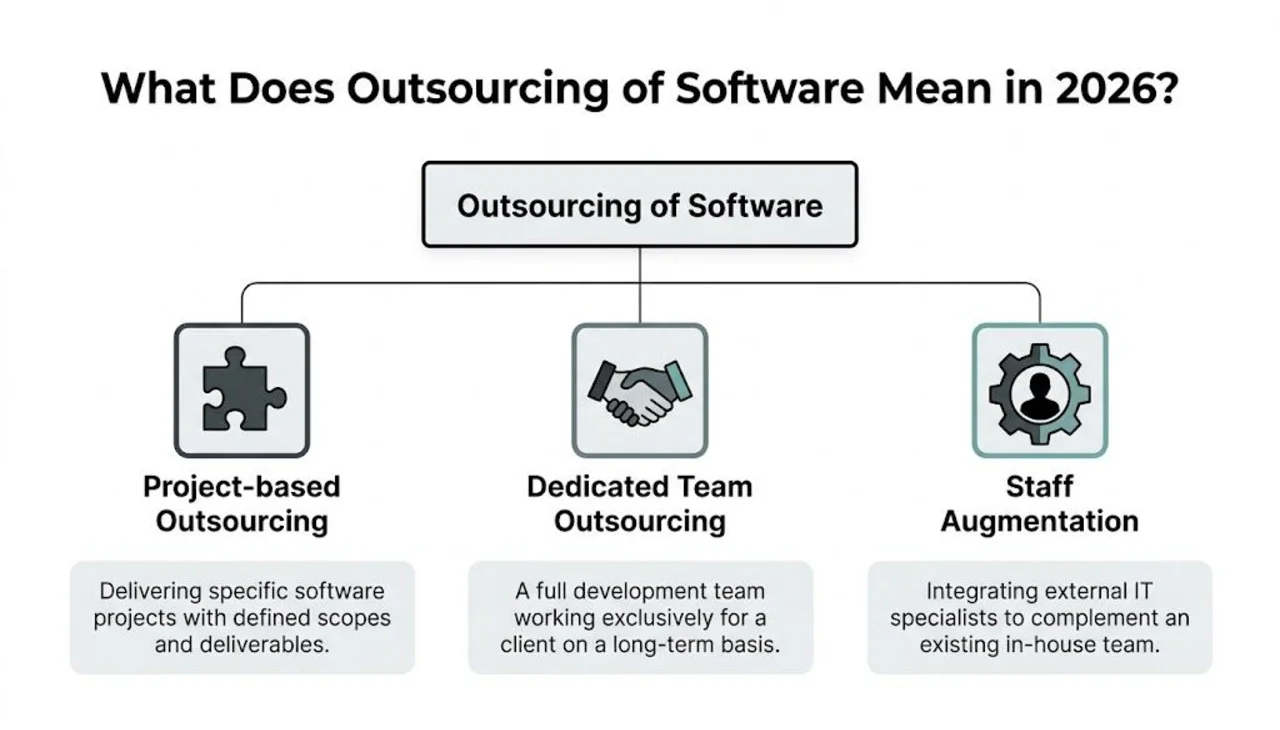
The term "outsourcing of software" used to mean one thing: hire a vendor, define a project, wait for delivery. That is too narrow now. Software outsourcing covers three distinct operating models, and the right one depends on whether your scope is stable or still evolving.
Software outsourcing is already a mainstream buying model. The market was estimated at USD 534.9 billion in 2024, and 76% of companies outsource at least one IT function according to Market.us citing Deloitte's 2024 Global Outsourcing Survey. That scale hides three very different operating models, and treating them as one buying decision is where most foreign employers go wrong.
Project outsourcing
This is the classic software house model. You buy an outcome: a mobile app, a platform rebuild, a migration, a QA package, or support for a defined backlog. It works best when scope is stable, acceptance criteria are explicit, and you do not need daily control over individual contributors.
It breaks down when the work is still evolving. Startups often underestimate this. If your product direction changes every two weeks, a fixed vendor scope becomes a change-order machine.
Dedicated team outsourcing
Here you are not buying a single deliverable. You are paying for a vendor-managed team that works on your roadmap over time. This model gives more continuity than a project contract and usually fits scale-ups better than fixed-scope outsourcing.
The trade-off is structural. You get capacity, but not always full hiring-level control. Knowledge can stay with the vendor unless you are deliberate about repositories, documentation, architecture ownership, and access rights.
Practical rule: if the work is core to your product, keep product ownership, code access, and technical direction on your side even when a vendor executes.
Staff augmentation and direct sourcing
Many foreign employers should prioritize this area first. Staff augmentation adds external specialists into your team structure. In practice, the most efficient version of this for many companies is not agency-led augmentation at all. It is direct hiring of a Polish specialist on B2B or through an EOR.
That model still sits inside the broad outsourcing category because you are sourcing engineering capacity outside your home market. But operationally, it behaves more like hiring than procurement. You choose the person, set the workflow, integrate them into GitHub, Jira, Slack, Linear, or whatever your team already uses, and retain far more control.
Scope matters more than most buyers think
Before choosing any model, define the unit of work. One of the more technically reliable methods in outsourcing literature is function point analysis, because it measures delivered functionality rather than raw lines of code. The function point analysis reference from Vrije Universiteit Amsterdam gives a useful example — 1,153 C statements with a benchmarked conversion factor of 128 equal about 9 function points — which shows why lines of code are a weak pricing shortcut across languages.
If your scope is vague, vendor quotes will not be comparable. If the role is ongoing, do not force it into a project shape. That is usually the point where direct hiring in Poland starts to look stronger than traditional outsourcing.
Why choose Poland for software nearshoring?
Poland is attractive for one practical reason: it gives foreign employers a strong nearshore option when they want engineering talent without taking on the communication drag and control loss that often come with distant offshore delivery.
Nearshore is no longer just about rates
The outsourcing conversation has moved beyond pure cost arbitrage. Buyers increasingly weigh time-zone alignment, cultural compatibility, and political stability, which is one reason nearshore models have gained attention in current outsourcing guidance, as discussed in Coherent Solutions' overview of IT outsourcing models and emerging trends.
For a company in Germany, the Netherlands, the Nordics, or the UK, Poland is operationally simple. Meetings fit the workday. Product managers and engineers can work in the same rhythm. You do not need to redesign communication around overnight handoffs.
Poland fits embedded product work better than generic offshore setups
If you need a specialist to join sprint planning, review pull requests, work inside your CI/CD process, and stay close to product decisions, Poland is often a better fit than a classic offshore vendor arrangement. The closer the person is to your core product loop, the more time-zone and context overlap matter.
This is especially true for roles that are not easy to spec as isolated packages of work:
- Backend engineers working across product and infrastructure boundaries
- DevOps specialists involved in incident response and release workflows
- QA automation engineers who need daily contact with developers
- Product designers tied to ongoing discovery and iteration
- Senior frontend engineers collaborating tightly with product and design
EU legal context reduces friction
For foreign employers, Poland also benefits from legal familiarity. It is an EU market, so GDPR and DSGVO concerns are easier to handle than in more fragmented cross-border setups. That does not remove the need for proper contracts, IP clauses, and data-processing discipline, but it does reduce structural uncertainty.
Poland usually makes sense when you want long-term remote capacity with real overlap, not just cheap execution.
The better question is not "outsource or hire"
A lot of buyers still ask, "Should we outsource software?" That is the wrong question. A more useful one is: which model gives us the right balance of control, risk, and speed?
Recent outsourcing guidance increasingly frames outsourcing as a strategic capability for innovation, agility, and niche expertise rather than only cost cutting. It also points to the hidden risks of weak governance, communication failures, and scope drift, which is why the more useful comparison is often vendor delivery versus direct B2B or EOR hiring in Poland, as outlined in Arnia's guide to software development outsourcing models and trade-offs.
For many foreign teams without a Polish entity, Poland works best when you treat nearshoring as direct access to specialists rather than defaulting to a software house.
How do B2B, EOR, and employment contracts in Poland compare?
When a foreign company hires in Poland, the hard part usually is not finding the right role profile. It is choosing the contract model that will not create avoidable tax, compliance, or IP problems later.
The useful comparison is not "outsource or do not outsource." It is whether a direct B2B or EOR hire gives you better control and lower operational drag than a traditional vendor contract.
The three workable models
B2B contract means you engage a self-employed Polish specialist or a one-person business directly. In Polish tech, this is a familiar model. It is usually the leanest option from the buyer side because invoicing is straightforward and the specialist often expects to manage their own business setup.
EOR (Employer of Record) means an EOR provider hires the person locally on your behalf and leases the employment relationship back to you operationally. You control day-to-day work. The EOR handles local payroll, employment paperwork, and employer compliance.
Direct employment through your own entity gives you the most formal control, but it only makes sense if you already have a Polish company or you are ready to establish one. For most foreign startups and scale-ups with no local office presence, this is the slowest route.
Hiring model comparison for foreign employers in Poland
| Model | Total monthly cost | Compliance risk | Time to hire | Best for |
|---|---|---|---|---|
| B2B | Leanest structure — you pay the agreed invoice and manage the contract directly | Higher if the relationship looks like disguised employment | Often fast if you already know the role and can contract directly | Startups, product teams, senior specialists comfortable working as contractors |
| EOR | Higher than B2B because employment administration sits with the provider | Lower than direct B2B for employers that want formal employment compliance support | Moderate, depending on provider process | Foreign companies without a Polish entity that want lower compliance burden |
| Own entity employment | Heaviest structure — you run local employment directly | Lower once properly established, but setup burden is much higher | Slowest if you do not already operate in Poland | Companies building a larger long-term presence in Poland |
What works and what usually fails
B2B works well when the relationship is genuinely business-to-business. The specialist has independence, controls their setup, and the contract reflects that. For German employers, Scheinselbstständigkeit risk needs real attention. If you want full-time exclusivity, fixed working patterns, and manager-like control without employment structure, a B2B contract can become the wrong tool.
EOR works when your finance or legal team wants a cleaner compliance path and the role is clearly long-term. You will pay more than with direct B2B, but you reduce internal administrative effort.
If your team wants employment-style control, use an employment-style structure. Do not try to recreate employment through a contractor agreement.
For DACH companies, details such as DSGVO handling, reverse-charge VAT on cross-border services, and in some cases A1-Bescheinigung questions can matter depending on the working pattern and travel assumptions. For a deeper operational breakdown of the EOR path specifically, the Employer of Record Poland 2026 guide for foreign employers is the right next read.
A simple decision filter
- Choose B2B when you want speed, direct access, and a specialist who already prefers contractor status.
- Choose EOR when you want to hire without opening a Polish entity and your legal team prefers employment-backed compliance.
- Choose your own entity when Poland is becoming a real operating location, not just a hiring market.
Traditional vendor outsourcing still has a place. But if the person will sit inside your sprint cadence and own recurring product work, direct hiring usually gives better long-term control.
Hiring Polish specialists for remote roles?
HiddenJobs is a verified job board for international companies hiring Polish remote specialists — across IT, sales, marketing and more.
What are the real costs of hiring a Polish developer?
A common outsourcing pitfall: buyers compare a vendor quote with a salary number and assume they are looking at the same thing. They are not. A software house price includes management layers, margin, bench risk, and delivery packaging. A direct hire in Poland is closer to a capacity cost.
Start with total engagement cost, not sticker price
For a B2B contractor, the practical cost is the agreed monthly invoice plus any equipment, paid leave conventions if you offer them contractually, and internal recruiting time. There is no one universal template because foreign employers structure these deals differently.
For EOR, the math is broader. You have salary, employer-side costs handled through the provider, and the EOR's service fee. That makes budgeting more predictable, but not necessarily cheaper than B2B.
Here is the mistake I see most often. A company says they want "outsourcing" because a vendor feels simpler, then ends up paying for simplicity they do not need. If the role is one backend engineer, one DevOps hire, or one product designer embedded in your team, direct hiring is often the cleaner economic model.
Cost comparison by engagement model
| Engagement route | What you usually pay for | Cost visibility | Control level |
|---|---|---|---|
| Software house project | Delivery team, project management, vendor margin, delivery risk packaging | Moderate at contract stage, weaker if scope moves | Lower on individual staffing decisions |
| Staff augmentation via agency | Specialist time plus agency margin | Usually clearer than project outsourcing | Medium |
| Direct B2B hire | Specialist invoice and your own internal management | High once rate is agreed | High |
| EOR hire | Salary, employment overhead managed by provider, provider fee | High | High on daily work, lower on employment administration |
A helpful market reality check: outsourcing remains structurally broad. Industry summaries note that US businesses can save up to 70% in labor costs by outsourcing IT services offshore, 57% of companies cite cost reduction as a primary reason, and around 70% of organizations say cost savings are a main driver, based on the compilation in these software development outsourcing statistics from Near. Those are broad outsourcing numbers — they do not answer whether a Polish direct hire beats a software house for your exact role. Often it does.
Direct hiring is better for ongoing roles
The cost case for direct hiring improves when the work is continuous:
- Ongoing roadmap work usually favors a direct specialist. A vendor team layers margin on every billable hour. Over 12-24 months that compounds.
- Role-based ownership favors a direct specialist. If a single person should own DevOps, observability, or platform health, a vendor team adds coordination tax.
- A sharply defined standalone build may still favor a vendor. Migration projects, one-off platforms, or specialized package work fit the vendor shape.
For a more role-specific budgeting lens, this Polish developer cost guide for foreign employers goes deeper into the buyer-side math.
The cheapest model on paper can become the most expensive one if you lose control of scope, handoff quality, or knowledge retention.
How does Poland compare to other nearshore locations?
Most foreign employers do not compare Poland to "all outsourcing." They compare it to other realistic nearshore choices. In Europe, that usually means Poland versus Ukraine, Romania, or Bulgaria.
Regional comparison for foreign employers
| Country | Strengths | Main trade-offs | Best fit |
|---|---|---|---|
| Poland | Strong nearshore fit for Western Europe, stable EU framework, good alignment for embedded teams | Usually not the cheapest option in the region | Companies prioritizing stability, long-term hiring, and product integration |
| Ukraine | Deep engineering reputation and strong technical talent | Business continuity and geopolitical risk require extra planning | Teams comfortable operating with elevated continuity risk |
| Romania | Solid EU nearshore option with good access for European buyers | Market choice often depends on role availability and employer preference | Companies comparing several EU locations on a role-by-role basis |
| Bulgaria | Another viable EU option for nearshoring | Smaller market perception for some buyers | Lean teams that want an EU option and are open on geography |
What actually decides the outcome
In practice, three things matter more than abstract country rankings:
- Overlap with your operating rhythm. Daily standups, real-time code reviews, incident response — these need time-zone overlap, not just availability.
- Ease of direct hiring. Some markets have a thick layer of agencies between you and the specialist. Poland has a strong direct-hire culture in IT, especially on B2B.
- Risk tolerance around continuity and legal structure. EU member states reduce structural uncertainty. Markets with active geopolitical exposure need more contingency planning.
That is why Poland keeps coming up for DACH, UK, and Nordic employers. Decision-makers increasingly care about political stability, culture fit, and time-zone alignment, not just nominal savings, as noted in the Coherent Solutions nearshore outsourcing analysis.
Poland is often the safer long-term default
If you are building a distributed but stable product team, Poland is often the safest default among nearshore options. Not because every engineer there is better than every engineer elsewhere — that is not how hiring works. It is because the combined package is strong: nearshore working hours, EU legal context, and a hiring model that supports direct long-term relationships.
For a founder or CTO, that matters more than shaving a small amount off a rate card while adding operational uncertainty.
Where can I find and hire Polish IT specialists directly?
The channel you choose shapes applicant quality more than most teams acknowledge. If you post in the wrong place, you will not just get fewer candidates — you will get the wrong candidate mix.
The common options
LinkedIn gives reach, but it also brings noise. Foreign employers often end up filtering a broad international response when they need people based in Poland and ready to work remotely from Poland.
Generic global job boards can work for broad awareness, but they usually do not solve the local-market signal problem. Your role competes with thousands of unrelated remote jobs, and many applicants will not match your contract constraints or geography.
Local Polish channels are often better targeted, but some are built more for the domestic employer market than for a foreign company with no Polish office presence. That creates friction in positioning, expectations, and employer branding.
What to look for in a hiring channel
Use a simple filter before you publish:
- Audience fit. Does the channel reach Polish IT specialists working remotely from Poland?
- Employer fit. Is it built for foreign HQ companies without a Polish entity?
- Language fit. Can you publish in English without looking out of place?
- Role fit. Does it work for developers, DevOps, QA, design, and product roles?
A good channel does not just produce applicants. It produces the right applicants for your legal setup, working model, and market positioning.
If you are comparing posting options specifically, the guide on where to post tech jobs for Polish developers is the practical shortlist.
The strongest approach is usually straightforward: publish where Polish IT specialists already expect to see remote roles from foreign employers, then run a direct hiring process around B2B or EOR depending on your model.
Where do you go from here?
The strongest version of "outsourcing of software" for most foreign employers is not a software house contract. It is a direct hire from Poland on B2B or EOR — same access to senior IT talent, more control, lower total cost of ownership, cleaner long-term economics.
A Polish developer can tell quickly whether a foreign company has thought through its engagement model. The signal is not a polished careers page or a fancy benefits deck. It is whether the contract model fits the work, the legal structure is honest about what the relationship really is, and the team treats the specialist as part of the engineering org rather than a vendor unit. For what happens after the contract is signed, the onboarding best practices for Polish IT hires guide covers the first 30 days.
That is what good cross-border hiring looks like. Choose the model before the role is posted. Decide who handles ZUS, taxes, equipment, and compliance. Communicate the working pattern, the contract type, and the long-term intent up front. Polish IT specialists are pragmatic — they respond well to clarity and disengage fast from vague positioning.
The companies that do this well treat outsourcing as a continuum, not a single buy. Project work goes to a software house. Ongoing product work goes to a directly hired specialist on the right contract model. Specialist roles that need real product integration go to a Polish hire on B2B or EOR. The model fits the work, not the other way around.
Hiring from Poland starts before the role goes live. It starts when you decide which engagement model fits, which contract model fits the worker, and how the relationship will run for 12-24 months. That clarity is what foreign companies who hire well from Poland share — and it is what Polish IT specialists look for at the sourcing stage. If you are earlier in the process and want the broader founder-level view, the hiring Polish IT specialists guide for founders walks through the full setup, and the practical end-to-end walkthrough lives in how to hire Polish developers and programmers remotely.
The right place to start is sourcing. If you want to hire Polish developers, DevOps, QA, designers, or product engineers remotely without going through a software house, list your IT job offer on HiddenJobs.pl — the Polish IT job board built for foreign companies hiring without a local office.
Frequently asked questions
Is software outsourcing to Poland only relevant for large companies?
No. It often fits startups and scale-ups especially well, because they need flexibility more than procurement complexity. A large software house contract can be excessive when you really need one senior backend engineer, one QA automation specialist, or one DevOps hire integrated into your team. Direct hiring from Poland on B2B or through an EOR is usually the cleaner economic and operational model for that shape of need.
Is direct hiring in Poland still a form of outsourcing?
In practical terms, yes. You are sourcing software capacity outside your home market, which sits inside the broad outsourcing category. The difference is that direct hiring gives you more control than a classic vendor arrangement, especially for ongoing product work. Operationally it behaves more like hiring than procurement — you choose the person, set the workflow, and integrate them into your team tooling.
Is B2B or EOR better for a foreign employer hiring in Poland?
It depends on how you want to manage risk. A B2B contract is usually leaner and faster when the specialist already works as an independent contractor and runs their own one-person business. An Employer of Record is stronger when your legal or finance team wants a more formal employment-backed setup without opening a Polish entity. For DACH employers, the German Scheinselbstständigkeit framework adds a layer of caution to B2B that often pushes the decision toward EOR for dedicated long-term work.
Do I need a Polish office to hire someone in Poland?
No. B2B and EOR models are designed exactly for this case. They let foreign employers access Polish IT talent without creating a local entity or office first. Setting up a Polish company only makes sense when you have a larger long-term hiring plan in Poland and want to operate locally rather than only hire remotely.
Can I pay Polish specialists in EUR or USD?
In many cross-border arrangements, yes — that can be structured contractually. The exact setup depends on the engagement model, invoicing mechanics, and the provider or contractor arrangement you use. This is one of those details worth confirming early with finance and legal, not after the offer stage, because it affects tax treatment, VAT mechanics, and how the worker handles their own accounting on the Polish side.
Is Poland mainly a cost-saving option for software outsourcing?
Not anymore, at least not for serious buyers. Cost still matters, but most high-quality decisions now come down to control, delivery quality, team integration, and low-friction collaboration. Poland combines nearshore working hours, EU legal context, and a hiring model that supports direct long-term relationships — that combined package is usually more important than shaving a small amount off a rate card.
What is the average hourly rate for a senior Polish developer?
Rates vary widely by role and seniority, but for senior backend, DevOps, or platform engineers on B2B, foreign employers typically see something in the range of 50-90 EUR per hour, with significant variance by stack and engagement length. EOR-based monthly rates land in a similar ballpark on a per-hour basis, plus the provider fee. Poland is no longer the bargain market it was a decade ago — on the upper end of seniority, expect to compete with German, Dutch, or Nordic local salary ranges rather than pure offshore pricing.
Do Polish developers speak English well enough for daily work?
In Polish IT, working English is the default for daily collaboration, code review, technical documentation, and Slack-style communication. Native-level English is less common than working fluency, but for product engineering, DevOps, QA, and design roles it is almost never a blocker for embedded work with foreign teams. The bigger variable is communication style — Polish IT specialists often default to terse, direct, problem-focused communication, which can read differently than some Western European or American norms but rarely causes substantive misunderstanding.
Editorial note
This guide is based on public market research on software outsourcing, Polish hiring practice as of May 2026, and industry analysis of nearshore engagement models. It is informational and not legal, tax, or HR advice. Engagement models, vendor pricing, and country comparisons vary by case and may change. Consult a qualified Polish employment lawyer or tax advisor before signing any contract or selecting an engagement model.