Outsourcing Software Development to Poland: 2026 Buyer's Guide for Foreign Employers

If you run a startup, scale-up, or established company in Berlin, London, Stockholm, Amsterdam, or San Francisco and you are evaluating where to source software development capacity in 2026, Poland sits in a specific corner of the global outsourcing market that suits a particular kind of foreign buyer. This guide explains who that buyer is, how Polish outsourcing actually works in 2026, and when it beats the alternatives.
The post focuses on outsourcing as an engagement model — vendor-led delivery of code, design, or operational work — rather than the broader category of "hiring Polish remote talent" which can also mean direct individual hire via B2B contract or Employer of Record. For the direct-hire angle, see the founder's guide to hiring Polish IT specialists.
Hiring Polish specialists for remote roles?
HiddenJobs is a verified job board and matching service for international companies recruiting Polish remote talent.
Table of contents8 sections
What is software development outsourcing to Poland in 2026?
Engaging a Polish company (or individual contractor) to deliver software work for your business — code, design, DevOps, QA, AI/ML — without putting that person on your direct payroll. The work is done by Polish IT talent under Polish or EU contract law, billed to your foreign company under standard EU B2B mechanics.
The category covers everything from a single Polish freelancer invoicing your German GmbH for a one-week React component build, to a 30-person dedicated team at a Warsaw-based software house running your entire mobile platform. The unifying feature: you don't hire the developer directly into your company. The developer is employed (or self-employed) on the Polish side, the engagement is governed by a contract between your company and the Polish vendor, and the cost flows as a service expense rather than a payroll line.
Why this corner of the market grew large enough to compete with US near-shore (Latin America) and offshore (India) options:
- Talent depth: 488,700 people in Polish business services per ABSL Q1 2025, with significant IT concentration. Polish technical universities (Warsaw University of Technology, AGH Krakow, Wrocław University of Science and Technology) produce 25,000+ engineering graduates annually.
- EU jurisdiction: full EU member since 2004, so data flows under GDPR directly, no Schrems II concerns for European clients.
- English fluency: Poland ranks 13th globally on the EF English Proficiency Index 2025 (Very High band), with B2-C1 the dominant level in the IT segment.
- Time-zone fit: CET (UTC+1) means same workday as Germany, France, Netherlands, Nordics, and Switzerland; one-hour offset from UK; 4-6 hour overlap with US East Coast.
The Polish outsourcing market has matured to the point where a foreign client can engage a Polish vendor on standard procurement terms (Article 28 GDPR DPA, reverse-charge VAT, EUR-denominated invoicing) without the additional friction that engaging an Indian or Latin American vendor sometimes adds (longer payment cycles, currency volatility, time-zone-specific calls scheduled at uncomfortable hours).
How is Polish outsourcing different from Indian or Latin American outsourcing?
Time zone, EU jurisdiction, and price positioning are the three differentiators. Polish outsourcing wins on time-zone fit and EU compliance posture; India wins on absolute cost; Latin America wins on US time-zone fit.
The decision frame across the three corridors:
Polish outsourcing:
- Time zone: CET (matches Western Europe exactly, 4-6h overlap with US East)
- Cost: senior B2B $25-65/h (median $42)
- EU jurisdiction: full member, GDPR direct
- English fluency: B2-C1 majority in IT
- Best for: European foreign employers, US East Coast scale-ups, projects with synchronous collaboration needs
Indian outsourcing:
- Time zone: IST (UTC+5:30) — 5h offset to Berlin, 9-12h to US East
- Cost: senior B2B $30-45/h per Accelerance 2025 (cheaper than Poland)
- EU jurisdiction: not applicable, requires Standard Contractual Clauses for EU clients
- English fluency: high (Tier 1 / Tier 2 cities)
- Best for: cost-optimized async-first projects, large enterprise outsourcing with established Indian dev shops, US clients with mature offshore management
Latin American outsourcing (Mexico, Argentina, Brazil, Colombia):
- Time zone: -5 to -7 hours from Berlin, identical or 1-3h offset from US East
- Cost: senior B2B $50-80/h per Stack Overflow 2025 (Mexico), comparable to Poland
- EU jurisdiction: not applicable, SCCs needed
- English fluency: variable by country (high in Argentina, Mexico Tier 1)
- Best for: US foreign employers prioritizing same time-zone, EU clients with strong Spanish/Portuguese requirements
For a typical European mid-market SaaS company, Poland is the default choice because of the time-zone and EU-jurisdiction stack. For a US-only company, the trade-off between Poland (deeper EU expertise) and Mexico (matching US time-zone) is real and often gets resolved by the team's specific operational needs.
Hiring Polish specialists for remote roles?
HiddenJobs is a verified job board and matching service for international companies recruiting Polish remote talent.
What outsourcing models are common with Polish vendors?
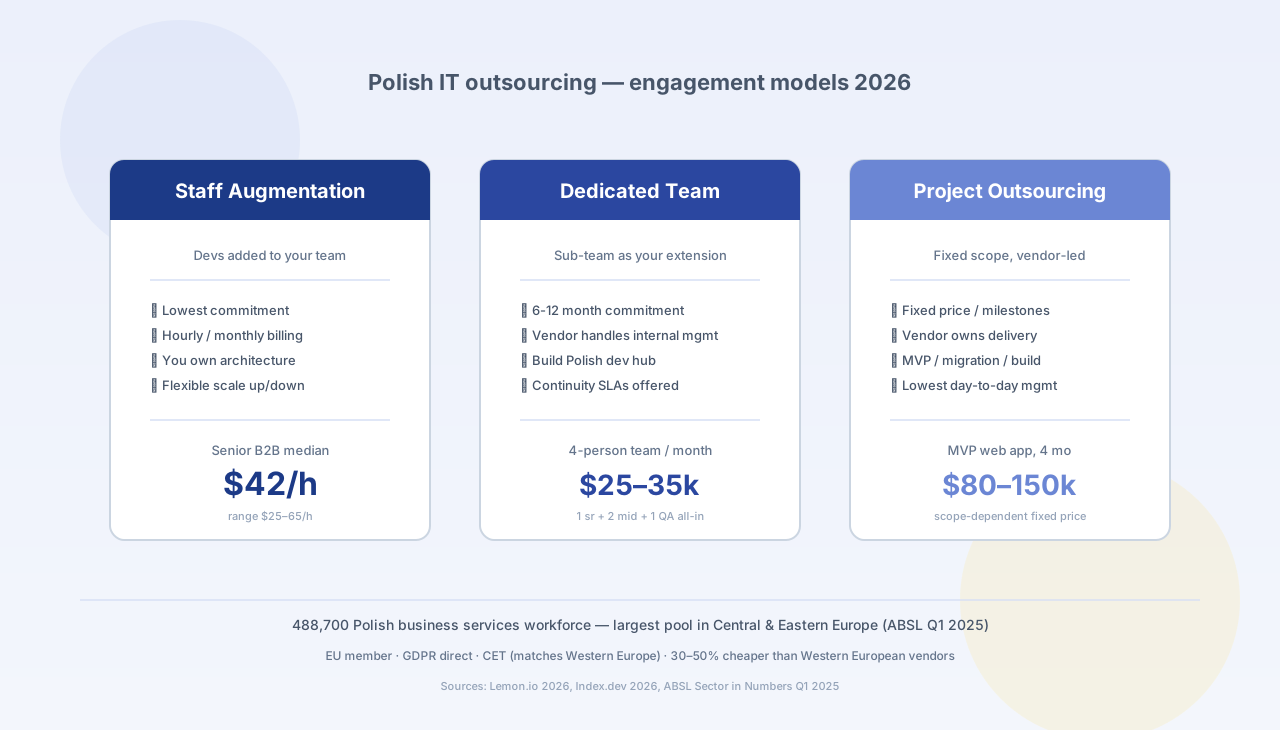
Three dominant patterns: staff augmentation (most flexible), dedicated team (long-term extension), and project outsourcing (fixed scope, vendor-led). Each fits a different procurement context and risk tolerance.
The three models in practice:
1. Staff augmentation — your team plus their contractor
The Polish vendor sources and onboards one or more developers into your existing team. Day-to-day work direction comes from your engineering manager; the developer joins your stand-ups, your code review process, your project tooling. Billing is typically hourly or monthly per developer.
- Lowest commitment: usually 1-3 month minimum, scale up or down per quarter
- Lowest abstraction: your team owns architecture, project management, and quality
- Best fit: scale-ups extending capacity on a known stack with capable internal management
- Typical rate: senior $45-65/h, mid $30-45/h B2B
- Risk: vendor markup on developer's actual rate (typically 25-50% margin)
2. Dedicated team — sub-team that operates as your extension
The Polish vendor stands up a full sub-team (developers, QA, often a tech lead or scrum master) that operates as a long-term extension of your engineering organization, typically with 6-month minimum commitment. The team has its own ramp-up and retention dynamics; some vendors offer guaranteed continuity SLAs.
- Higher commitment: 6-12 month engagements common, full team mobilization
- Mixed abstraction: vendor manages team-internal dynamics; you direct the deliverables
- Best fit: scale-ups building a Polish development hub without setting up a Polish entity
- Typical cost: 4-person team (1 senior, 2 mids, 1 QA) ~$25,000-35,000/month all-in
- Risk: less flexibility to scale down quickly; team-internal staffing changes happen on vendor's schedule
3. Project outsourcing — fixed scope, vendor-led delivery
The Polish vendor delivers a fixed-scope project end-to-end with their own project management, fixed price or milestone-based billing. You set requirements; the vendor designs, builds, ships. Common for net-new product builds, integrations, or specific feature sprints with clear acceptance criteria.
- Highest commitment per engagement: typically 3-12 month projects
- Highest abstraction: vendor owns delivery quality and schedule
- Best fit: companies without internal engineering management capacity, well-defined project scope
- Typical pricing: varies widely with scope; Polish vendors typically come in 30-50% under Western European agencies for equivalent quality
- Risk: scope creep is the dominant failure mode; vendor's project management quality determines outcome
Most foreign buyers start with staff augmentation (lowest friction, fastest to ramp) and graduate to dedicated team if the engagement scales. Project outsourcing is a separate decision rooted in delivery model rather than capacity expansion.
How much does it cost to outsource to Poland in 2026?
Senior B2B median $42/h (Lemon.io 2026, Index.dev 2026). Range $25-65/h with lead engineers and AI/ML specialists at the top of band. Translated to monthly: senior staff augmentation $6,500-9,000/mo all-in.
The cost picture by engagement type:
Staff augmentation (per developer, monthly):
- Junior (1-2 yrs): €2,500-3,500/mo
- Mid (3-5 yrs): €4,500-6,500/mo
- Senior (6+ yrs): €6,500-9,000/mo
- AI/ML or specialist senior: €8,500-12,000/mo
- Lead / architect: €9,500-13,000/mo
These are typical vendor-billed rates including their margin. The developer's take-home is roughly 50-70% of the rate (varies by vendor markup structure).
Dedicated team (4-person team, monthly):
- 1 senior + 2 mids + 1 QA: $25,000-35,000/mo
- 1 senior + 1 mid + 1 junior + 1 QA: $22,000-30,000/mo
- 1 lead + 2 seniors + 1 mid: $32,000-45,000/mo
Project outsourcing (representative):
- MVP web app, 4-month build: $80,000-150,000 fixed
- Mobile app (iOS + Android), 6-month build: $150,000-300,000 fixed
- Cloud infrastructure migration, 3-month: $60,000-120,000 fixed
Polish vendor pricing typically comes in 30-50% under Western European agencies for equivalent project quality. The specific gap depends on stack (TypeScript / React commodities vs Rust / specialized stacks), seniority mix, and project management overhead.
For comparison context, the Polish developer cost guide covers direct-hire B2B and EOR cost stacks (without vendor markup) — useful when deciding between outsourcing and direct hire.
What are the top Polish software development companies in 2026?
The Polish landscape includes household names (Netguru, Asseco Poland, Comarch, Sii Poland), specialized mid-size shops (Brainhub, STX Next, Grape Up, Boldare, ARDURA Consulting), and dozens of focused boutiques. Top 100 Polish IT companies by revenue collectively service thousands of foreign clients.
Categorized by focus and scale:
Large enterprise outsourcing:
- Asseco Poland — largest Polish IT company by revenue. Enterprise software, banking, public sector. Foreign clients include Volkswagen, BNP Paribas, large EU banks.
- Comarch — enterprise software, ERP, telecom. Strong presence in DACH and France.
- Sii Poland — IT services, consulting, automotive (BMW, Mercedes), aerospace (Airbus).
Mid-size product engineering:
- Netguru — design + engineering for mid-market SaaS clients. Strong portfolio with US and Western European startups.
- Brainhub — JavaScript/TypeScript and AI/ML specialists. Foreign client base.
- STX Next — Python and Django specialists, ~400 engineers. Active blog and conference presence.
- Grape Up — Cloud Foundry and Kubernetes specialists, automotive vertical.
- Boldare — full-stack product development, design + engineering for European and US clients.
Specialized boutiques:
- ARDURA Consulting — DevOps and cloud engineering specialists. Active rate-transparency publishing (their 2026 rate guide is publicly available).
- Mobilunity — Polish-Ukrainian hybrid, specializes in dedicated team engagements.
- Apptension — design + product engineering for SaaS startups.
- The Software House — typescript/Node.js specialists.
Top 100 Polish IT Companies lists are published annually by ITwiz, Computerworld Poland, and the Polish Outsourcing Institute. These rankings track revenue, headcount, and growth — useful for shortlisting at scale.
For project-specific shortlists with verified client reviews, Clutch.co and GoodFirms maintain regularly updated listings with budget filters, team size, and client testimonials. The Polish presence on these platforms is one of the deepest in any single country, with multiple verified shops in every major specialization.
The above names are illustrative of the Polish outsourcing landscape — not endorsements. Always run your own due diligence per the vetting checklist below.
How do you vet a Polish outsourcing partner?
Five non-negotiable checks before signing the master service agreement: client references, individual developer CVs, paid trial sprint, GDPR posture, financial stability via KRS. Skip any of these and you increase your chance of a six-figure mistake.
The vetting protocol that experienced foreign buyers run:
1. Client references in your vertical (3 minimum)
Request 3 references from clients in your industry vertical from the past 24 months — not the vendor's "best case" list. Call all three before deciding. Specific questions to ask:
- "What was the original timeline vs actual delivery?"
- "Were there any senior developer changes mid-project? How was that handled?"
- "What's the one thing you wish you had done differently in setting up the engagement?"
- "Would you sign with them again? For what kind of work?"
A vendor that resists providing references in your vertical, or whose references can only speak to projects more than 2 years old, is a yellow flag.
2. Individual developer CVs (or anonymized profiles)
For staff augmentation and dedicated team engagements, request the CV of every developer who would actually work on your project — not the vendor's portfolio of "our seniors." Validate stack expertise, English fluency, and prior project work directly. The vendor's overall reputation is downstream of their individual people.
3. Paid 2-week trial sprint
Run a paid 2-week sprint with the actual team (not their pre-sales team) on a small piece of real work. Validate quality, communication cadence, code review responsiveness, and PM handoffs under realistic conditions. The cost of a 2-week sprint (typically $5,000-15,000) is a fraction of the cost of discovering quality issues 6 months into a multi-six-figure engagement.
4. GDPR posture
Request the vendor's standard Article 28 GDPR Data Processing Agreement template, technical and organizational measures (TOM) documentation, and confirm they have a Data Protection Officer or equivalent compliance lead. EU-based vendors should have this material on standard procurement turn-around (1-2 days).
5. Financial stability via KRS
Polish company registry (Krajowy Rejestr Sądowy / KRS, accessible at eKRS.ms.gov.pl) shows company registration, ownership structure, and financial filings for limited liability companies. Established vendors with 5+ year track records and clean filings reduce the continuity risk of mid-engagement vendor failure. Annual revenue, profit margin, and ownership stability are leading indicators.
Vendors that resist any of these five checks should be deprioritized regardless of how compelling their pitch deck looks.
Outsourcing vs hiring direct — which fits your stage?
Outsourcing wins on speed and project-specific work. Direct hire wins on long-term cost optimization and core engineering capability. Most scale-ups end up running both — outsourcing for spikes, direct hire for the core.
The decision frame that experienced founders and CTOs use:
Outsourcing wins when:
- Your need is project-specific, not core product engineering capability
- You don't have local management bandwidth to direct individual contractors
- You need a full team (not just one developer) without building HR infrastructure
- Speed of capacity ramp matters more than long-term cost optimization
- The work has a clear end date or fixed scope (mobile app build, infrastructure migration, new product line)
- Your team's existing engineering management is at capacity
Direct hire wins when:
- You're building core product engineering capability that should stay in-house long-term
- You want full control over hiring criteria, culture fit, and individual development paths
- Budget constraints favor the 30-40% lower fully-loaded cost of avoiding vendor markup
- You already have engineering management capacity to absorb individual contractors
- The work is open-ended (not project-bounded) and benefits from long-tenured employees who develop product context
Hybrid is most common at scale:
- Direct hire for core platform / infrastructure / domain expertise (long-tenured Polish senior engineers via B2B or EOR)
- Outsourcing for spikes (mobile build, design system audit, ML proof-of-concept)
- Vendor relationships maintained as "rolodex" partners — engaged 1-2 times per year for specific projects
For a foreign company at the 5-50 person stage hiring its first Polish technical capacity, the typical pattern is: start with direct hire of 1 Polish senior via B2B contract or EOR (covered in the founder's guide), use that engagement to build the relationship template (DPA, payment, communication cadence), then optionally graduate to a Polish vendor for bigger pieces of work.
For a company at the 100+ person stage with established engineering org, outsourcing-first makes more sense: lower management overhead, faster ramp, vendor handles team-internal staffing dynamics.
Where do you start the search for a Polish outsourcing partner?
Three channels in parallel: vendor directories with verified reviews (Clutch.co, GoodFirms), Top 100 Polish IT Companies lists by revenue (ITwiz, Computerworld Poland), and peer references from your network. Skip vendor-marketed lead-gen channels disguised as neutral comparisons.
The channel mix that works for a first Polish outsourcing engagement:
1. Vendor directories with verified reviews:
- Clutch.co — most active for Polish dev shops. Filters by budget, team size, vertical. Client testimonials verified by Clutch researchers.
- GoodFirms — similar model, slightly less Polish coverage but useful for cross-validation.
2. Top 100 Polish IT Companies lists:
- Published annually by ITwiz, Computerworld Poland, and Polish Outsourcing Institute
- Tracks revenue, headcount, and growth
- Useful for shortlisting established shops at scale
3. Peer references from your network:
- Ask 2-3 founders or CTOs in your network who have engaged Polish vendors which one they would use again — and which they would not
- LinkedIn outreach to engineering leaders at companies you know use Polish vendors (their bio often lists "scaled engineering team in Poland")
- Industry-specific Slack groups and Discord servers (FinTech founders, SaaS CEO networks)
Channels to skip:
- Vendor-marketed lead-gen comparison sites that appear "neutral" — most are pay-to-play and rank vendors by their marketing budget rather than by client outcomes
- Generic "best Polish dev shops" listicles published by SaaS marketing teams — read these for vocabulary, not for selection
For direct individual hires (not vendor engagements):
If your decision frame favors direct hire over outsourcing — see the founder's guide to hiring Polish IT specialists and the where-to-post guide. HiddenJobs.eu sits in the curated job-board lane (verified roles for foreign employers, direct candidate apply via your ATS) rather than the vendor-directory lane.
Where this guide goes from here
Outsourcing software development to Poland is a mature engagement model with deep talent supply, EU compliance posture, and time-zone fit unmatched by other corridors for European foreign employers. The remaining work is the vetting protocol and the engagement model that fits your specific use case.
For deeper guides on this site:
- Direct hire alternative — the founder's guide to hiring Polish IT specialists covers B2B contract and EOR paths for individual hires
- Cost detail — the Polish developer cost guide breaks down direct-hire economics with itemized math (vendor markup excluded)
- Eastern European comparison — the Poland vs Ukraine vs Romania comparison covers when an alternative country fits better
The short version of Polish outsourcing 2026: default choice for European foreign employers, deepest senior outsourcing pool in Eastern Europe, EU-jurisdiction frictionless, 30-50% cheaper than Western European vendors at comparable quality.
To list a verified Polish role on HiddenJobs.eu (direct hire, not vendor engagement), send the brief to hiddenjobs.eu or get in touch directly. Response within a day or two.
Frequently asked questions
What does it mean to outsource software development to Poland?
Outsourcing software development to Poland means engaging a Polish company (or individual contractor) to deliver software work for your business — code, design, DevOps, QA, AI/ML — without putting that person on your direct payroll. Three models dominate in 2026: staff augmentation (Polish vendor places one or more developers into your team, you direct the work), dedicated team (Polish vendor stands up a full team that operates as your extension), and project outsourcing (Polish vendor delivers a fixed-scope project end-to-end with their own management). All three engage Polish IT talent at 30-50% lower fully-loaded cost than equivalent Western European seniors per Lemon.io 2026 and Index.dev 2026.
How is outsourcing to Poland different from outsourcing to India or Latin America?
Three structural differences. First, time zone: Poland is on CET (same as Germany, Netherlands, France, Nordics), so synchronous work happens without async constraints — unlike India (5h offset to Berlin) or Mexico (5-7h offset). Second, EU jurisdiction and GDPR: Poland is a full EU member since 2004, so data flows under standard EU rules with no Schrems II concern, no Standard Contractual Clauses needed for European clients. Third, cost positioning: Polish senior rates ($25-65/h B2B per Lemon.io 2026) are higher than Indian senior rates ($30-45/h per Accelerance) but comparable to Mexican and lower than Western European. Polish outsourcing wins on time-zone fit and EU compliance, India on absolute cost, Latin America on US time-zone fit.
What are the main outsourcing engagement models with Polish vendors?
Three models dominate. Staff augmentation: Polish vendor places one or more developers into your team, you manage the work directly, billing is hourly or monthly per developer. Most flexible, lowest commitment, common for mid-stage scale-ups extending engineering capacity. Dedicated team: Polish vendor stands up a full sub-team (developers, QA, sometimes PM) that operates as a long-term extension of your engineering organization, typically 6-month minimum commitment. Common for scale-ups building a Polish development hub. Project outsourcing: Polish vendor delivers a fixed-scope project end-to-end with their own project management, fixed price or milestone-based billing. Lowest day-to-day involvement on your side, highest dependency on the vendor's project management quality.
How much does it cost to outsource software development to Poland in 2026?
Senior software developer hourly rates B2B in Poland in 2026 run \$25-65 with median around \$42 per Lemon.io 2026 and Index.dev 2026. Top of band ($65-80/h) is reserved for lead engineers, AI/ML specialists, and architects. Translated to monthly engagement: a senior on full-time staff augmentation runs roughly \$6,500-9,000 per month all-in. A dedicated team of 4 (1 senior, 2 mids, 1 QA) typically runs \$25,000-35,000 per month. Project outsourcing pricing varies more widely with scope but Polish vendors typically come in 30-50% under Western European agencies for equivalent project quality. Always ask for itemized rate cards and avoid blended team rates that hide pricing structure.
What are the largest Polish software development companies in 2026?
Poland's outsourcing landscape in 2026 includes mid-to-large companies like Netguru, Brainhub, STX Next, Boldare, Grape Up, Asseco Poland (largest Polish IT company by revenue), Comarch, Sii Poland, ARDURA Consulting, Mobilunity (Polish-Ukrainian hybrid), and dozens of smaller specialized shops. The Polish business services sector employed 488,700 people in Q1 2025 per ABSL Q1 2025 — the largest concentrated outsourcing workforce in Central and Eastern Europe. The Top 100 Polish IT companies by revenue collectively service thousands of foreign clients including Volkswagen, IBM, Credit Suisse, BNP Paribas, Mercedes-Benz, and large US/UK SaaS firms. For project-specific shortlists, Clutch.co maintains regularly updated reviews of Polish dev shops with verified client testimonials.
How do I vet a Polish outsourcing partner before signing?
Run five checks. First, request 3 client references in your industry vertical from the past 2 years and call all three before deciding. Second, ask for the CV (or anonymized profile) of every developer who would work on your project — not the company's overall portfolio of seniors. Third, request a paid 2-week trial sprint with the actual team (not their pre-sales team) to validate quality, communication, and delivery cadence under realistic conditions. Fourth, validate their GDPR posture — request their standard Article 28 Data Processing Agreement template and confirm they have a Data Protection Officer or equivalent. Fifth, check their financial stability via Polish company registry (KRS) — established companies with multi-year track records reduce continuity risk. Skip vendors that resist any of these checks.
When does outsourcing to Poland make more sense than hiring directly?
Outsourcing wins when speed matters more than long-term cost optimization, when your need is project-specific (not core product engineering), when you don't have local management bandwidth to direct individual contractors, or when you need a full team (not just one developer) without building HR infrastructure. Direct hire wins when you're building core product engineering capability that should stay in-house long-term, when you want full control over hiring criteria and culture fit, when your budget constraints favor 30-40% lower fully-loaded cost (avoiding the vendor markup), or when you already have engineering management capacity to absorb individual contractors. Many scale-ups run hybrid: direct hire for core engineering, outsourcing for specific spikes (e.g., new product line, mobile app build, infrastructure migration).
Where do I start the search for a Polish outsourcing partner?
Three channels in parallel. First, vendor directories: Clutch.co and GoodFirms maintain reviewed listings of Polish software houses with verified client testimonials, project budget ranges, and team size filters. Second, the Top 100 Polish IT companies list by revenue (published annually by ITwiz, Computerworld Poland, and Polish Outsourcing Institute) gives you a starting universe of established shops. Third, peer references — ask 2-3 founders or CTOs in your network who have engaged Polish vendors which one they would use again. Skip vendor-marketed lead-gen channels that pretend to be neutral comparisons (most are pay-to-play). HiddenJobs.eu sits in the curated job-board lane (verified roles for foreign employers) rather than the vendor-directory lane — for direct hire of Polish individuals or small teams via your own ATS.
Editorial note
This guide cites named public sources for every concrete number: Lemon.io 2026 rate calculator (Poland) and Index.dev European Developer Hourly Rates 2026 for senior B2B rates, ABSL Q1 2025 Sector in Numbers for Polish business services workforce (488,700 employees), Accelerance and Stack Overflow 2025 for cross-country comparison context. Vendor names cited are illustrative of the Polish outsourcing landscape and should not be read as endorsements; always run your own due diligence per the vetting checklist in section 6. The post is informational and does not constitute legal, tax, or HR advice; consult qualified advisors before signing your first outsourcing contract in Poland.