Hiring Polish Developers via B2B Contract: 2026 Operational Guide for Foreign Employers

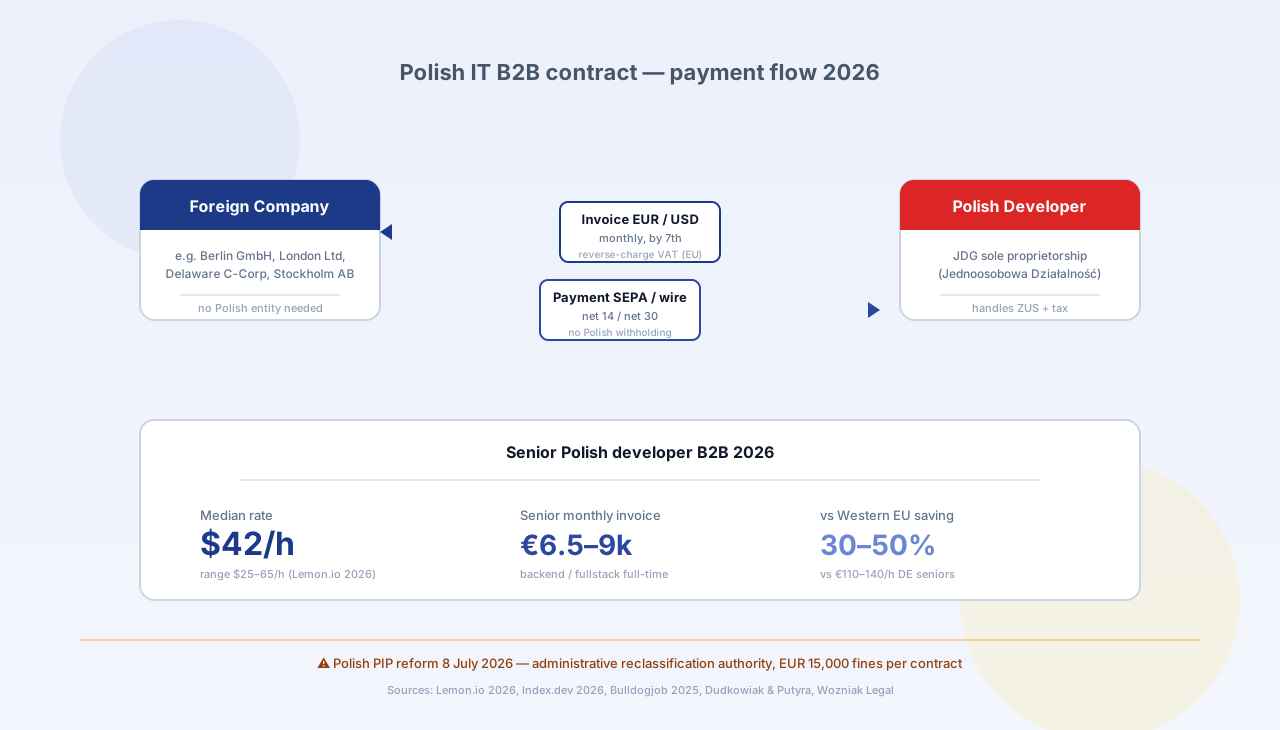
If you run a foreign company that has decided to hire a senior Polish developer in 2026, the contract path that 60-70% of senior Polish IT specialists actually use — and the path most foreign employers default to — is the B2B contract with the developer's Polish sole proprietorship (JDG). This guide walks through how it works in practice, what should be in the contract, where the misclassification trap sits, and how the July 2026 PIP reform changes the calculus.
The post is for foreign founders, CTOs, heads of talent, and procurement owners at companies without a Polish entity who want to hire Polish remote IT talent on the contract path that gives the developer the highest net pay and you the lowest operational complexity.
Hiring Polish specialists for remote roles?
HiddenJobs is a verified job board and matching service for international companies recruiting Polish remote talent.
Table of contents8 sections
What is a B2B contract with a Polish developer, and why is it so common?
A B2B contract is a service agreement between two businesses — your foreign company and the Polish developer's sole proprietorship (JDG). The developer is self-employed in Poland, invoices you monthly, and handles all Polish-side taxes, social contributions, and bookkeeping. You receive an invoice, pay it, and that's effectively the full transaction.
The Polish term is JDG — Jednoosobowa Dzialalnosc Gospodarcza, sole proprietorship in English. It's the simplest legal structure for a self-employed person in Poland, registered through the central business registry (CEIDG) in 1-2 business days, no minimum capital, no notary, no chartered accountant required.
Why it's the dominant choice for senior Polish IT specialists working for foreign employers:
For the developer:
- 15-30% higher net pay than equivalent gross on employment (UoP), driven by lower social contribution base + tax structure flexibility
- Choice of tax regime: 19% linear income tax (most common, applies to all income) or 12% IT-specific lump-sum tax (Ryczalt, since 2022 reforms — eligible for IT services up to certain revenue threshold)
- Preferential ZUS rate for the first 24 months of JDG (roughly half the standard contribution)
- Costs deductible against revenue (laptop, software, home office, training)
- Operational autonomy — controls own working hours, methods, and tooling
For the foreign employer:
- No Polish payroll setup, no Polish tax registration
- No Polish entity required (you can engage from Berlin GmbH, London Ltd., Delaware C-Corp, etc.)
- One invoice per month, paid via standard SEPA or international wire
- No employer-side ZUS contributions on top of the invoice
- Reverse-charge VAT for EU clients, simple VAT-free for non-EU
- Termination by notice (1-3 months typical), without statutory severance obligations
The combined math creates a strong default: the developer gets more take-home, you get less complexity. Both sides win versus employment-style structures (where you'd need an Employer of Record or your own Polish entity, both adding friction).
The model isn't unique to Poland — Romania has PFA (Persoana Fizică Autorizată), Ukraine has FOP (Fizychna Osoba-Pidpryyemets), Germany has Freiberufler, France has micro-entrepreneur — but Polish JDG is among the most operationally clean and tax-efficient in Europe for IT services.
How does the payment flow work from foreign company to Polish developer?
Developer issues a monthly invoice in EUR or USD with their JDG details (company name, address, NIP tax ID, IBAN). You pay via SEPA or international wire. Reverse-charge VAT for EU clients, no VAT for non-EU. End of transaction.
The end-to-end flow:
Step 1 — Developer issues invoice (typically 1st-7th of each month for the previous month):
Standard fields on a Polish JDG invoice issued to a foreign client:
- Seller: developer's JDG name, address, NIP (tax ID — format
PL+ 10 digits) - Buyer: your foreign company, address, your VAT ID
- Invoice number, date of issue, date of completion
- Description of services (e.g., "Software development services for May 2026")
- Net amount in EUR or USD
- VAT treatment: "Reverse charge — Article 196 of EU VAT Directive 2006/112/EC" for EU clients with valid VAT ID; "Out of scope of Polish VAT — service to non-EU business" for non-EU clients
- Payment terms (net 14, net 30, etc.)
- Bank details (IBAN, SWIFT/BIC)
Step 2 — Your company pays:
For EU clients, SEPA transfer — typically free of charge or very low cost, settled within 1-2 business days. For non-EU (US, UK post-Brexit, Switzerland, Australia, etc.), international wire — usually 25-50 EUR transfer fee on your side, settled within 2-5 business days. Some companies use third-party payment platforms (Wise, Revolut Business) for lower-cost cross-currency transfers.
Step 3 — Developer's tax obligations on the Polish side:
This is the developer's responsibility, not yours, but useful context for understanding the full picture:
- Income tax: 19% linear (most common for IT) or 12% IT-specific lump-sum (Ryczalt). Paid monthly to the Polish tax office (Polish Tax Office).
- Health contribution: 4.9% of net income (under linear tax) or fixed monthly amounts under Ryczalt. Paid to Polish ZUS.
- Social contributions (ZUS): Roughly 1,400-1,800 PLN monthly for the standard non-preferential rate, or roughly 700-900 PLN monthly for the preferential rate available during the first 24 months of JDG operation.
- VAT: If the developer is VAT-registered (mandatory above ~PLN 200k annual revenue threshold; voluntary below), they file quarterly VAT returns. For services to foreign clients, the invoice is reverse-charge or out-of-scope, so no VAT collected on those invoices.
Step 4 — Your company's accounting:
- Booked as a service expense in your P&L (typically COGS for product engineering or OPEX for support functions)
- Reverse-charge VAT self-accounted on your VAT return (zero net VAT impact for fully-VAT-recoverable companies)
- No Polish tax filings on your side — the entire Polish tax exposure sits with the developer's JDG
The combination is intentionally simple. Foreign employers engage hundreds of Polish JDG contractors every month with no more complexity than engaging a US LLC consultant.
Hiring Polish specialists for remote roles?
HiddenJobs is a verified job board and matching service for international companies recruiting Polish remote talent.
What should a B2B contract with a Polish developer actually include?
A clean B2B contract for foreign-employer + Polish-JDG engagement covers ten essentials: scope, fee, payment terms, VAT treatment, IP assignment, confidentiality, governing law, termination, non-employment language, and force majeure. A good Polish IT-specialized lawyer can produce this template in 2-4 hours of work, and it serves as your standard template for every subsequent Polish hire.
The ten essentials, in the order they typically appear in a Polish B2B IT contract:
1. Scope of services
Defined deliverables, not "whatever the company asks for." For a software developer engagement, typical phrasing: "Software development services in the area of [backend / frontend / fullstack / AI/ML / DevOps], including but not limited to design, implementation, code review, testing, and deployment of features within the agreed sprint scope, as defined in writing by the Client through standard project management tooling (Jira, Linear, GitHub Issues, etc.)."
2. Fee and invoicing terms
Either monthly fixed fee (e.g., €7,500 net per month) or hourly rate (e.g., €55 per hour, capped at 168 hours per month). Invoicing cadence — most common is monthly, issued by the 7th of the following month. Payment terms — net 14 (most common in IT) or net 30 (more common in enterprise procurement).
3. VAT treatment
For EU clients with valid VAT ID — reverse-charge per Article 196 of the EU VAT Directive 2006/112/EC. For non-EU clients — out of scope of Polish VAT under EU export rules. The developer's invoice should reflect this; the contract should specify expected VAT treatment to avoid mid-engagement disputes.
4. IP assignment
Critical for software work. Standard phrasing: "All intellectual property rights, including copyright in source code and documentation, in any work product created by the Service Provider in the performance of services under this Agreement, shall transfer to the Client upon payment of the corresponding invoice." Avoid ambiguous "joint ownership" language — full transfer on payment is the foreign-employer-friendly default.
5. Confidentiality and NDA
Standard mutual NDA clause covering technical information, business plans, customer data, code base. Survives termination, typically for 5 years. For sensitive engagements (financial services, healthcare, defense), consider a separate stand-alone NDA executed before the master service agreement.
6. Governing law and jurisdiction
Two reasonable choices: (a) the foreign company's jurisdiction (e.g., German law for a Berlin GmbH), with disputes resolved in the foreign courts — gives you familiarity but harder to enforce against Polish-side party; (b) Polish law with disputes in Polish courts — better enforceability against the Polish JDG. Many foreign employers compromise: governing law of the foreign jurisdiction, jurisdiction of mutual choice via arbitration. A Polish IT lawyer will recommend the local norm.
7. Termination
Notice period — 1 month for short engagements, 2-3 months for senior long-term roles. Whether either party can terminate at-will (with notice) or only for cause should be specified. For foreign employers running ongoing engagements, "either party with 1-month written notice" is the dominant pattern.
8. Non-employment language
Explicit declaration that the developer is an independent contractor, not your employee, retains autonomy over working hours and methods, and is not entitled to employee benefits (paid leave, sick pay, statutory severance). This clause is operationally weak as a defense against misclassification (the substance of the relationship matters more than the contract label) but it's the procurement standard.
9. Multi-client acknowledgment
A written statement that the developer "maintains or intends to maintain other clients during the engagement period." This helps with misclassification defense — courts and inspectors look at whether the developer's revenue is single-client-dominated. Even if the developer is currently full-time on your engagement, the willingness to take other clients is a signal.
10. Force majeure, indemnification, audit rights
Standard procurement clauses. Force majeure covers unpredictable events. Indemnification protects each party for breaches caused by the other. Audit rights (sometimes included) allow the foreign employer to audit work product or process compliance — usually scaled to the engagement size.
A clean B2B template prepared by a Polish IT-specialized lawyer (typical cost €500-1,500 for the first template) becomes your standard for all subsequent Polish hires. Many foreign employers maintain two templates: one for B2B-with-individual-JDG and one for engagement-via-Polish-software-house (vendor) — the contracts have different shapes.
What are typical B2B rates for Polish developers in 2026?
Senior Polish developer B2B median $42/hour, range $25-65 per Lemon.io 2026 and Index.dev 2026. Translated monthly: €6,500-9,000 gross invoice for senior backend, €8,500-12,000 for AI/ML or Kubernetes specialists.
Senior B2B rates by stack, 2026:
- Senior fullstack / backend (TypeScript, Java, Python, Ruby): €45-65/hour (€6,500-9,000/month full-time)
- Senior AI/ML engineer: €60-100/hour (€8,500-13,000/month full-time, top-of-band reaches Polish AI startups paying $99,000+/month)
- Senior DevOps / Kubernetes specialist: €55-85/hour (€7,500-11,500/month)
- Senior cloud architect (AWS/GCP/Azure certified): €65-95/hour (€9,000-13,000/month)
- Senior frontend / React specialist: €40-60/hour (€5,800-8,500/month)
- Senior mobile (iOS/Android): €40-60/hour (€5,800-8,500/month)
- Senior data engineer / data scientist: €50-75/hour (€7,000-10,500/month)
- Lead engineer / staff engineer: €70-100/hour (€10,000-14,000/month)
The variance reflects:
- Stack scarcity — Polish AI/ML pool is smaller than fullstack pool, premium follows
- Certification value — AWS / GCP / Azure certifications add 15-25% across stacks, Kubernetes CKA/CKS adds another 10-15%
- Seniority depth — 5+ years experience = senior baseline, 10+ years with leadership = lead/staff baseline
- English fluency — C1 fluency is the senior expectation; B2 is acceptable for individual-contributor roles, weaker fit for staff/lead
For comparison context, Bytefront 2025 puts German senior IT freelancers at €110-140/hour. Levels.fyi covers Polish positions at major international employers — useful for benchmarking total compensation for company-employed Polish seniors (not B2B contractors, but the data illuminates the upper band of Polish IT compensation).
The Polish-side developer's net take-home for a typical €7,500/month gross invoice:
- Linear 19% tax (most common for IT): roughly €5,400-5,800/month net (after income tax, health contribution, ZUS)
- Ryczalt 12% lump-sum: roughly €5,800-6,200/month net (slightly higher due to lower tax rate, but no cost deductions)
- Linear 19% with preferential ZUS (first 24 months of JDG): roughly €5,800-6,200/month net
Foreign employers don't see this breakdown — you just see €7,500/month invoice. But understanding the developer's net helps in negotiation: the developer cares about net, you care about gross — meeting in the middle requires understanding both sides of the tax math.
How do you avoid misclassification as a foreign employer?
Misclassification — pozorne samozatrudnienie (fake self-employment) ("fake self-employment") in Polish, Scheinselbstständigkeit in German — happens when a B2B contract is treated as such on paper but the working relationship structurally mirrors employment. The Polish authorities (and courts) look at substance, not contract label.
The five criteria that Polish courts and the PIP inspector look at:
1. Fixed working hours dictated by the client
If your contract or operational reality requires the developer to be online 9-17 CET, available for sync calls at scheduled times, with no flexibility in start/end of workday — that's an employment characteristic. B2B contractors set their own schedule (within reason — they show up for agreed meetings, but don't have a "shift").
2. Single dominant client
If the developer's JDG generates more than 5/6 of its revenue from your company over a sustained period, that's a strong reclassification signal. The threshold isn't a hard rule (it's the GIODO / PIP guideline) but the principle is clear: a true contractor maintains diversified revenue.
3. Client-provided equipment
If you provide the laptop, the SaaS licenses (under the developer's email on your tenant), the firmware-locked phone — that's an employment characteristic. B2B contractors use their own equipment. Some foreign employers ship a laptop "for security and compliance reasons" (single-tenant device for source code access) — this is a yellow flag, mitigated by either explicit "rental" terms in the contract or a procurement equivalent (e.g., the developer owns the laptop, you reimburse the cost).
4. Integration into client organization
Listed in your org chart, on your "Team" page on the company website, with a @yourcompany.com email, attending all-hands meetings, with direct reporting line to a manager — all classic employment signals. B2B contractors typically have their own JDG email, do not appear in org charts, and join meetings as service providers, not team members.
5. Direction over methods, not just deliverables
If you direct how the work is done (specific tools to use, specific code-review patterns, specific debugging approaches) rather than what is delivered, that pushes toward employment. B2B contractors are hired to deliver outcomes — they choose methods.
Mitigation for foreign employers running long-term Polish B2B engagements:
- Encourage the developer to maintain at least one other client (even at 10-20% of revenue), and document the multi-client status
- Use the developer's own laptop where security policy allows, or structure a clean rental arrangement
- Avoid org-chart inclusion; use the developer's email, not a
@yourcompany.comalias - Direct deliverables, not methods — give the developer scope and let them choose the implementation approach
- Document working autonomy — meeting attendance is by mutual agreement, not employer obligation
The Polish PIP inspector, post-July 2026, will look at the substance of the relationship before the contract label. The above five criteria, applied to your specific engagement, predict the outcome.
What changes with the PIP reform on 8 July 2026?
The Polish Labour Inspectorate (PIP) gains expanded administrative authority to reclassify B2B contracts as employment relationships by inspector decision, without prior court proceedings. Penalties: up to three years of backdated ZUS contributions, fines up to 90,000 PLN per violation, EUR 15,000 per contract.
The pre-reform regime (until 7 July 2026): PIP could investigate suspected misclassification, but reclassification required a court decision. Court proceedings took 12-24 months and the burden of proof was distributed between PIP and the parties.
The post-reform regime (from 8 July 2026): PIP can issue reclassification decisions administratively. Parties can appeal to court, but the immediate effect is that the inspector's decision triggers ZUS recalculation, back-due tax, and fine assessment. The administrative path is faster, more aggressive, and shifts the burden of proof.
What this means for foreign employers running Polish B2B engagements:
Higher-risk profiles (consider migration to EOR):
- Long-term dedicated full-time engagements (12+ months) with single-dominant-client revenue dependency
- Engagements where you provide laptop, SaaS licenses, org-chart inclusion
- Engagements where the developer has no other clients
- Engagements where work direction is operational (daily standups, sprint planning, manager 1:1s) rather than scope-driven
Lower-risk profiles (B2B remains clean):
- Project-bounded engagements with defined deliverables and end dates
- Engagements where the developer maintains other clients (even part-time)
- Engagements where the developer uses their own equipment
- Engagements where direction is at the deliverable level, not the method level
The pragmatic foreign-employer response post-July 2026:
For long-term dedicated roles where the operational reality is employment-like, migrate to Employer of Record (EOR). The EOR provider becomes the formal Polish employer, takes on Polish payroll and labor compliance, and you pay a consolidated monthly invoice. Cost is roughly 30-40% higher than equivalent B2B (gross salary + employer ZUS + EOR platform fee), but the structural reclassification risk disappears. See the EOR guide for foreign employers for the full mechanics, vendor selection, and total cost breakdown.
For genuine independent contractor work (defined deliverables, multiple clients, autonomous schedule), B2B remains the default — and the right model. The PIP reform targets fake self-employment, not real contractor engagements.
Sources for the reform analysis: Dudkowiak & Putyra B2B reform guide, Wozniak Legal, and Accace Polish IT contractor advisory.
When is B2B the wrong choice for a foreign employer?
B2B is the wrong fit when the role is operationally identical to employment and you can't or won't restructure to look like a contractor relationship. EOR is the correct alternative — it gives you the contractor-like operational simplicity for a small premium and removes the reclassification risk entirely.
The decision frame:
B2B is wrong fit when:
- The role is dedicated full-time work for your company exclusively, with fixed schedule and defined manager reporting
- You expect the developer to integrate into your team's communication tooling and be present in daily standups (operationally identical to employment)
- The engagement will run more than 12 months continuously with no scope-bounded structure
- You want full Polish labor protections for the developer (paid sick leave, vacation, statutory benefits)
- You need the option to direct work outside the contracted scope at will (B2B is task-based, not employer-employee)
- The developer has expressed preference for employment over B2B (less common for senior IT but common for junior/mid)
EOR is the structurally correct alternative for these cases. The EOR provider (Deel, Remote, Velocity Global, Multiplier, etc.) is the formal Polish employer. You pay a single consolidated monthly invoice covering: gross salary, employer-side ZUS contributions (20-22% of gross per getsix.eu), EOR platform fee ($599/month per Deel pricing), and standard mandatory benefits (medical, life insurance). The full mechanics are in the EOR guide.
Mid-position alternative: dedicated team via Polish vendor. If you want vendor-managed staffing without the Polish-entity setup, see the outsourcing software development to Poland guide — the dedicated team model handles internal staffing dynamics on the vendor side.
The right decision depends on the specific operational profile, not on a generic best-practice. For most senior Polish IT engagements with international foreign employers, B2B remains the dominant choice because both sides prefer it. For specific cases where the role is operationally employment, EOR fixes the structural mismatch.
Where do you find Polish developers open to B2B engagements?
Three channels in parallel for the first hire: a curated foreign-only Polish IT job board, large Polish-language IT job boards translated to English, and LinkedIn outbound. Senior Polish developers with established JDG receive 5-15 outbound messages weekly — your message has to differentiate.
The channel mix:
1. Curated foreign-only Polish IT job boards — listings verified for foreign-employer fit, contract path indicated upfront, pre-qualified audience for cross-border B2B engagements. HiddenJobs.eu sits in this category.
2. Large Polish-language IT job boards translated to English — NoFluffJobs, Bulldogjob, JustJoin.it reach the largest segment of senior Polish developers actively seeking B2B engagements (the dominant model in Polish IT). Translate your listing to English and explicitly mark it as a foreign-employer role.
3. LinkedIn outbound to senior individuals matching your stack. Senior Polish developers with established JDG receive 5-15 outbound messages weekly — your message has to differentiate. Concrete openers (role name, contract path = B2B, EUR rate range, time-zone expectation, one specific reason you're reaching out to this person) get 5-10x the response rate over generic templates.
4. Polish dev communities — niche Slacks (Devstyler, Polish JS Slack), regional Discord servers, meetup networks (Warsaw, Krakow, Wrocław tech meetups). Slower flow, higher-quality candidates, useful for specialty stacks.
5. Top Polish IT vendors — for engagements where you'd prefer vendor-managed staffing rather than direct B2B, see the outsourcing guide. Polish vendor markup is typically 25-50% on the developer's net rate, which trades cost for vendor-managed continuity.
To list a verified Polish role for B2B engagement on HiddenJobs.eu, send the brief to hiddenjobs.eu or get in touch directly — role title, stack, contract path (B2B), monthly EUR rate range, time-zone expectation, and one paragraph about your company. You'll get a response within a day or two with the live listing or a brief clarification.
Where this guide goes from here
B2B is the dominant contract model for senior Polish IT specialists working for foreign employers. The post-July 2026 calculus shifts the line for long-term dedicated full-time engagements, but the fundamentals remain: B2B for genuine contractor work, EOR for operationally-employment roles, vendor outsourcing for project-bounded engagements with vendor-managed staffing.
For deeper guides on this site:
- EOR alternative — the EOR guide for foreign employers covers when EOR replaces B2B and the full cost / vendor selection mechanics
- Cost detail — the Polish developer cost guide breaks down direct-hire economics with itemized math (B2B + EOR + own entity)
- Country comparison — the Eastern Europe comparison covers when an alternative country fits better
- Founder's overview — the pillar guide covers all three contract paths end-to-end
The short version of Polish B2B 2026: default contract path for senior Polish IT specialists, dominant for individual hires by foreign employers, structurally clean for genuine contractor work, structurally risky for operationally-employment engagements after the July 2026 PIP reform.
To list a verified Polish B2B role on HiddenJobs.eu, send the brief to hiddenjobs.eu or get in touch directly. Response within a day or two.
Frequently asked questions
What is a B2B contract with a Polish developer?
A B2B contract is a service agreement between two businesses — your foreign company and the Polish developer's sole proprietorship (JDG, Jednoosobowa Dzialalnosc Gospodarcza). The developer registers as a self-employed business in Poland, invoices your company monthly for delivered services, and handles their own Polish ZUS (social contributions), tax filings, and bookkeeping. From your side, you receive an invoice, pay it, and that's effectively the full transaction — no payroll, no Polish tax filings, no employment law exposure on your side. B2B is the dominant contract model for senior Polish IT specialists working for foreign employers because the math heavily favors the developer (15-30% higher net than employment for the same gross) and the operational simplicity favors you.
How does the payment flow work between a foreign company and a Polish developer's JDG?
The developer issues a monthly invoice in EUR or USD with their Polish JDG details (company name, address, NIP tax ID, IBAN). Your company pays the invoice via standard SEPA or international wire. For EU companies with valid VAT IDs, reverse-charge VAT applies — the invoice is issued without VAT and your company self-accounts for it on the receiving end. For non-EU companies, invoices are typically issued without VAT under the EU export rules. The developer's JDG handles all Polish-side tax obligations: 19% linear income tax (most common for IT) or 12% IT-specific lump-sum tax (Ryczalt, eligible since 2022 reforms), monthly ZUS payments (social contributions, ~1,400-1,800 PLN for non-preferential rate), and quarterly VAT reporting if VAT-registered. You see only the gross invoice amount.
What should a B2B contract with a Polish developer actually include?
The contract (umowa B2B / umowa o swiadczenie uslug) should specify: scope of services (defined deliverables, not 'whatever the company asks for'), monthly fee or hourly rate plus invoicing terms (typically net 14 or net 30), VAT treatment (reverse-charge for EU clients, no VAT for non-EU), IP assignment clause (work product transfers to your company on payment), confidentiality / NDA, governing law (typically the foreign company's jurisdiction; Polish law optional alternative), termination notice (1-3 months standard for senior roles), and explicit non-employment language (the developer is not your employee, retains autonomy over working hours and methods). Also include: indemnification, force majeure, and a written acknowledgment that the developer maintains other clients (helps with misclassification defense). A good Polish IT-specialized lawyer can produce this template in 2-4 hours of work.
What are typical B2B rates for senior Polish developers in 2026?
Senior Polish developer B2B hourly rates in 2026 run $25-65 per Lemon.io 2026 and Index.dev 2026, with median around $42/hour. Translated to monthly engagements: senior backend or fullstack on full-time B2B typically invoices €6,500-9,000 gross per month. AI/ML and Kubernetes specialists run €8,500-12,000. Lead engineers and architects reach €10,000-13,000. The developer's net take-home depends on their tax structure (linear 19% or 12% lump-sum) and ZUS choice (preferential rate for first 24 months of JDG cuts contributions roughly in half). Most senior Polish developers earning €7,000+ monthly gross take home roughly €5,200-5,800 net. Compared to Western European seniors (€110-140/hour per Bytefront 2025), Polish B2B saves you 30-50% on fully-loaded cost.
What is misclassification risk when hiring a Polish developer on B2B?
Misclassification — also called 'fake self-employment' (pozorne samozatrudnienie (fake self-employment) in Polish, Scheinselbstständigkeit in German) — happens when a B2B contract is treated as such on paper but the working relationship structurally mirrors employment: fixed working hours dictated by the client, single dominant client (more than 5/6 of the developer's revenue from one source), use of client-provided equipment, integration into the client's organization (org chart entries, team meetings, reporting line). If a Polish authority or a Polish court reclassifies the relationship as employment, the consequences fall primarily on the developer (back-due taxes, ZUS contributions, potential fines) but can also reach foreign clients via cross-border enforcement. Mitigation: ensure the developer maintains other clients, controls their own working hours, uses their own equipment, and the contract explicitly defines non-employment characteristics.
What changes with the Polish PIP reform on 8 July 2026?
From 8 July 2026, the Polish Labour Inspectorate (PIP — Polish State Labour Inspectorate / Polish State Labour Inspectorate) gains expanded administrative authority to reclassify B2B contracts as employment relationships by inspector decision, without the prior step of court proceedings. Penalties for reclassification: up to three years of backdated ZUS contributions, fines up to 90,000 PLN per violation, administrative fines up to EUR 15,000 per contract. Sources: [Dudkowiak & Putyra](https://www.dudkowiak.com/blog/new-b2b-law-in-poland-pip-reform-and-reclassification-risk-2026), [Wozniak Legal](https://wozniaklegal.com/en/news-and-insight/483/polands-2026-labour-shake-up-b2b-contracts-at-risk.html). For foreign employers running long-term dedicated Polish B2B engagements that look operationally like employment, the post-July 2026 calculus shifts toward Employer of Record (EOR) — the EOR provider is the formal Polish employer, the structural risk disappears. For genuinely independent contractor work (defined deliverables, multiple clients, autonomous schedule), B2B remains clean.
When is B2B the wrong choice for hiring a Polish developer?
B2B is the wrong fit when: the role is dedicated full-time work for your company exclusively (with fixed schedule, defined manager reporting, equipment and tooling provided by you), when you expect the developer to integrate into your team's communication tooling and be present in your daily standups (operationally identical to employment), when the engagement will run more than 12 months (the longer it lasts, the worse the misclassification optics), when you want full Polish labor protections for the developer (paid sick leave, vacation, statutory benefits — these come with employment, not B2B), or when you need the option to direct work outside the contracted scope at will (B2B is task-based, not employer-employee). For these cases, EOR (Employer of Record) is the structurally correct path — see the [EOR guide for foreign employers](/blog/employer-of-record-poland-2026-foreign-employers-guide).
Where do I find Polish developers open to B2B engagements with foreign companies?
Three channels work in parallel for the first hire. First, a curated foreign-only Polish IT job board — HiddenJobs.eu sits in this category, every listing verified for foreign-employer fit, contract path indicated upfront. Second, large Polish-language IT job boards translated to English — NoFluffJobs, Bulldogjob, JustJoin.it reach the largest segment of senior Polish developers actively seeking B2B engagements (the dominant model in Polish IT). Third, LinkedIn outbound to senior individuals matching your stack — concrete openers (role name, contract path = B2B, EUR rate, time-zone expectation, one specific reason) get 5-10x the response rate over generic templates. Senior Polish developers with established JDG receive 5-15 outbound messages weekly — your message has to differentiate.
Editorial note
This guide cites named public sources for every concrete number: Lemon.io 2026 rate calculator (Poland) and Index.dev European Developer Hourly Rates 2026 for senior B2B rates, Bulldogjob IT Community Survey 2025 for monthly net invoice benchmarks, Dudkowiak & Putyra plus Wozniak Legal for the July 2026 PIP reform analysis, freelancermap-Leitfaden for German Scheinselbstständigkeit logic that mirrors Polish misclassification rules. Currency conversion ~$1.06 = €1 (May 2026). Treat ranges as ranges — actual rates vary by stack, seniority, and individual negotiation. The post is informational and does not constitute legal, tax, or HR advice; consult a Polish IT-specialized lawyer before signing your first B2B contract in Poland.