Hiring Polish DevOps & Cloud Engineers in 2026: Specialty Talent Guide for Foreign Employers

If you run an international company building cloud-native infrastructure — fintech in London, scale-up in Berlin, AI startup in San Francisco, e-commerce in Amsterdam — and you've decided to hire Polish DevOps or cloud engineering talent, you're entering a corner of the global platform engineering market that's deeper than most foreign employers expect.
Poland is one of the strongest Eastern European corridors for DevOps and cloud in 2026: deep international employer presence trains senior platform engineers at scale, large IT business services workforce (488,700 per ABSL Q1 2025) creates demand pull, and Polish technical universities emphasize systems engineering rigor. This guide breaks down what Polish DevOps actually costs, where talent concentrates, and how to source.
The post is for foreign founders, CTOs, infrastructure leaders, and SREs hiring senior DevOps engineers, cloud architects, platform engineers, and SREs from Poland. For general Polish IT hiring, see the pillar guide.
Hiring Polish specialists for remote roles?
HiddenJobs is a verified job board for international companies hiring Polish remote specialists — across IT, sales, marketing and more.
Table of contents8 sections
Is Poland actually strong on DevOps and cloud engineering in 2026?
Yes — three structural reasons stack: deep international employer presence, large IT business services workforce, and Polish university systems-engineering rigor.
The structural drivers behind Polish DevOps strength:
1. Deep international employer presence (the largest driver)
International employers running large cloud / DevOps engineering teams in Poland have trained senior platform engineers at scale for 10-15 years:
- Cisco Krakow — largest non-US Cisco engineering site (~3,000 engineers across multiple product lines, with major DevOps and platform engineering teams)
- Amazon Web Services Polish presence — AWS engineering team (smaller than US but growing)
- Microsoft Azure engineering Poland — Azure platform team includes DevOps engineering
- Google Cloud Polish team — Google Cloud Platform engineering presence
- IBM Cloud team Poland — enterprise cloud + IBM Cloud product engineering
- JP Morgan Tech DevOps Warsaw — large internal cloud / platform team supporting global financial infrastructure
- Goldman Sachs Tech Warsaw — internal platform engineering
- Volvo IT Wroclaw — automotive cloud / platform team (~3,000 engineers total, large platform sub-team)
- Schibsted Tri-City — media platform engineering
The aggregate effect: Polish senior DevOps engineers in 2026 typically have 2-3 production-scale cloud / platform stints on their CV with at least one international employer engagement.
2. Polish IT business services workforce demand pull
Per ABSL Q1 2025, Poland's business services sector reached 488,700 employees — much of this is IT services for international clients. This creates internal demand for senior DevOps to support large-scale Polish IT operations, growing the senior pool by attrition and training.
3. Polish technical universities emphasize systems engineering rigor
Polish CS curricula heavily cover systems programming, networking, distributed systems, and Linux internals — foundations that translate directly to senior DevOps practice. Universities with notable systems / networking depth:
- Warsaw University of Technology
- AGH University of Science and Technology Krakow
- Wroclaw University of Science and Technology
- Gdansk University of Technology
The aggregate: Polish DevOps/cloud pool sits in the low tens of thousands of senior engineers — meaningful for foreign employers but tighter than fullstack backend.
What do Polish DevOps & cloud engineers cost on B2B in 2026?
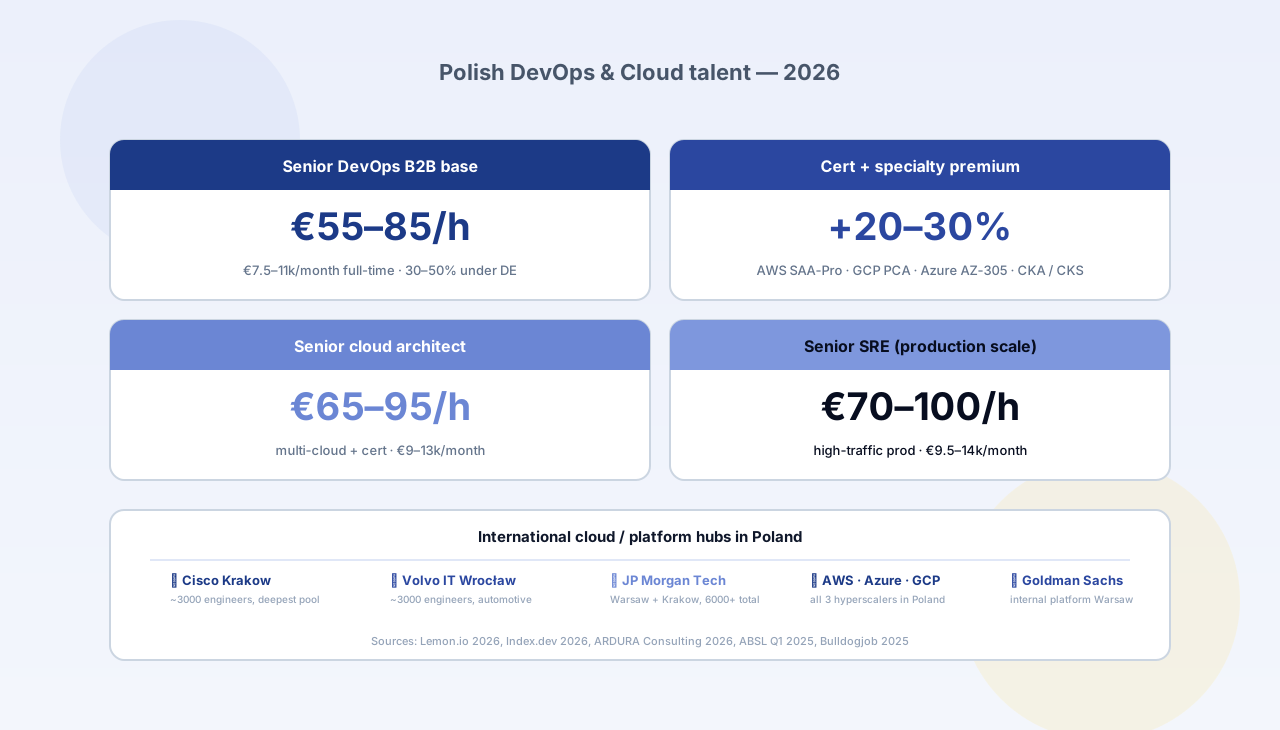
Senior Polish DevOps EUR 55-85/hour B2B in 2026 — modest premium over general senior backend (EUR 50-65/hour). AWS/GCP/Azure cert and Kubernetes specialist add another 20-30% to baseline.
The DevOps rate stack:
Senior DevOps B2B hourly rates (2026):
- Junior DevOps engineer (1-3 yrs): EUR 35-50/hour
- Mid DevOps engineer (3-5 yrs): EUR 45-65/hour
- Senior DevOps engineer (5-8 yrs): EUR 55-75/hour
- Senior cloud architect (AWS/GCP/Azure cert): EUR 65-95/hour
- Senior Kubernetes specialist (CKA/CKS): EUR 60-90/hour
- Senior SRE (high-traffic production): EUR 70-100/hour
- Lead / staff DevOps: EUR 80-110/hour
- Multi-cloud architect (3+ platforms with certs): EUR 90-115/hour
Translated monthly:
- Senior DevOps full-time B2B: EUR 7,500-11,000/month gross
- Senior cloud architect with cert: EUR 9,000-13,000/month
- Senior Kubernetes specialist: EUR 8,000-12,500/month
- Senior SRE: EUR 9,500-14,000/month
- Lead / staff: EUR 11,000-15,000/month
Why DevOps premium is smaller than AI/ML:
DevOps and cloud engineering have larger Polish supply (Cisco Krakow alone trained thousands of senior engineers over a decade) versus AI/ML's smaller specialty pool. The market premium therefore is modest (5-15% over general backend at baseline), with certifications and Kubernetes specialty adding the meaningful spike.
For comparison context:
- Lemon.io 2026 Polish rate calculator — broadly aligns with these ranges
- ARDURA Consulting 2026 DevOps engineer rate guide — publishes detailed Polish DevOps rate tables (with Kubernetes specialist breakdown)
- Bytefront 2025 Stundensatz guide — German senior DevOps EUR 110-140/hour, Polish 30-50% cheaper
For German foreign employers specifically, Polish DevOps saves roughly 35-45% on fully-loaded cost for comparable seniority — and the time-zone parity (CET) means same-day operations work without async overhead.
Hiring Polish specialists for remote roles?
HiddenJobs is a verified job board for international companies hiring Polish remote specialists — across IT, sales, marketing and more.
What cloud platforms and stacks do Polish DevOps engineers cover?
AWS dominant in Polish DevOps pool, Azure second (driven by Microsoft Azure Poland team + DACH foreign employer adoption), GCP third (growing). Terraform IaC universal. Kubernetes orchestration dominant.
The stack landscape for Polish DevOps in 2026:
Cloud platforms (sub-pool depth in order):
- AWS — deepest pool, anchored by AWS Polish engineering presence + many international employers running AWS-first. Senior pool includes hundreds of AWS-certified architects across major cloud certifications.
- Azure — second-deepest, driven by Microsoft Azure engineering team Poland + many DACH foreign employers using Azure. Strong overlap with .NET-leaning Polish engineering teams.
- GCP — third, growing fast. Google Cloud Polish team anchors the pool. Strong overlap with AI/ML talent (GCP is preferred ML platform).
- Multi-cloud (rare specialty, growing demand) — engineers with hands-on production experience across 2-3 clouds. Top-of-market rates.
Infrastructure as Code:
- Terraform — universal. Vast majority of senior Polish DevOps have 3+ years of production Terraform.
- Pulumi — growing, especially in TypeScript-leaning teams.
- CloudFormation — AWS-specific, smaller pool.
- CDK (AWS Cloud Development Kit) — growing among AWS specialists.
Container orchestration:
- Kubernetes — dominant. CKA (Certified Kubernetes Administrator) and CKS (Certified Kubernetes Security Specialist) certifications common in senior pool.
- Docker — universal, no longer specialty.
- ECS/EKS/AKS/GKE — all covered with cloud-specific specialization. EKS deepest (AWS dominance).
Observability:
- Prometheus + Grafana — open-source standard, universal in Polish DevOps senior pool.
- Datadog — enterprise standard, common at international employers.
- New Relic — slightly older enterprise stack, still in use.
- OpenTelemetry — growing fast, modern observability standard.
- CloudWatch / Stackdriver / Azure Monitor — cloud-native equivalents.
CI/CD:
- GitHub Actions — dominant for new projects, fast adoption since 2020.
- GitLab CI — strong second, especially in DACH-leaning teams.
- Jenkins — legacy, still in production at older Polish enterprises.
- ArgoCD / Flux — GitOps, growing for Kubernetes-first teams.
- CircleCI / Travis CI — minor, mostly legacy.
Polish DevOps senior typical CV:
A senior Polish DevOps engineer in 2026 typically has: 5+ years of production experience, hands-on at least 2 cloud platforms (AWS + 1 other), Terraform expert, Kubernetes proficient (CKA in many cases), Prometheus + Grafana fluent, GitHub Actions + GitLab CI exposure, Docker universal. The variation is in specialty depth (SRE production scale, multi-cloud, Kubernetes security) rather than baseline coverage.
How much do AWS/GCP/Azure certifications add to the rate?
Cloud certifications add 20-30% to baseline senior DevOps rate. AWS SAA-Pro, GCP PCA, Azure SAA-Expert all command similar premiums. Kubernetes CKA + CKS stack on top.
Concrete certification premium in Polish DevOps market 2026:
| Certification | Hourly rate add | Monthly add |
|---|---|---|
| AWS Solutions Architect Associate (SAA) | +EUR 3-6/h | +EUR 500-1,000/mo |
| AWS Solutions Architect Professional (SAA-Pro) | +EUR 8-15/h | +EUR 1,200-2,500/mo |
| AWS DevOps Engineer Professional | +EUR 7-12/h | +EUR 1,000-2,000/mo |
| GCP Professional Cloud Architect (PCA) | +EUR 8-15/h | +EUR 1,200-2,500/mo |
| GCP Professional DevOps Engineer | +EUR 7-12/h | +EUR 1,000-2,000/mo |
| Azure Solutions Architect Expert (AZ-305) | +EUR 8-15/h | +EUR 1,200-2,500/mo |
| Azure DevOps Engineer Expert (AZ-400) | +EUR 7-12/h | +EUR 1,000-2,000/mo |
| Kubernetes CKA | +EUR 5-10/h | +EUR 800-1,500/mo |
| Kubernetes CKS | +EUR 5-10/h | +EUR 800-1,500/mo |
| HashiCorp Terraform Associate | +EUR 2-5/h | +EUR 300-700/mo |
Stacking certifications:
A senior Polish DevOps engineer with AWS SAA-Pro + Kubernetes CKA + Terraform Associate typically commands EUR 75-95/hour B2B — top of the senior baseline range, before specialty adjustments.
A multi-cloud senior with AWS SAA-Pro + GCP PCA + Azure AZ-305 + Kubernetes CKA + CKS (rare, ~50-100 such candidates total in Polish pool) commands EUR 95-115/hour B2B — deep specialty pricing, comparable to lead/staff engineer rates without leadership scope.
Why foreign employers care:
- Cost predictability — certified engineers reduce architecture-decision time on first 30 days of engagement
- Audit / compliance — some foreign-employer enterprise clients require certified personnel for SOC 2, ISO 27001, or sector-specific compliance
- Multi-cloud risk — companies running on multiple clouds need engineers with breadth, not just depth on one
For a foreign employer hiring Polish DevOps for the first time, screen for at least one cloud platform certification at Professional / Expert level. The certification premium (20-30%) is a small fraction of the salary saving versus Western European DevOps rates.
Where does Polish DevOps & cloud talent concentrate?
Heavy concentration in Warsaw + Krakow + Wroclaw, meaningful Tri-City Gdansk and Poznan secondary. Krakow is the deepest pool because of Cisco's largest non-US engineering site (~3,000 engineers including major DevOps team).
City-by-city breakdown:
Warsaw — strongest senior pool:
- AWS Polish engineering presence
- Microsoft Azure engineering team (large)
- Google Cloud Polish team
- JP Morgan Tech DevOps (large internal team supporting global financial infrastructure)
- Goldman Sachs Tech (internal platform)
- Polish DevOps consultancies — Pretius, Allero, DevOps.pl founders
- Polish enterprises — mBank cloud, Asseco Cloud Services
Krakow — deepest sheer headcount:
- Cisco Krakow (~3,000 engineers, deep DevOps and platform team) — largest single-employer DevOps cluster in Poland
- IBM Cloud Polish team
- Capgemini Cloud practice
- HSBC Operations DevOps
- Smaller Polish DevOps consultancies
Wroclaw — automotive + enterprise cloud:
- Volvo IT Wroclaw (~3,000 engineers, large platform engineering sub-team) — automotive software platform
- Siemens Energy R&D (industrial automation cloud)
- Atos Polish HQ (enterprise cloud)
- Credit Suisse / UBS Operations
- HP / HPE Polish
- Nokia (5G platform engineering)
Tri-City Gdansk:
- Intel R&D platform team
- Schibsted Tri-City (media platform)
- Smaller DevOps consultancies
Poznan:
- Allegro (largest Polish e-commerce, large internal platform team for high-traffic production)
- Volkswagen IT (~2,000 engineers, platform sub-team)
- Smaller DevOps consultancies
Tier 2 cities (Lodz, Lublin, Rzeszow, Bydgoszcz, Szczecin, Katowice):
- Isolated DevOps talent, no major hubs
- Lodz: P&G shared services, mBank cloud transformation
- Lublin: smaller DevOps presence at Asseco subsidiaries
- Rzeszow: aerospace IT (smaller cloud presence)
- Katowice: mining tech, growing cloud adoption
For foreign employers, sourcing from Warsaw + Krakow + Wroclaw covers ~80% of the senior Polish DevOps pool. For specialty needs (Kubernetes security, multi-cloud, automotive cloud), city-specific targeting matters: Cisco Krakow alumni for Kubernetes security, Volvo IT Wroclaw alumni for automotive platform engineering, Allegro Poznan alumni for high-traffic e-commerce DevOps.
What Polish companies employ the strongest DevOps & cloud engineers?
Three buckets: international cloud/platform engineering hubs in Poland (Cisco, AWS, Azure, Google Cloud, IBM Cloud, Volvo IT), Polish IT consultancies with DevOps practice (ARDURA, Brainhub, Grape Up, STX Next), and Polish enterprises building cloud capabilities (Allegro, mBank, Asseco).
The three buckets:
Bucket 1: International cloud / platform engineering hubs in Poland
- Cisco Krakow — anchor employer, deep DevOps and platform engineering across multiple Cisco product lines
- Amazon Web Services Polish presence — AWS engineering Poland, growing
- Microsoft Azure Poland engineering — Azure platform engineering, including Azure DevOps team
- Google Cloud Polish team — Google Cloud Platform engineering
- IBM Cloud team Poland — enterprise cloud + IBM Cloud product engineering
- JP Morgan Tech DevOps Warsaw — large internal cloud / platform team supporting global financial infrastructure (multi-thousand engineer site spanning Warsaw + Krakow)
- Goldman Sachs Tech Warsaw — internal platform engineering
- Volvo IT Wroclaw — automotive cloud / platform team
- Citi Tech Poland — financial cloud engineering
- HSBC Operations Krakow — operations DevOps
For foreign employers, candidates with 2+ years at these international hubs bring production cloud experience at scale, plus mature engineering practices.
Bucket 2: Polish IT consultancies with DevOps practice
- ARDURA Consulting — DevOps and cloud engineering specialists; active rate-transparency publishing (their 2026 DevOps rate guide is publicly available)
- Grape Up — Cloud Foundry and Kubernetes specialists, automotive vertical, Krakow HQ
- Brainhub DevOps practice — JavaScript/TypeScript-leaning + DevOps
- STX Next platform team — Python ecosystem + DevOps integration
- The Software House DevOps practice — TypeScript / Node.js + DevOps
- Pretius — full-stack with DevOps practice
- Sii Poland DevOps practice — large consultancy with cross-vertical DevOps work
- Capgemini Cloud Polish practice — enterprise cloud transformation
These consultancies attract senior DevOps engineers who prefer client variety over single-employer depth. Engineers rotating out for direct foreign-employer engagements bring cross-domain experience.
Bucket 3: Polish enterprises building cloud capabilities
- Allegro Poznan — largest Polish e-commerce, deep platform team for high-traffic production scale (10M+ DAU, complex scaling needs)
- mBank — financial cloud transformation, AWS-leaning
- Santander Bank Polska — financial cloud, similar profile to mBank
- Asseco Cloud Services — Polish IT giant cloud division
- PZU — insurance, growing cloud capability
- Polish telecoms (Orange, Play, T-Mobile, Plus) — large internal cloud teams supporting telecom infrastructure
- CD Projekt Red — game studio, gaming cloud / platform engineering
Polish enterprise candidates often have strong domain expertise (banking, telecom, gaming) but may need recalibration on modern open-source DevOps tooling versus proprietary enterprise stacks.
How do you screen a Polish DevOps/cloud candidate?
Four screens stack: real production troubleshooting, cloud architecture trade-offs, IaC fluency, foreign-employer comfort signal.
The four-screen protocol:
1. Real production troubleshooting
Pick a real production scenario and ask the candidate to walk through diagnosis. Examples:
- "A pod is OOM-killing in production every 4 hours but only on 3 of 8 replicas. Walk me through diagnosis."
- "API latency spiked from p95=200ms to p95=2s in the last hour. No deploys. Walk me through investigation."
- "We're seeing intermittent 5xx errors at 0.1% rate that we can't reproduce in staging. Diagnosis approach?"
- "Database connection pool is exhausting at 4pm every day. What do you check first?"
Strong candidates engage with concrete tools (kubectl describe, logs, metrics, profilers) and named pitfalls (request/limit mismatch, JVM heap, sidecar memory, namespace quota for Kubernetes; connection pool sizing, slow queries, lock contention for databases). Weak candidates list generic concepts without operational specifics.
2. Cloud architecture trade-offs
Pick a real cloud architecture decision and ask the candidate to walk through the choice. Examples:
- "We need 99.95% SLA for our API serving 10k RPS at $5k/month infrastructure budget. Walk me through your AWS architecture."
- "We're migrating a monolithic Postgres to a multi-tenant SaaS. RDS vs Aurora vs self-managed?"
- "Our latency to US East Coast is too high. Multi-region active-active vs CDN vs eventual migration?"
Strong candidates discuss multi-AZ vs multi-region, RDS vs Aurora, ALB vs API Gateway, caching layers, observability — with explicit cost trade-offs. Weak candidates pick technologies without acknowledging the cost-quality-complexity triangle.
3. IaC fluency
Ask the candidate for a 50-line Terraform sample they wrote that they're proud of, and walk through the choices. Strong candidates:
- Can explain why specific resource arguments are set (timeouts, lifecycle rules, count vs for_each)
- Acknowledge Terraform pitfalls (state locking, drift detection, refactoring complexity)
- Discuss their team's Terraform module structure and review process
This screen separates senior practitioners from copy-paste-from-tutorial mid-level candidates.
4. Foreign-employer comfort signal
Ask about prior international employer experience. Specifically:
- AWS / Microsoft Azure / Google Cloud / IBM Cloud Polish presence?
- Cisco Krakow, JP Morgan Tech, Goldman Sachs Tech Warsaw, Volvo IT Wroclaw?
- Active conference involvement (Warsaw DevOps Days, KubeCon EU, AWS re:Invent attendance)?
- Open-source contributions or active blog presence?
Candidates with 2+ years at international cloud / platform employers ramp 3-4x faster on foreign-employer engagements. Candidates without it often need a longer adjustment to English-language process and cross-cultural communication.
Where do you find Polish DevOps engineers open to remote foreign-employer roles?
Three channels in parallel: curated foreign-only Polish IT job boards, large Polish IT job boards with DevOps category filters, and Polish DevOps-specific communities. Plus LinkedIn alumni outbound to specific cloud hubs in Poland.
Channel mix for Polish DevOps hiring:
1. Curated foreign-only Polish IT job boards
- HiddenJobs.eu — verified foreign-employer listings, DevOps/cloud category tagging, contract path indicated upfront
2. Large Polish IT job boards with DevOps filters
- Bulldogjob — dedicated DevOps section + annual DevOps salary survey (most active Polish DevOps candidate flow)
- NoFluffJobs — DevOps category, strong filter by cloud platform (AWS / Azure / GCP) and certifications
- JustJoin.it — filter by stack including DevOps and Cloud, plus seniority levels
3. Polish DevOps-specific communities
The Polish DevOps community is small enough that senior engineers often know each other:
- DevOps.pl Slack — Polish DevOps community, active conversations
- Polish Cloud Native Community Slack — Kubernetes-focused
- Warsaw DevOps Days — annual flagship conference, top-tier Polish DevOps speakers
- Krakow DevOps Meetup — monthly meetup, Cisco / Capgemini alumni network
- AWS User Group Poland — regional chapters in Warsaw, Krakow, Wroclaw
- GCP Warsaw Meetup — Google Cloud focused
- Azure Krakow Meetup — Microsoft Azure focused
- KubeCon EU + KubeCon NA attendees — list of Polish attendees from each year is a high-quality candidate pool
4. LinkedIn outbound to specific cloud hubs
Targeting alumni networks for senior DevOps:
- "Cisco Krakow alumni" — broad senior platform engineering pool
- "AWS Polish presence alumni" — AWS specialists
- "Microsoft Azure Poland alumni" — Azure specialists
- "JP Morgan Tech Warsaw alumni" — financial cloud
- "Volvo IT Wroclaw alumni" — automotive platform
- "Allegro alumni" — high-traffic e-commerce DevOps
Concrete openers (specific role + cloud platforms expected + monthly EUR rate range + time-zone) get 5-10x the response rate of generic templates.
To list a verified senior Polish DevOps role on HiddenJobs.eu, send the brief to hiddenjobs.eu — role title with DevOps specialty (cloud architect / Kubernetes specialist / SRE / multi-cloud), stack expectations, contract path (B2B or EOR), monthly EUR rate range, and one paragraph about your infrastructure context. Response within a day or two.
Where this guide goes from here
Polish DevOps and cloud talent is one of the strongest Eastern European specialty pools in 2026. Premium pricing is real (cert + Kubernetes specialist + multi-cloud all command meaningful uplifts) but cost-quality positioning still beats Western European DevOps rates by 30-50%.
For deeper guides on this site:
- How to hire, end to end - the guide to hiring remote developers from Poland covers the full process from role definition to onboarding
- General Polish IT hiring - the pillar guide covers all three contract paths
- Cost overview - the cost guide covers the national cost stack
- Where to post the role - the best job boards to hire Polish developers compare channels, costs, and response rates
The short version of Polish DevOps hiring 2026: specialty pool concentrated in Warsaw / Krakow / Wroclaw, senior B2B EUR 55-85/hour (modest premium over general backend, certifications add 20-30%), strong international employer presence (Cisco Krakow, AWS, Azure, Google Cloud, IBM Cloud, Volvo IT) trains production cloud engineers at scale, time-to-hire 3-6 weeks for senior with foreign-employer-relevant experience.
To list a verified Polish DevOps role on HiddenJobs.eu, send the brief to hiddenjobs.eu or get in touch directly. Response within a day or two.
Frequently asked questions
Is Poland strong on DevOps and cloud engineering in 2026?
Yes — Poland is one of the strongest Eastern European corridors for DevOps and cloud engineering. Three structural reasons. First, deep international employer presence: Cisco's largest non-US engineering site (Krakow, ~3,000 engineers including major DevOps team), Amazon Web Services Polish presence, Google Cloud Polish team, Microsoft Azure engineering, IBM Cloud team Poland. These employers train senior platform engineers at scale. Second, large polish IT business services workforce (488,700 per ABSL Q1 2025) creates demand pull for DevOps to support Polish IT teams supporting foreign clients. Third, Polish technical universities emphasize systems engineering rigor — Linux, networking, distributed systems all covered at depth. Aggregate Polish DevOps/cloud pool is in the low tens of thousands of senior engineers.
What do Polish DevOps and cloud engineers cost on B2B in 2026?
Senior Polish DevOps engineers run EUR 55-85/hour B2B in 2026 — modest premium over general senior backend (EUR 50-65/hour per Lemon.io 2026 and Index.dev 2026). Translated monthly: senior DevOps full-time B2B EUR 7,500-11,000 gross. Senior cloud architects with AWS/GCP/Azure professional certifications run EUR 65-95/hour (EUR 9,000-13,000/month). Senior Kubernetes specialists with CKA or CKS run EUR 60-90/hour. SRE (Site Reliability Engineering) seniors with high-traffic production experience run EUR 70-100/hour. Lead DevOps / staff engineer EUR 80-110/hour. Compared to German seniors (EUR 110-140/h per Bytefront 2025), Polish DevOps saves you 30-50% for comparable seniority.
What cloud platforms and stacks do Polish DevOps engineers cover?
Strongest 2026 cloud platforms in Polish DevOps pool: AWS (deepest, largest single platform skillset due to AWS Polish presence + many international employers running on AWS), Azure (second, driven by Microsoft Azure engineering team Poland + many DACH foreign employers using Azure), GCP (third, growing with Google Cloud Polish presence). Strongest infrastructure-as-code: Terraform (universal), Pulumi (growing), CloudFormation (smaller, AWS-specific). Container orchestration: Kubernetes dominant (CKA/CKS certifications common in senior pool); Docker universal; ECS/EKS/AKS/GKE all covered with cloud-specific specialization. Observability: Prometheus + Grafana standard, Datadog and New Relic in enterprise, OpenTelemetry growing. CI/CD: GitHub Actions, GitLab CI, Jenkins legacy, ArgoCD/Flux for GitOps. Polish senior DevOps usually has 2-3 cloud platforms on CV.
How much do AWS/GCP/Azure certifications add to the rate?
Cloud certifications add roughly 20-30% to baseline senior DevOps rates in Poland. Concrete premium ranges: AWS Solutions Architect Professional (~$300 cert) adds EUR 8-15/hour to senior baseline. GCP Professional Cloud Architect adds similar. Azure Solutions Architect Expert adds similar. Kubernetes CKA (Certified Kubernetes Administrator) adds EUR 5-10/hour, CKS (Certified Kubernetes Security Specialist) adds another EUR 5-10. Senior with all three major cloud platform certs (rare) commands EUR 90-110/hour B2B — top-of-band for non-architect senior engineers. Multi-cloud expertise is actively demanded by foreign employers running on multiple clouds (typical mid-market scenario).
Where does Polish DevOps and cloud talent concentrate?
Strong concentration in Warsaw, Krakow, Wroclaw, with meaningful Tri-City Gdansk and Poznan secondary. Warsaw hosts AWS Polish presence, Microsoft Azure engineering, Google Cloud Polish team, JP Morgan Tech DevOps (large internal team), Goldman Sachs Tech, plus Polish DevOps consultancies (DevOps.pl, Pretius, Allero). Krakow has Cisco's largest engineering site outside US (deep DevOps and platform engineering across multiple Cisco product lines), plus IBM Cloud Polish team, Capgemini Cloud practice, HSBC Operations DevOps. Wroclaw has Volvo IT (~3,000 engineers, strong platform team), Siemens Energy R&D, Atos, plus Credit Suisse / UBS Operations. Tri-City Gdansk has Intel R&D platform team. Tier 2 cities have isolated DevOps talent but thinner pool.
What Polish companies employ the strongest DevOps and cloud engineers?
Three buckets in 2026. International employers running cloud/platform engineering in Poland: Amazon Web Services Polish presence, Microsoft Azure engineering Poland (including Azure DevOps team), Google Cloud Polish team, IBM Cloud, Cisco platform engineering Krakow, JP Morgan Tech DevOps Warsaw, Goldman Sachs Tech, Volvo IT Wroclaw (large platform team supporting automotive software). Polish IT consultancies with DevOps practice: ARDURA Consulting (active rate-publishing), Brainhub DevOps practice, Grape Up (Cloud Foundry / Kubernetes specialists, automotive vertical), STX Next platform team, The Software House DevOps practice. Polish enterprises building cloud capabilities: Allegro Poznan (large internal platform team for e-commerce scale), mBank cloud transformation, Asseco Cloud Services, Polish telecoms (Orange, Play, T-Mobile cloud teams). Senior candidates from these buckets bring production cloud experience at scale.
How do you screen a Polish DevOps/cloud candidate for foreign-employer fit?
Run four screens. First, real production troubleshooting question: 'A pod is OOM-killing in production every 4 hours but only on 3 of 8 replicas. Walk me through diagnosis.' Strong candidates engage with concrete tools (kubectl describe, logs, metrics, memory profiler) and named pitfalls (request/limit mismatch, JVM heap, sidecar memory, namespace quota). Second, cloud architecture trade-offs: 'We need 99.95% SLA for our API serving 10k RPS at $5k/month infrastructure budget. Walk me through your AWS architecture.' Strong candidates discuss multi-AZ vs multi-region, RDS vs Aurora, ALB vs API Gateway, caching layers, observability — with explicit cost trade-offs. Third, IaC fluency: ask for a 50-line Terraform sample they wrote that they're proud of and walk through the choices. Fourth, foreign-employer comfort: prior international employer experience (AWS, Azure, GCP, Cisco, JPM, Goldman Sachs in Poland all count). Candidates with 2+ years at international cloud/platform employers ramp 3-4x faster.
Where do you find Polish DevOps engineers open to remote foreign-employer roles?
Three channels work in parallel for Polish DevOps specialty. First, curated foreign-only Polish IT job boards (HiddenJobs.eu) with explicit DevOps/cloud category tagging. Second, large Polish IT job boards with DevOps/Cloud filters (Bulldogjob has dedicated DevOps section + annual DevOps salary survey, NoFluffJobs DevOps category, JustJoin.it filter by stack). Third, Polish DevOps-specific communities — DevOps.pl Slack, Polish Cloud Native Community Slack, Warsaw DevOps Days conference (annual flagship), Krakow DevOps Meetup, AWS User Group Poland, GCP Warsaw Meetup. Plus LinkedIn outbound to alumni of specific Polish cloud hubs (AWS Polish presence, Microsoft Azure Poland, Cisco Krakow, Volvo IT) — concrete openers (role + cloud platforms expected + monthly EUR rate range + time-zone) get 5-10x the response rate of generic templates.
Editorial note
This guide cites named public sources for every concrete number: Lemon.io 2026 rate calculator (Poland) and Index.dev European Developer Hourly Rates 2026 for senior DevOps B2B rates including certification premium, ABSL Q1 2025 Sector in Numbers for Polish IT workforce, ARDURA Consulting 2026 DevOps engineer rate guide, Bulldogjob IT Community Survey 2025 DevOps section. Currency conversion ~$1.06 = €1, PLN/EUR ~4.27 (May 2026). Treat ranges as ranges — actual DevOps rates vary by cloud platform mix, certification depth, production scale experience, and individual negotiation. The post is informational and does not constitute legal, tax, or HR advice; consult a Polish IT-specialized recruiter before locking your offer band for a senior DevOps hire.