Hiring Polish Java & Spring Engineers in 2026: Enterprise Talent Guide for Foreign Employers

If you run an international company building enterprise backend infrastructure — fintech in London, banking platform in Frankfurt, retail SaaS in Amsterdam, B2B platform in San Francisco — and you've decided to hire Polish Java or Spring engineering talent, you're entering the deepest single-language specialty pool in Eastern Europe.
Poland's Java market is anchored by three structural drivers in 2026: massive financial services engineering hubs run by international banks, decades of Polish enterprise software heritage at Comarch and Asseco, and Polish technical universities teaching Java as the primary OOP language with strong Spring exposure by graduation. This guide breaks down what Polish Java actually costs, where talent concentrates, and how to source.
The post is for foreign founders, CTOs, engineering leaders, and platform teams hiring senior Java engineers, Spring Boot specialists, and Kotlin/JVM developers from Poland. For general Polish IT hiring, see the pillar guide.
Hiring Polish specialists for remote roles?
HiddenJobs is a verified job board and matching service for international companies recruiting Polish remote talent.
Table of contents8 sections
Is Poland actually strong on Java and Spring in 2026?
Yes — three structural drivers stack: international financial services hub gravity, Polish enterprise software heritage, and university Java-first curricula. Aggregate senior Java pool is the deepest single-language cluster in Eastern Europe.
The structural drivers behind Polish Java strength:
1. International financial services hub gravity (the largest driver)
International banks run enormous internal Java engineering hubs in Poland. The decade-long pattern: London / New York / Frankfurt headquarters offshore mid-to-senior engineering work to Polish hubs at 30-50% cost saving while keeping CET time-zone alignment with London / Frankfurt:
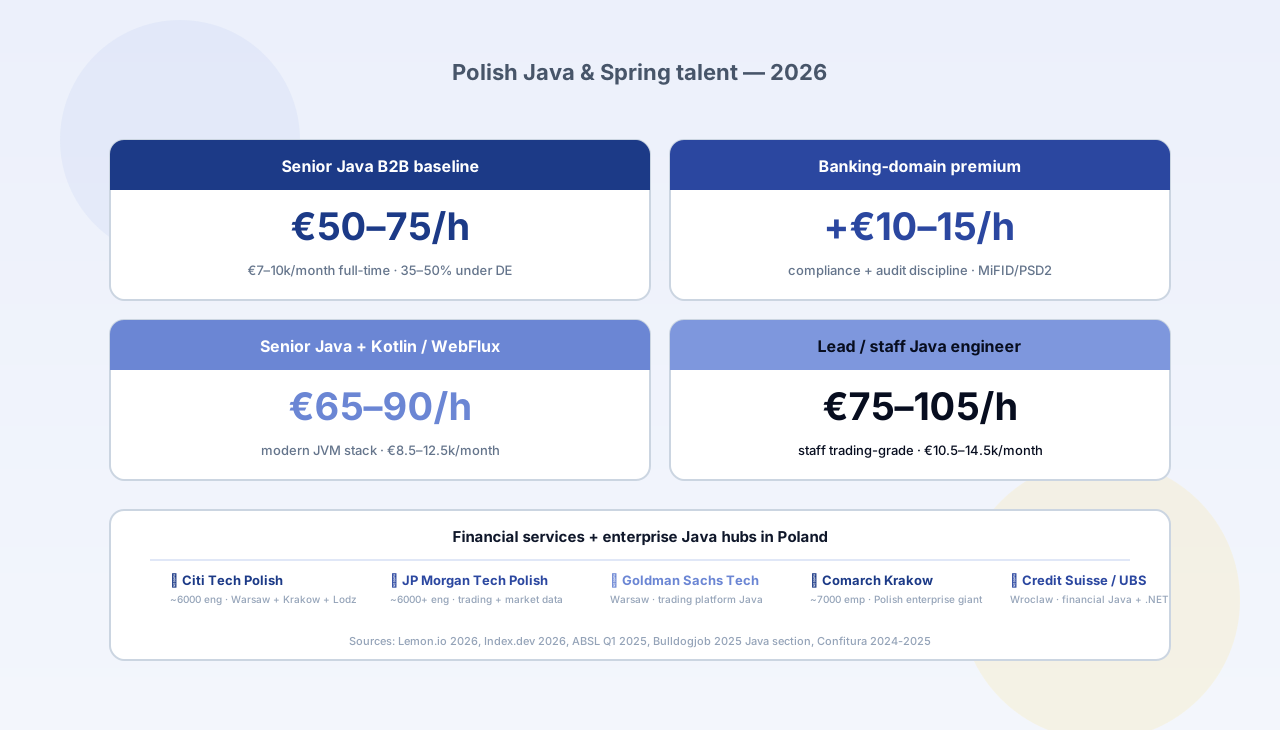
- Citi Tech Polish — ~6,000 engineers split across Warsaw, Krakow, and Lodz. Massive Java/Spring estate for global trading platforms, retail banking, operations
- JP Morgan Tech Polish — ~6,000+ engineers split Warsaw + Krakow. Large internal Java + Kotlin estate for trading platforms and financial infrastructure
- Goldman Sachs Tech Warsaw — internal platform engineering with large Java team for trading platforms
- Credit Suisse / UBS Operations Wroclaw — financial Java + .NET hybrid
- HSBC Operations Krakow — banking Java for retail and commercial
- ING Tech Poland — Dutch retail bank Java engineering
- Société Générale Polish — French bank tech team
- Nordea — Nordic retail bank Java team
- Société Générale Equipment Finance Polish — leasing platform Java
- Bank of America — smaller Polish presence, financial Java
The aggregate effect: a senior Polish Java engineer in 2026 frequently has 2-3 production-scale banking Java stints on their CV.
2. Polish enterprise software heritage
Polish enterprise software heritage runs deep. The two anchor employers:
- Comarch Krakow (~7,000 employees globally, Polish HQ in Krakow) — Polish enterprise software giant, Java-first stack for two decades across banking, telecom, ERP, retail, financial services products
- Asseco (~30,000 employees globally, Polish HQ in Rzeszow) — largest Polish IT company, Java-heavy financial services and government software
Beyond the giants:
- Allegro Poznan — largest Polish e-commerce, Java + Kotlin backend at high-traffic scale
- mBank Warsaw — largest mobile-first Polish bank, Java + AWS modernization
- Santander Bank Polska — financial Java + Salesforce hybrid
- CD Projekt Red Warsaw — game studio backend Java/Kotlin
- Polish telecoms (Orange, Play, T-Mobile, Plus) — large internal Java estates
3. Polish technical universities teach Java first
Polish CS curricula universally teach Java as primary OOP language with strong Spring exposure by graduation. Universities with notable Java strength:
- Warsaw University of Technology (Polish: Politechnika Warszawska) — Java/Spring track in computer science program
- AGH University of Science and Technology Krakow (Polish: Akademia Gorniczo-Hutnicza) — Java + Spring + JPA standard course content
- Wroclaw University of Science and Technology (Polish: Politechnika Wroclawska) — Java enterprise track with Spring Boot in upper years
- Gdansk University of Technology (Polish: Politechnika Gdanska) — Java with Hibernate
- Poznan University of Technology (Polish: Politechnika Poznanska) — Java backend track
The aggregate: Polish senior Java pool sits in the tens of thousands — the largest single-language specialty cluster in Poland and arguably in Eastern Europe.
What do Polish Java & Spring engineers cost on B2B in 2026?
Senior Polish Java engineers EUR 50-75/hour B2B in 2026 — at general senior backend baseline (no scarcity premium because supply is deep). Banking domain exposure adds EUR 10-15/hour. Kotlin + Java fluency adds another EUR 5-10/hour.
The Java rate stack:
Senior Java B2B hourly rates (2026):
- Junior Java engineer (1-3 yrs): EUR 30-45/hour
- Mid Java engineer (3-5 yrs): EUR 40-60/hour
- Senior Java engineer (5-8 yrs): EUR 50-75/hour
- Senior Spring Boot specialist (banking domain): EUR 60-85/hour
- Senior Java + Kotlin (modern JVM stack): EUR 65-90/hour
- Senior Java + reactive (WebFlux + Project Reactor): EUR 65-90/hour
- Lead / staff Java engineer: EUR 75-105/hour
- Principal Java architect: EUR 90-120/hour
Translated monthly:
- Senior Java full-time B2B: EUR 7,000-10,000/month gross
- Senior banking-domain Java: EUR 8,000-11,500/month
- Senior Java + Kotlin: EUR 8,500-12,500/month
- Lead / staff: EUR 10,500-14,500/month
Why Java premium is at baseline:
Java has the deepest Polish supply of any specialty (financial services hubs alone trained tens of thousands of senior Java engineers over two decades). The market premium therefore is at general senior backend baseline rather than specialty-driven. The premium signals foreign employers actually pay for: banking domain (regulatory compliance discipline), Kotlin fluency (modern JVM stack), reactive programming (high-throughput services), and Java 21 modern syntax depth (records, sealed classes, pattern matching, virtual threads).
For comparison context:
- Lemon.io 2026 Polish rate calculator — broadly aligns with these ranges
- Index.dev European Developer Hourly Rates 2026 — Polish senior Java baseline matches
- Bytefront 2025 Stundensatz guide — German senior Java EUR 90-130/hour, Polish 35-50% cheaper
For German foreign employers specifically, Polish Java saves roughly 35-45% on fully-loaded cost for comparable seniority — and the time-zone parity (CET) means same-day code review and pair programming work without async overhead.
Hiring Polish specialists for remote roles?
HiddenJobs is a verified job board and matching service for international companies recruiting Polish remote talent.
What Java frameworks and stacks do Polish engineers cover?
Spring Boot dominant in Polish pool, Hibernate/JPA universal, Kotlin growing fast as JVM second language, Quarkus and Micronaut niche but present. Maven still dominates build tooling, Gradle growing in Kotlin teams.
The stack landscape for Polish Java in 2026:
Frameworks (sub-pool depth in order):
- Spring Boot — dominant. Vast majority of senior Polish Java engineers have 5+ years of production Spring Boot. Spring Cloud common in microservices teams. Spring Security universal in financial services. Spring WebFlux + Project Reactor in newer reactive microservices.
- Hibernate / JPA — universal. Vast majority of senior pool has production JPA experience.
- Quarkus — growing, especially in Red Hat / IBM influenced teams (and Capgemini Cloud practice). GraalVM native compilation traction in serverless contexts.
- Micronaut — niche but present, especially in startup-leaning teams.
- Jakarta EE (formerly Java EE) — legacy, still in production at older Polish enterprises (Comarch / Asseco product lines).
- Vert.x — niche, financial services event-driven systems.
- Helidon — very niche, Oracle-leaning teams only.
JVM languages:
- Java — primary, ~85% of senior pool baseline. Java 17 LTS standard, Java 21 LTS adopted in modern teams.
- Kotlin — growing fast (Android backend overlap, modern microservices). ~30-40% of Polish senior backend now has production Kotlin.
- Scala — niche but present at fintech (Akka Streams, Spark/big data), especially Wroclaw / Warsaw banking.
- Groovy — legacy, build scripts and Spock testing.
- Clojure — very niche.
Build tools:
- Maven — dominant (legacy and current).
- Gradle — growing, especially in Kotlin teams and modern microservices.
- Bazel — very niche, Google-leaning teams only.
Testing:
- JUnit 5 — universal.
- Mockito — universal.
- AssertJ — strong adoption.
- Testcontainers — strong adoption for integration testing.
- Spock (Groovy) — niche, mostly legacy.
- WireMock — common in microservices teams.
- REST Assured — common in API testing.
Messaging:
- Apache Kafka — dominant in modern microservices.
- RabbitMQ — secondary, common in older microservices.
- ActiveMQ / Artemis — legacy, financial services older systems.
- Kafka Streams — growing in event-driven architectures.
Persistence layer extensions:
- PostgreSQL + JPA — dominant database/ORM combination.
- MySQL — secondary.
- Oracle DB — common in banking legacy and Comarch product lines.
- MongoDB / Cassandra — NoSQL when needed.
- Redis — universal caching layer.
Polish senior Java engineer typical CV:
A senior Polish Java engineer in 2026 typically has: 5+ years of production Spring Boot, Maven (and likely Gradle), Kafka or RabbitMQ production messaging, JUnit + Testcontainers test discipline, Java 17 (often Java 21) modern syntax fluent, Kotlin secondary if not primary. Variation is in domain depth (banking, e-commerce, telecom, gaming) rather than baseline coverage.
How deep is the Polish banking and financial services Java pool?
The Polish banking Java pool is the deepest specialty corner of the Polish Java market — possibly the deepest single Java specialty pool in Eastern Europe. Citi Tech alone runs ~6,000 engineers across Warsaw + Krakow + Lodz with massive Java estate.
The banking Java landscape:
International banks running massive internal Java engineering in Poland:
- Citi Tech Polish (~6,000 engineers split Warsaw + Krakow + Lodz) — global trading platforms, retail banking, operations, anti-money-laundering systems. Java + Spring + Kafka + Oracle. This is the largest single banking employer in Poland.
- JP Morgan Tech Polish (~6,000+ engineers split Warsaw + Krakow) — trading platforms, financial infrastructure, market data. Java + Kotlin + Spring + Kafka. Aggressive Kotlin adoption in newer microservices.
- Goldman Sachs Tech Warsaw — internal platform engineering for trading. Java + Slang (Goldman's internal language) + Spring.
- Credit Suisse / UBS Operations Wroclaw — financial Java + .NET hybrid. Operations and back-office for the merged UBS entity.
- HSBC Operations Krakow — banking Java for retail and commercial banking.
- ING Tech Poland — Dutch retail bank Java engineering, mobile banking platform.
- Société Générale Polish — French bank tech team.
- Nordea — Nordic retail bank Java team.
- Bank of America Polish — smaller but growing.
Polish retail banks running internal Java engineering:
- mBank Warsaw — largest mobile-first Polish bank, Java + AWS modernization, Spring Boot microservices.
- Santander Bank Polska Warsaw — Java + Salesforce hybrid.
- PKO BP (state-owned) — Java legacy + modernization.
- Pekao — Java legacy + modernization.
- ING Bank Polski — Polish ING subsidiary, Java + Kotlin.
- BNP Paribas Polish subsidiary — Java retail banking.
Insurance and capital markets:
- PZU — largest Polish insurance group, Java systems.
- GPW (Warsaw Stock Exchange) — Java trading systems.
- Polish brokerages — Java trading platforms.
Why banking domain matters to foreign fintech:
Senior candidates with banking domain experience bring valuable compliance discipline:
- Audit trail design — every transaction is traceable, every state change is logged
- Regulatory reporting — familiar with MiFID II, SFTR, EMIR, GDPR, Basel III data flows
- Transaction integrity — careful @Transactional boundary design, optimistic concurrency, idempotency keys
- Security discipline — PII handling, encryption-at-rest, key rotation, SOC 2 audit experience
- Operational maturity — incident response, on-call rotations, runbooks, post-mortems
For foreign fintech employers (especially European fintechs subject to PSD2, MiFID II, AMLD5), Polish banking Java seniors are the highest-value hire bracket because the compliance discipline transfers directly.
Where does Polish Java talent concentrate?
Heavy concentration in Warsaw + Krakow + Wroclaw, meaningful Lodz + Poznan + Tri-City Gdansk secondary. Warsaw is the financial epicenter. Krakow is the deepest sheer headcount because of Comarch + Cisco + AGH graduate pipeline.
City-by-city breakdown:
Warsaw — financial epicenter:
- Citi Tech Warsaw — large Java/Spring estate
- JP Morgan Tech Warsaw — trading platforms Java + Kotlin
- Goldman Sachs Tech Warsaw — internal platform Java
- Société Générale Polish — French bank tech
- mBank — largest mobile-first Polish bank
- Santander Bank Polska
- PKO BP (state-owned bank) — Java legacy + modernization
- Polish Java consultancies — Pretius, Sii Poland Java practice, Polish-founded boutiques
- GPW (Warsaw Stock Exchange) — Java trading
Krakow — deepest headcount pool:
- Comarch Krakow (~7,000 employees, Polish enterprise software giant) — Java-first stack across banking, telecom, ERP, retail, financial products
- Cisco Krakow (~3,000 engineers, including Java/Spring teams)
- JP Morgan Tech Krakow — financial Java
- HSBC Operations Krakow — banking Java
- Capgemini Cloud + Java practice Krakow
- AGH University Java graduate pipeline — feeds local employers
- ABB Krakow — industrial automation Java
Wroclaw — banking + enterprise hub:
- Credit Suisse / UBS Operations Wroclaw — financial Java + .NET
- Volvo IT Wroclaw (~3,000 engineers) — Java-heavy automotive software
- Nokia Wroclaw — telecom Java
- IBM Polish HQ Wroclaw
- Capgemini Wroclaw
- Atos Polish HQ Wroclaw
- HP / HPE Polish
- Wroclaw University Java graduate pipeline
Lodz — Citi shared services:
- Citi Tech Lodz Operations — Citi's third-largest Polish hub for operations Java
- mBank cloud transformation team Lodz
- Smaller Java consultancies
Poznan — e-commerce + automotive:
- Allegro Poznan — largest Polish e-commerce, Java + Kotlin at high-traffic scale (10M+ DAU)
- Volkswagen IT Poznan (~2,000 engineers) — automotive Java
- Roche IT Poznan — pharmaceutical Java
- Poznan University Java graduate pipeline
Tri-City Gdansk:
- Intel R&D — some Java
- Sii Poland branch
- Smaller financial services operations
Tier 2 cities (Rzeszow, Lublin, Bydgoszcz, Szczecin, Katowice):
- Rzeszow — Asseco HQ (largest Polish IT company), Java-heavy
- Lublin — smaller Java presence at Asseco subsidiaries, Sii branch
- Katowice — mining and industrial Java
- Bydgoszcz — Atos branch, smaller Java
- Szczecin — DACH-leaning Java presence
For foreign employers, sourcing from Warsaw + Krakow + Wroclaw covers ~75% of the senior Polish Java pool. Adding Lodz + Poznan covers ~90%. For specialty needs (banking domain, Kotlin fluency, automotive), city-specific targeting matters: Citi/JPM/Goldman alumni in Warsaw for trading-grade Java, Comarch/Cisco alumni in Krakow for enterprise Java depth, Volvo IT alumni in Wroclaw for automotive Java.
What Polish companies employ the strongest Java engineers?
Three buckets: international banks running massive Java engineering hubs in Poland (Citi, JP Morgan, Goldman, Credit Suisse, HSBC, ING), Polish IT consultancies with deep Java practice (Comarch, Asseco, Capgemini, Sii, Pretius, Luxoft), and Polish enterprises with Java engineering (Allegro, mBank, telecoms, gaming).
The three buckets:
Bucket 1: International banks running large Java engineering hubs in Poland
- Citi Tech Polish — anchor employer (~6,000 engineers Warsaw + Krakow + Lodz), trading platforms + retail banking + operations
- JP Morgan Tech Polish (~6,000+ engineers Warsaw + Krakow) — trading platforms + financial infrastructure + market data
- Goldman Sachs Tech Warsaw — internal platform for trading
- Credit Suisse / UBS Operations Wroclaw — financial Java + .NET hybrid
- HSBC Operations Krakow — banking Java for retail and commercial
- ING Tech Poland — Dutch retail bank Java
- Société Générale Polish — French bank tech
- Nordea — Nordic retail bank Java
- Bank of America Polish — growing
- Crédit Agricole Polish — French bank tech subsidiary
For foreign employers, candidates with 2+ years at these international hubs bring production-scale banking Java plus regulatory compliance discipline that transfers directly to fintech employers.
Bucket 2: Polish IT consultancies with deep Java practice
- Comarch Krakow — Polish enterprise software giant (~7,000 employees, Java-first stack across banking, telecom, ERP, retail, financial services products for global clients)
- Asseco — largest Polish IT company (~30,000 employees globally, Polish HQ in Rzeszow), Java-heavy financial services and government software
- Capgemini Polish — cross-vertical Java practice (~9,000 engineers across Krakow, Warsaw, Wroclaw)
- Sii Poland — large body shop with Java practice (~7,000 engineers across major cities)
- EPAM Polish — international consultancy with Polish presence
- Luxoft Poland — financial services consultancy (acquired by DXC)
- Tieto / TietoEVRY Polish — Nordic-leaning consultancy with Polish branch
- Pretius Warsaw — Java specialty consultancy
- Future Processing Gliwice — Java consultancy (Silesia region)
- Akamai Polish — internal Java services
- Mood Up Wroclaw — Java + .NET consultancy
These consultancies attract senior Java engineers who prefer client variety over single-employer depth. Engineers rotating out for direct foreign-employer engagements bring cross-domain experience.
Bucket 3: Polish enterprises with Java engineering
- Allegro Poznan — largest Polish e-commerce, deep platform team (Java + Kotlin) for high-traffic production scale (10M+ DAU)
- mBank Warsaw — largest mobile-first Polish bank, Java + AWS modernization
- Polish telecoms (Orange, Play, T-Mobile, Plus) — large internal Java estates
- CD Projekt Red Warsaw — game studio backend Java + Kotlin
- PZU — Polish insurance giant, Java systems
- GPW (Warsaw Stock Exchange) — Java trading systems
- Polish state-owned banks (PKO BP, Pekao) — Java legacy + modernization
- Polish insurers (Warta, Compensa, Generali Polish) — Java enterprise systems
Polish enterprise candidates often have strong domain expertise (banking, telecom, insurance, gaming) but may need recalibration on modern open-source Java tooling versus proprietary enterprise stacks.
How do you screen a Polish Java/Spring candidate?
Four screens stack: JVM internals depth, Spring fluency, JPA/Hibernate pitfalls, foreign-employer comfort signal with English communication test.
The four-screen protocol:
1. JVM internals depth
Pick a real production JVM scenario and ask the candidate to walk through diagnosis. Examples:
- "Walk me through diagnosing a Java service consuming 8 GB heap with 1 GB working set on Kubernetes."
- "Service GC pauses spiked from 100ms p99 to 2s p99 after we bumped heap from 4G to 16G. Diagnosis approach?"
- "Thread dump shows 200 threads BLOCKED on the same monitor. Walk me through the investigation."
- "Native memory growth without heap growth — heap is stable at 4G but RSS climbs to 12G over 24h. What do you check?"
Strong candidates engage with concrete tools (jcmd, jmap, async-profiler, jstack, JFR, eclipse MAT) and named pitfalls (heap fragmentation, off-heap caches, ClassLoader leaks, large object allocation patterns, GC tuning, native memory leaks via JNI). Weak candidates list generic concepts without operational specifics.
2. Spring fluency
Pick concrete Spring nuance and ask the candidate to walk through trade-offs. Examples:
- "Compare @Transactional propagation REQUIRED vs REQUIRES_NEW vs NESTED in concrete production scenarios."
- "When would you use @Async vs CompletableFuture vs reactive WebFlux for a slow downstream call?"
- "Walk me through Spring Security configuration for an OAuth 2 resource server with custom JWT claims validation."
- "When would you use Spring Cloud Stream vs raw Kafka client?"
Strong candidates explain transaction boundary semantics with concrete examples — "REQUIRES_NEW for outbox publishing inside an audit trail, NESTED for retry-able sub-units, REQUIRED for the default case." Weak candidates list concepts without operational consequence.
3. JPA/Hibernate pitfalls
JPA is universal in Polish Java but expertise varies. Ask:
- "A query that ran in 50ms on dev now takes 2s in prod with the same data volume. Walk me through diagnosis."
- "When would you pick fetch=EAGER vs LAZY for a particular @ManyToOne, and what's the trade-off?"
- "Walk me through detecting and fixing N+1 select problems."
- "How do you handle entity locking in a high-concurrency scenario?"
Strong candidates discuss N+1 selects, lazy loading boundaries, query plan analysis, connection pool sizing, fetch strategies, optimistic vs pessimistic locking, JPQL vs native query trade-offs. This screen separates senior practitioners from copy-paste-from-tutorial mid-level candidates.
4. Foreign-employer comfort signal + English communication test
Ask about prior international employer experience. Specifically:
- Citi Tech, JP Morgan Tech, Goldman Sachs Tech, Credit Suisse / UBS, HSBC, ING in Poland?
- Comarch Krakow product lines that ship internationally?
- Capgemini / Sii / Luxoft client engagements with Western European clients?
- Active conference involvement (Confitura Warsaw, JDD Krakow, Devoxx Poland, JPoint, Warsaw JUG)?
- Open-source Java contributions or active blog presence?
Combine with a written communication test: ask the candidate to write a 200-300 word slack-style threaded discussion of an architectural choice. Look for: clear reasoning chain, named trade-offs, comfort with disagreement (politely), and absence of corporate-speak. Candidates with 2+ years at international Polish banking hubs ramp 3-4x faster on cross-cultural foreign-employer engagements.
Where do you find Polish Java engineers open to remote foreign-employer roles?
Three channels in parallel: curated foreign-only Polish IT job boards, large Polish IT job boards with Java filters, and Polish Java-specific communities. Plus LinkedIn outbound to alumni of Polish banking hubs.
Channel mix for Polish Java hiring:
1. Curated foreign-only Polish IT job boards
- HiddenJobs.eu — verified foreign-employer listings, Java/Spring category tagging, contract path indicated upfront
2. Large Polish IT job boards with Java filters
Polish Java listings dwarf any other single language in volume:
- Bulldogjob — dedicated Java section + annual Java salary survey (highest Polish Java candidate flow)
- NoFluffJobs — Java category with strong filter by stack version, Spring Boot version, JVM language (Kotlin/Scala)
- JustJoin.it — Java filter with seniority levels and remote/hybrid breakdown
- Pracuj.pl — broader Polish job board with strong Java IT category
- theProtocol.it — Polish IT-focused job board
3. Polish Java-specific communities
The Polish Java community is huge — meetups regularly draw 100-200 people:
- Warsaw Java User Group (one of the largest in Eastern Europe, monthly meetup)
- Krakow Java User Group (active monthly, Comarch + Cisco + AGH alumni network)
- Wroclaw Java User Group (banking + automotive crossover)
- Confitura Warsaw — annual flagship Polish Java conference (~1,500-2,000 attendees)
- JDD Krakow — Java Developers Day Krakow (annual, ~500-800 attendees)
- JPoint — Polish Java conference circuit
- Devoxx Poland Krakow — international JVM conference Polish edition
- 4Developers — general Polish dev conference, strong Java track
- Code Europe — Warsaw / Krakow tech conference
4. LinkedIn outbound to specific Polish banking + enterprise hubs
Targeting alumni networks for senior Java:
- "Citi Tech Polish alumni" — broadest banking Java pool
- "JP Morgan Tech Polish alumni" — modern Java + Kotlin at scale
- "Goldman Sachs Tech Warsaw alumni" — trading platform Java
- "Credit Suisse / UBS Operations Wroclaw alumni" — financial Java + .NET hybrid
- "HSBC Operations Krakow alumni" — banking Java
- "Comarch Krakow alumni" — Polish enterprise software depth
- "Asseco alumni" — Polish enterprise breadth
- "Allegro alumni" — high-traffic Java + Kotlin
- "mBank alumni" — modern Java + AWS
Concrete openers (specific role + Spring Boot version + Kotlin yes/no + monthly EUR rate range + time-zone) get 5-10x the response rate of generic templates.
To list a verified senior Polish Java role on HiddenJobs.eu, send the brief to hiddenjobs.eu — role title with Java specialty (Spring Boot specialist / Kotlin backend / banking domain / reactive WebFlux), stack expectations, contract path (B2B or EOR), monthly EUR rate range, and one paragraph about your platform context. Response within a day or two.
Where this guide goes from here
Polish Java and Spring talent is the deepest single-language specialty pool in Eastern Europe in 2026. Rates sit at general senior backend baseline (no scarcity premium because supply is deep) but cost-quality positioning still beats Western European Java rates by 35-50%, with the additional advantage of CET time-zone parity for same-day code review and pair programming.
For deeper guides on this site:
- DevOps companion guide — the DevOps & cloud hiring guide covers Polish DevOps specialty pool
- AI/ML companion guide — the AI/ML hiring guide covers Polish AI/ML specialty pool
- General Polish IT hiring — the pillar guide covers all three contract paths
- Cost overview — the cost guide covers national cost stack
- City breakdown — the city salary guide covers per-city benchmarks (Java follows similar pattern with Krakow + Warsaw deepest senior pools)
- B2B contract operational — the B2B contract guide covers JDG mechanics and the July 2026 reform
The short version of Polish Java hiring 2026: deepest single-language specialty pool in Eastern Europe, senior B2B EUR 50-75/hour (at general senior backend baseline because supply is deep), banking domain adds EUR 10-15/hour, Kotlin fluency adds another EUR 5-10/hour, time-to-hire 3-6 weeks for senior with foreign-employer-relevant experience, financial services Java pool (Citi, JP Morgan, Goldman, Credit Suisse, HSBC, ING) brings compliance discipline that transfers directly to fintech employers.
To list a verified Polish Java role on HiddenJobs.eu, send the brief to hiddenjobs.eu or get in touch directly. Response within a day or two.
Frequently asked questions
Is Poland strong on Java and Spring engineering in 2026?
Yes — Poland is the deepest single-language pool in Eastern Europe for Java/Spring. Three structural reasons. First, financial services hub gravity: Citi Tech (Warsaw + Krakow ~6,000 engineers), JP Morgan Tech (Warsaw + Krakow ~6,000+), Goldman Sachs Tech Warsaw, Credit Suisse / UBS Operations Wroclaw, HSBC Krakow, ING Tech, Société Générale Polish — all run massive internal Java estates. Second, Polish enterprise software heritage: Comarch Krakow (~7,000 employees), Asseco (largest Polish IT company), Allegro Poznan, mBank — all Java-first stacks for two decades. Third, Polish technical universities (Warsaw University of Technology, AGH Krakow, Wroclaw University of Science and Technology) teach Java as the primary OOP language with strong Spring exposure by graduation. Aggregate senior Java pool sits in the tens of thousands — the largest specialty cluster of any language.
What do Polish Java and Spring engineers cost on B2B in 2026?
Senior Polish Java engineers run EUR 50-75/hour B2B in 2026 — at general senior backend baseline (per Lemon.io 2026 and Index.dev 2026), with no specialty premium because Java supply is deep. Translated monthly: senior Java full-time B2B EUR 7,000-10,000 gross. Senior Spring Boot specialist with banking domain exposure runs EUR 60-85/hour (premium for fintech compliance familiarity). Senior with Kotlin + Java + Spring fluency runs EUR 65-90/hour (modern JVM stack premium). Lead / staff Java engineer EUR 75-105/hour. Compared to German seniors (EUR 90-130/hour per Bytefront 2025), Polish Java saves you 35-50% for comparable seniority. Compared to Polish AI/ML or DevOps specialty rates, Java is at baseline because supply is deeper.
What Java frameworks and stacks do Polish engineers cover?
Strongest 2026 Java frameworks in Polish pool: Spring Boot dominant (vast majority of senior Polish Java engineers have 5+ years of production Spring Boot), Spring Cloud common in microservices teams, Spring Security universal in financial services. Hibernate / JPA universal. Build tools: Maven dominant (legacy and current), Gradle growing (especially in Kotlin teams). JVM languages: Java still primary (~85% of senior pool), Kotlin growing fast for backend (especially newer microservices and Android), Scala niche but present at fintech (Akka Streams). Reactive stacks: Spring WebFlux + Project Reactor in newer microservices teams. Alternative frameworks: Quarkus (growing, strong Red Hat / IBM influence in Polish market), Micronaut (smaller). Testing: JUnit 5 universal, Mockito universal, Testcontainers strong adoption. Messaging: Kafka dominant, RabbitMQ secondary, ActiveMQ legacy. Polish senior Java engineer typical CV: Spring Boot expert, Maven/Gradle fluent, Kafka or RabbitMQ production, JUnit + Testcontainers test discipline, Java 17/21 modern syntax fluent.
How deep is the Polish banking and financial services Java pool?
The Polish banking Java pool is the deepest specialty corner of the Polish Java market — possibly the deepest in Eastern Europe. Major international banks running large internal Java engineering in Poland: Citi Tech Polish (~6,000 engineers split Warsaw + Krakow, large Java/Spring estate for global trading and operations platforms), JP Morgan Tech (~6,000+ engineers split Warsaw + Krakow, large internal Java + Kotlin for trading platforms and financial infrastructure), Goldman Sachs Tech Warsaw (large internal Java team for trading platforms), Credit Suisse / UBS Operations Wroclaw (financial Java + .NET hybrid), HSBC Operations Krakow (banking Java for retail and commercial), ING Tech Poland (Dutch retail bank Java team), Société Générale Polish (French bank tech team), Nordea (Nordic retail bank tech). Polish retail banks running Java internal: mBank (largest mobile-first Polish bank, AWS + Java), Santander Bank Polska (Java + Salesforce hybrid), PKO BP (state-owned bank, Java legacy + modernization). Senior candidates with banking domain experience bring valuable compliance discipline (audit trails, regulatory reporting, transaction integrity) — actively desired by foreign fintech employers.
Where does Polish Java talent concentrate?
Heavy concentration in Warsaw + Krakow + Wroclaw + Lodz + Poznan, with Tri-City Gdansk meaningful. Warsaw is the financial services epicenter: Citi Tech Warsaw, JP Morgan Tech Warsaw, Goldman Sachs Tech, Société Générale Polish, mBank, Polish-founded Java consultancies (Pretius, Sii Poland Java practice). Krakow is the deepest sheer headcount pool: Cisco Krakow (~3,000 engineers including Java/Spring teams), Capgemini Cloud + Java practice, Comarch (~7,000 employees, Polish enterprise software giant — Java-heavy stack), HSBC Operations Krakow, AGH University Java graduate pipeline. Wroclaw is the secondary banking + enterprise hub: Credit Suisse / UBS Operations, Volvo IT Wroclaw (Java-heavy automotive software), Nokia (telecom Java), IBM. Lodz has Citi Tech Lodz operations and shared services Java teams. Poznan has Allegro (largest Polish e-commerce, Java/Kotlin stack), Volkswagen IT (Java-heavy automotive), Roche IT. Tri-City Gdansk has Intel R&D (some Java) and smaller financial services operations.
What Polish companies employ the strongest Java engineers?
Three buckets in 2026. International banks running large Java engineering hubs in Poland: Citi Tech (6,000+ engineers Warsaw + Krakow + Lodz), JP Morgan Tech (6,000+ Warsaw + Krakow), Goldman Sachs Tech Warsaw, Credit Suisse / UBS Operations Wroclaw, HSBC Operations Krakow, ING Tech Poland, Société Générale Polish, Nordea. Polish IT consultancies with deep Java practice: Comarch Krakow (Polish enterprise software giant, ~7,000 employees, Java-first stack across banking, telecom, ERP, retail products), Asseco (largest Polish IT company, ~30,000 employees globally, Java-heavy), Capgemini Polish (cross-vertical Java practice, ~9,000 engineers), Sii Poland Java practice (large body shop), EPAM Polish (international consultancy), Luxoft Poland (financial services consultancy), Pretius (Java specialty), Tieto (Polish branch). Polish enterprises with Java engineering: Allegro Poznan (Java + Kotlin, largest Polish e-commerce), mBank (Java + AWS, largest mobile-first Polish bank), Polish telecoms (Orange, Play, T-Mobile, Plus), CD Projekt Red (game studio backend), PZU (insurance), state-owned banks (PKO BP, Pekao). Senior candidates from these buckets bring production-scale Java experience plus enterprise integration discipline.
How do you screen a Polish Java/Spring candidate for foreign-employer fit?
Run four screens. First, JVM internals depth: 'Walk me through diagnosing a Java service consuming 8 GB heap with 1 GB working set on Kubernetes.' Strong candidates engage with concrete tools (jcmd, jmap, async-profiler, jstack, JFR) and named pitfalls (heap fragmentation, off-heap caches, ClassLoader leaks, large object allocation patterns, GC tuning). Second, Spring fluency: 'Compare @Transactional propagation REQUIRED vs REQUIRES_NEW vs NESTED in concrete production scenarios.' Strong candidates explain transaction boundary semantics with concrete examples — weak candidates list concepts without operational consequence. Third, JPA/Hibernate pitfalls: 'A query that ran in 50ms on dev now takes 2s in prod with the same data volume. Walk me through diagnosis.' Strong candidates discuss N+1 selects, lazy loading boundaries, query plan analysis, connection pool sizing, fetch strategies. Fourth, foreign-employer comfort: prior international employer experience (Citi, JP Morgan, Goldman Sachs, Credit Suisse, HSBC, ING in Poland all count) plus English written communication test (slack-style threaded discussion of architectural choice, 200-300 words). Candidates with 2+ years at international Polish banking hubs ramp 3-4x faster on cross-cultural foreign-employer engagements.
Where do you find Polish Java engineers open to remote foreign-employer roles?
Three channels work in parallel for Polish Java specialty. First, curated foreign-only Polish IT job boards (HiddenJobs.eu) with explicit Java/Spring category tagging. Second, large Polish IT job boards with Java filters (Bulldogjob has dedicated Java section + annual Java salary survey, NoFluffJobs Java category, JustJoin.it Java filter — Polish Java listings dwarf any other single language). Third, Polish Java-specific communities — Warsaw Java User Group (one of the largest in Eastern Europe, monthly meetup), Krakow Java User Group, Wroclaw Java User Group, Confitura Warsaw (annual flagship Polish Java conference), JDD Krakow (Java Developers Day), 4Developers (general but Java-heavy), Devoxx Poland. Plus LinkedIn outbound to alumni of Polish banking hubs (Citi Tech Polish alumni, JP Morgan Tech Polish alumni, Goldman Sachs Tech Polish alumni, Comarch Krakow alumni, Asseco alumni) — concrete openers (role + Spring Boot version + monthly EUR rate range + time-zone) get 5-10x the response rate of generic templates.
Editorial note
This guide cites named public sources for every concrete number: Lemon.io 2026 rate calculator (Poland) and Index.dev European Developer Hourly Rates 2026 for senior Java B2B rates, ABSL Q1 2025 Sector in Numbers for Polish IT workforce, Bulldogjob IT Community Survey 2025 Java section for stack adoption rates, Confitura Warsaw 2024-2025 attendance for community size signal. Currency conversion ~$1.06 = €1, PLN/EUR ~4.27 (May 2026). Treat ranges as ranges — actual Java rates vary by Spring Boot version depth, banking domain exposure, JVM language mix (Kotlin/Scala premium), and individual negotiation. The post is informational and does not constitute legal, tax, or HR advice; consult a Polish IT-specialized recruiter before locking your offer band for a senior Java hire.