Hiring Polish Frontend & React Engineers in 2026: Specialty Talent Guide for Foreign Employers

If you run an international company building product-led infrastructure — SaaS startup in Berlin, fintech in London, e-commerce in Amsterdam, AI tools in San Francisco — and you've decided to hire Polish frontend or React engineering talent, you're entering one of the most product-savvy frontend pools in Eastern Europe.
Poland's frontend market in 2026 is anchored by three structural drivers: product-grade engineering at international-scale Polish digital companies (Allegro 10M+ DAU, CD Projekt Red, Booksy, Brainly, DocPlanner, mBank), JavaScript/TypeScript bootcamp explosion that trained tens of thousands of senior engineers since 2018, and design-school plus university crossover feeding the high-value UI/UX engineer hybrid pool. This guide breaks down what Polish frontend actually costs, where talent concentrates, and how to source.
The post is for foreign founders, CTOs, product engineering leaders, and design directors hiring senior frontend engineers, React specialists, Next.js developers, and UI/UX engineers from Poland. For general Polish IT hiring, see the pillar guide.
Hiring Polish specialists for remote roles?
HiddenJobs is a verified job board and matching service for international companies recruiting Polish remote talent.
Table of contents8 sections
Is Poland actually strong on frontend and React in 2026?
Yes — three structural drivers stack: product-grade engineering at international-scale Polish digital companies, JavaScript/TypeScript bootcamp explosion 2018-2024, and university plus design school crossover feeding UI/UX engineer hybrid talent.
The structural drivers behind Polish frontend strength:
1. Polish digital product success (the largest driver)
Polish digital companies have built international-scale products with deep frontend engineering:
- Allegro Poznan — largest Polish e-commerce (~10M+ DAU), deep React + TypeScript platform with internal design system, world-class scale challenges
- CD Projekt Red Warsaw — game launcher and ecosystem UX at AAA scale (Cyberpunk 2077, The Witcher franchise digital ecosystem)
- Booksy — international booking platform (US + UK + DACH + Polish), strong product UX
- Brainly — edtech with 350M+ users globally, deep React platform
- DocPlanner / ZnanyLekarz Warsaw — largest healthcare booking platform in Europe, React-heavy frontend with multi-language (Polish, German, Spanish, Italian, etc.)
- mBank Warsaw — mobile-first Polish banking with award-winning UX (Polish design industry case studies)
- Polish startups exited internationally — Estimote (US sale), Synerise (AI/ML platform), Brainly, Booksy, DocPlanner all building global frontend platforms
- Polish gaming studios — beyond CD Projekt: Techland (Dying Light), 11 bit studios, People Can Fly, all with strong UI/UX teams
The pattern: senior Polish frontend engineers in 2026 commonly have 2-3 product stints at international-scale Polish digital companies — bringing product-led growth thinking, A/B testing maturity, and design system fluency.
2. JavaScript/TypeScript bootcamp explosion 2018-2024
Polish bootcamp scene exploded post-2018 as JavaScript/TypeScript demand outpaced traditional CS graduate supply:
- Coderslab — largest Polish bootcamp (Warsaw, Krakow, Wroclaw, Lodz, Poznan), strong frontend track
- Kodilla — fully online bootcamp, strong React track
- WSEI bootcamp — Krakow-based with university affiliation
- Get Noticed — content / contest-led path into junior frontend
- Self-taught path — large community of Polish frontend developers entered via self-taught route 2020-2023
Aggregate effect: tens of thousands of mid-to-senior frontend engineers in Polish market by 2026, vs the smaller traditional CS-graduate pipeline that dominated pre-2018.
3. University plus design school crossover feeding UI/UX engineer hybrid pool
The Polish UI/UX engineer hybrid pool — engineers who do both UI implementation and UX design with strong Figma + React fluency — is fed by:
- School of Form Poznan — design-led education with code electives (under SWPS University umbrella)
- Academy of Fine Arts Warsaw (Polish: Akademia Sztuk Pieknych) — design-leaning graduates with bootcamp code
- AGH University Krakow — strong design electives in CS programs
- Warsaw University of Technology — HCI (Human-Computer Interaction) specialization
- Lodz Film School — design-thinking culture spillover into UX practice
Universities with strong frontend / web tech depth:
- AGH Krakow — strong web technologies courses
- Warsaw University of Technology — HCI + frontend depth
- Wroclaw University of Science and Technology — web tech + design crossover
- Poznan University of Technology — strong link to Allegro main HQ in Poznan
The aggregate: Polish senior frontend pool sits in the tens of thousands — second-deepest specialty cluster after Java — with a high-value UI/UX engineer hybrid sub-pool of low thousands.
What do Polish frontend & React engineers cost on B2B in 2026?
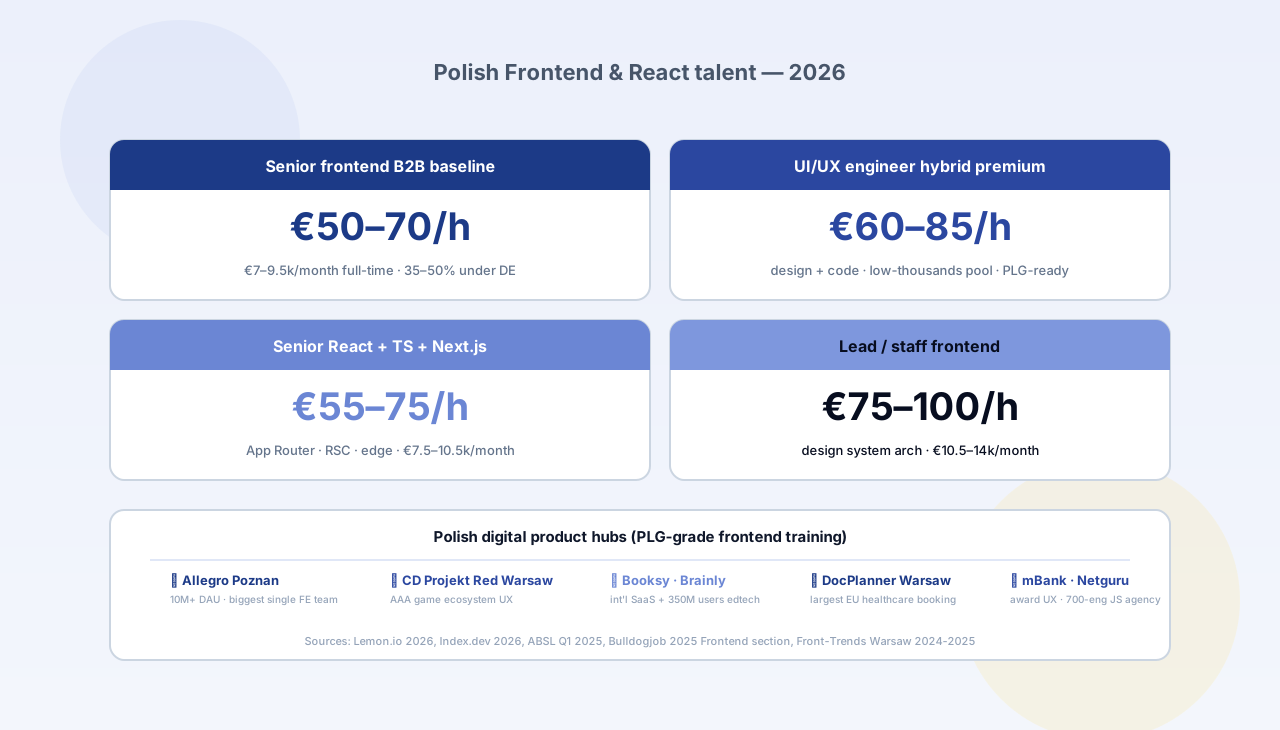
Senior Polish Frontend EUR 50-70/hour B2B in 2026 — at general senior frontend baseline (no scarcity premium because supply is deep). Senior React + TypeScript + Next.js EUR 55-75/h. UI/UX engineer hybrid EUR 60-85/h (specialty premium). Lead / staff EUR 75-100/h.
The frontend rate stack:
Senior Frontend B2B hourly rates (2026):
- Junior frontend engineer (1-3 yrs): EUR 28-42/hour
- Mid frontend engineer (3-5 yrs): EUR 38-55/hour
- Senior frontend engineer (5-8 yrs): EUR 50-70/hour
- Senior React + TypeScript + Next.js: EUR 55-75/hour
- Senior React Native (mobile crossover): EUR 60-80/hour
- Senior UI/UX engineer (design + code): EUR 60-85/hour
- Senior with design system + motion specialty: EUR 65-90/hour
- Senior with WebGL / 3D / canvas specialty: EUR 70-95/hour
- Lead / staff frontend: EUR 75-100/hour
- Principal frontend architect: EUR 90-115/hour
Translated monthly:
- Senior frontend full-time B2B: EUR 7,000-9,500/month gross
- Senior React + TypeScript: EUR 7,500-10,500/month
- Senior UI/UX engineer hybrid: EUR 8,500-12,000/month
- Senior with design system + motion: EUR 9,000-12,500/month
- Lead / staff: EUR 10,500-14,000/month
Why frontend baseline is at general backend level (not premium):
Frontend has the second-deepest Polish supply after Java (JS/TS bootcamp explosion 2018-2024 trained tens of thousands of mid-to-senior frontend engineers). The market premium therefore is at general senior baseline rather than specialty-driven. The premium signals foreign employers actually pay for: TypeScript fluency at senior level, Next.js depth (App Router, RSC, edge deployment fluency), design system architecture experience (Allegro/CD Projekt/Brainly alumni signal), motion / animation specialty (Framer Motion, Lottie, GSAP), WebGL / 3D / canvas specialty (rare specialty, gaming/visualization premium).
For comparison context:
- Lemon.io 2026 Polish rate calculator — broadly aligns with these ranges
- Index.dev European Developer Hourly Rates 2026 — Polish senior frontend baseline matches
- Bytefront 2025 Stundensatz guide — German senior frontend EUR 90-130/hour, Polish 35-50% cheaper
For German foreign employers specifically, Polish frontend saves roughly 35-45% on fully-loaded cost for comparable seniority — and the time-zone parity (CET) means same-day design review and pair programming with London/Berlin/Amsterdam product teams without async overhead.
Hiring Polish specialists for remote roles?
HiddenJobs is a verified job board and matching service for international companies recruiting Polish remote talent.
What frontend frameworks and stacks do Polish engineers cover?
React dominant in Polish pool, TypeScript universal at senior level (~95%), Next.js growing fast, Vue secondary, Angular legacy enterprise/banking. Tailwind CSS in ~70% of senior listings. Vite dominant for new projects.
The stack landscape for Polish frontend in 2026:
Frameworks (sub-pool depth in order):
- React — dominant. Vast majority of senior Polish frontend engineers have 5+ years of production React. Functional components + hooks universal at senior level.
- Next.js — growing fast. App Router + React Server Components + edge deployment fluency in modern teams. Particularly strong at Polish digital product companies.
- Vue — secondary, smaller pool. Common in DACH-leaning teams (German Vue community is strong, Polish Vue follows). Vue 3 + Composition API at senior level.
- Angular — legacy enterprise / banking. Comarch product lines, financial services internal apps, some banking teams. AngularJS (1.x) very legacy.
- Svelte / SvelteKit — niche but growing. Strong fan community, smaller production deployment.
- Solid / Qwik / Astro — niche specialty for content-heavy or interactive sites.
- Remix — small but present, especially among Vercel-leaning teams.
JavaScript runtimes / tooling:
- TypeScript — universal at senior level (~95% of senior frontend listings require it).
- Vite — dominant for new projects (replaced Create React App, Webpack).
- Webpack — legacy, still common in long-lived projects.
- esbuild / SWC — under-the-hood adoption.
- Turbopack — growing in Next.js teams.
State management:
- TanStack Query / SWR — universal for server state (replacing redundant Redux usage).
- Redux Toolkit — current Redux pattern, common in established teams.
- Zustand — growing fast for client state, lightweight alternative.
- Jotai / Recoil / Valtio — atomic state management, niche but present.
- MobX — legacy, declining.
- Context API — universal for app-wide state slices.
- URL state (React Router / nuqs) — growing emphasis on URL as source of truth.
Styling:
- Tailwind CSS — dominant (~70% of senior listings), both v3 and v4.
- CSS Modules — common.
- CSS-in-JS (styled-components, Emotion) — declining (RSC compatibility issues drove decline).
- Vanilla CSS / Sass — legacy.
- Vanilla Extract / Panda CSS — niche modern alternative.
- Stitches — declining.
Component libraries:
- Radix UI + shadcn/ui — growing fast in Tailwind teams.
- Headless UI — common in Tailwind teams.
- Material UI (MUI) — legacy, still common.
- Chakra UI — still active.
- Ant Design — declining.
- Polish team internal design systems — Allegro Allegro UI, Brainly Brainly UI, CD Projekt internal design systems all influential references.
Testing:
- Jest — universal.
- Testing Library (
@testing-library/react) — universal for React. - Vitest — growing for Vite-based projects.
- Playwright — winning e2e (replaced Cypress in many teams).
- Cypress — still common, declining.
- Storybook — universal for component-driven development.
- Chromatic — visual regression in Storybook teams.
Mobile:
- React Native — common in mobile-leaning teams. Strong overlap with Polish mobile pool.
- Expo — dominant React Native tooling.
- Capacitor / Ionic — niche for hybrid apps.
Polish senior frontend typical CV:
A senior Polish frontend engineer in 2026 typically has: 5+ years of production React, TypeScript fluent, Tailwind CSS experience, Vite + Webpack exposure, TanStack Query / SWR for server state, Storybook + Playwright test discipline, Next.js App Router exposure (especially in modern teams). Variation is in framework specialty depth (React vs Vue vs Angular ratio) and design system experience.
How deep is the Polish UI/UX engineer pool?
The Polish UI/UX engineer pool — engineers who do both UI implementation and UX design with strong Figma + React fluency — is one of the most desirable specialty corners for foreign product employers. Estimated low thousands of senior practitioners (vs tens of thousands for pure frontend).
The UI/UX engineer landscape:
What "UI/UX engineer" means in 2026:
A UI/UX engineer combines:
- Implementation fluency — React/Vue/Svelte production code, TypeScript, design system architecture
- Design fluency — Figma to production-ready level (Auto Layout, components, design tokens, prototyping with Figma Variables)
- Product thinking — A/B testing, conversion optimization, user research methodology
- Motion / micro-interaction sensibility — Framer Motion, Lottie, GSAP, native CSS transitions/animations
- Accessibility discipline — WCAG 2.2 AA at minimum, semantic HTML, focus management, ARIA labeling, keyboard navigation
Three sources train Polish UI/UX engineers:
1. International design-led companies in Poland
- Booksy product team — international booking platform with strong product UX, Polish team
- Brainly UX team — 350M+ users edtech, design system + frontend integration
- DocPlanner / ZnanyLekarz UX Warsaw — multi-language European healthcare booking
- Allegro UX Poznan — Polish e-commerce design system platform
- mBank UX Warsaw — award-winning mobile-first banking UX
- CD Projekt Red Warsaw — game launcher and ecosystem UX
- Synerise UX Krakow — AI/ML platform with strong UX
2. Polish design + code agencies
- Hype4 Warsaw — design-led agency with strong code capability
- Netguru Warsaw + Wroclaw studios — UX practice with senior code integration
- 10Clouds Warsaw — UX practice within full-stack agency
- EL Passion Warsaw — design + code agency
- Brainhub Gliwice — TypeScript-leaning with UX integration
- The Software House Gliwice — design + code crossover
3. University + design school crossover
- School of Form Poznan (under SWPS University) — design-led education with code electives, strongest single Polish design school for code+design hybrid
- Academy of Fine Arts Warsaw — design-leaning graduates with bootcamp code
- AGH University Krakow — strong design electives within CS programs
- Warsaw University of Technology HCI specialization — Human-Computer Interaction focus
- Polish design conferences — UX Poland Warsaw, World Usability Day Krakow, ConcatJS
UI/UX engineer specialty premium:
- Pure frontend senior: EUR 50-70/hour B2B
- UI/UX engineer hybrid senior: EUR 60-85/hour B2B
- UI/UX engineer with design system + motion specialty: EUR 70-95/hour B2B
The specialty premium (20-30% over pure frontend baseline) reflects the smaller pool size — possibly 5-10% of pure frontend population. Foreign product employers building product-led growth (PLG) startups especially value this profile because:
- Compresses design-to-implementation cycle — eliminates handoff overhead
- Improves product quality — engineers who design build with conversion / accessibility in mind
- Enables fast experimentation — A/B testing iterations don't bottleneck on design
- Better design system stewardship — engineers who design maintain design system better
For a foreign employer hiring Polish frontend for the first time, screening for UI/UX engineer hybrid candidates — especially from Allegro / Booksy / Brainly / DocPlanner / mBank alumni networks — is high-leverage.
Where does Polish frontend talent concentrate?
Heavy concentration in Warsaw + Krakow + Wroclaw + Tri-City Gdansk + Poznan, with meaningful Lodz UX studio cluster. Warsaw is the digital product epicenter. Poznan has Allegro main HQ as the single largest frontend platform team.
City-by-city breakdown:
Warsaw — digital product epicenter:
- DocPlanner / ZnanyLekarz Warsaw — largest healthcare booking in Europe
- mBank Warsaw — mobile-first banking, award-winning UX
- CD Projekt Red Warsaw — game studio digital ecosystem
- Synerise (Warsaw + Krakow split)
- Polish design agencies — Hype4, Netguru Warsaw studio, 10Clouds Warsaw, EL Passion
- Goldman Sachs Tech Warsaw — internal trading UI
- JP Morgan Tech Warsaw — internal financial UI
- Spotify Warsaw — smaller team
- Booksy product (Polish team)
Krakow — design + code hybrid hub:
- CD Projekt Red Krakow secondary studio
- Comarch frontend product lines
- Cisco Krakow product UX teams
- AGH University design+code graduate pipeline
- HSBC Operations Krakow — banking UI
- Capgemini Krakow frontend practice
- Polish design agencies — smaller branches of Warsaw firms
Wroclaw — banking + automotive UI:
- Volvo IT Wroclaw (~3,000 engineers) — Java-heavy automotive software with frontend teams
- Credit Suisse / UBS Operations Wroclaw — banking UI
- Capgemini Wroclaw frontend practice
- Netguru Wroclaw studio (largest Netguru office)
- Wroclaw University design + code crossover
Poznan — Allegro main HQ:
- Allegro Poznan — largest single Polish frontend platform team (10M+ DAU e-commerce). Anchor employer for Polish frontend at scale.
- School of Form Poznan — strongest single Polish design school for code+design hybrid
- Volkswagen IT Poznan — automotive frontend
- Roche IT Poznan — pharmaceutical frontend
- Poznan University of Technology — strong link to Allegro
Tri-City Gdansk:
- Schibsted Tri-City — media product UX
- Smaller Polish design agencies
- Intel R&D — some frontend
Lodz — UX studio cluster:
- Citi Tech Lodz Operations — internal UI teams
- Lodz design agency cluster — surprisingly strong UX studio scene (Lodz Film School design-thinking spillover)
- Smaller Polish design agencies
Tier 2 cities (Rzeszow, Lublin, Bydgoszcz, Szczecin, Katowice, Gliwice):
- Gliwice — Brainhub HQ, The Software House HQ (strong frontend agencies)
- Rzeszow — Asseco frontend at financial services products
- Katowice / Silesia — some design agencies, smaller pool
For foreign employers, sourcing from Warsaw + Krakow + Wroclaw + Poznan covers ~85% of the senior Polish frontend pool. For specialty needs (UI/UX engineer hybrid, design system architecture, motion specialty), targeted Polish digital product alumni outreach (Allegro / Booksy / Brainly / DocPlanner / mBank / CD Projekt) is high-leverage.
What Polish companies employ the strongest frontend engineers?
Three buckets: Polish digital product companies running large frontend platforms (Allegro, CD Projekt, Booksy, Brainly, DocPlanner, mBank), Polish design + code agencies (Netguru, 10Clouds, Hype4, EL Passion, Brainhub, The Software House), and international employers running frontend in Poland (Cisco, Goldman Sachs Tech, Spotify, Microsoft).
The three buckets:
Bucket 1: Polish digital product companies running large frontend platforms
- Allegro Poznan — anchor employer, ~10M+ DAU e-commerce, deep React + TypeScript platform with internal design system
- CD Projekt Red Warsaw — game launcher and ecosystem UX at AAA scale
- Booksy — international booking platform, strong product UX (Polish team headquartered in Warsaw)
- Brainly — edtech with 350M+ users globally, deep React platform
- DocPlanner / ZnanyLekarz Warsaw — largest healthcare booking platform in Europe, multi-language React
- mBank Warsaw — mobile-first Polish banking with award-winning UX
- Synerise — AI/ML platform with strong UX
- Polish startups exited internationally — Estimote, Brainly, Booksy, DocPlanner all building global frontend
- CD Projekt broader (beyond Red) — GOG.com platform UI
- Polish gaming studios — Techland (Dying Light), 11 bit studios, People Can Fly all with strong UI/UX teams
- PRACUJ.pl — Polish recruitment market leader, large React platform
- OLX Polish — classifieds platform, large React team
For foreign product employers, candidates with 2+ years at these Polish digital product companies bring product-led growth thinking, A/B testing maturity, and design system fluency that transfer directly.
Bucket 2: Polish design + code agencies
- Netguru — largest Polish JavaScript consultancy (~700 engineers across Wroclaw, Warsaw, Poznan), strong UX practice
- 10Clouds Warsaw (~250 engineers) — design + code agency with senior frontend depth
- Hype4 Warsaw — design-led with strong code capability
- EL Passion Warsaw — design + code agency
- Brainhub Gliwice — TypeScript-leaning, frontend specialty
- The Software House Gliwice — design + code crossover
- STX Next Poznan — Python-heavy but strong frontend practice
- Future Processing Gliwice — Java-heavy but with frontend teams
- Netguru subsidiaries / spin-offs
These agencies attract senior frontend engineers who prefer client variety over single-employer depth. Engineers rotating out for direct foreign-employer engagements bring cross-domain experience plus exposure to many design system patterns.
Bucket 3: International employers running frontend in Poland
- Cisco Krakow — product UX teams within larger engineering org
- Goldman Sachs Tech Warsaw — internal trading UI (specialty financial UI)
- JP Morgan Tech Polish — internal financial UI
- Citi Tech Polish — internal banking UI
- Spotify Warsaw — smaller team
- Microsoft Polish — small frontend presence
- Adobe Polish — small UX research team
- Volvo IT Wroclaw — automotive software frontend
For foreign employers, candidates from international employer hubs in Poland bring mature engineering practices but less product-led growth exposure than Polish digital product company alumni.
How do you screen a Polish frontend/React candidate?
Four screens stack: React internals depth, state management trade-offs, accessibility plus performance optimization, foreign-employer comfort signal with PR review test.
The four-screen protocol:
1. React internals depth
Pick a React internals scenario and ask the candidate to walk through mechanics. Examples:
- "Walk me through what happens between setState() being called and the DOM updating, including reconciliation and the commit phase."
- "When does useEffect run vs useLayoutEffect — and why does Strict Mode run effects twice?"
- "Explain the practical difference between useMemo and useCallback — when does the cost outweigh the benefit?"
- "What's a stale closure, when does it bite, and how do you avoid it?"
Strong candidates engage with concrete React mechanics (Fiber tree, lanes, batching, effects vs commits, Strict Mode side effects, server components vs client components in Next.js) and named pitfalls (stale closures, dependency arrays, useEffect timing, useMemo cost vs benefit, prop drilling vs context vs state libraries). Weak candidates list concepts without operational context.
2. State management trade-offs
Pick a state management scenario and ask the candidate to walk through trade-offs. Examples:
- "When would you choose Zustand vs TanStack Query vs Redux Toolkit vs URL state vs server-driven UI for a particular feature?"
- "We have a complex multi-step form with conditional fields and 30+ inputs. Walk me through your state architecture choice."
- "How would you handle optimistic updates with rollback for a chat application?"
- "What's the trade-off between server-driven UI vs client-side rendering for an admin dashboard with 50+ views?"
Strong candidates discuss server state vs client state distinction, optimistic updates, cache invalidation, derived state, single-source-of-truth pitfalls, URL as state for shareability, with specific named libraries and concrete architecture choices.
3. Accessibility + performance optimization
Pick a performance + accessibility scenario:
- "A page renders 2,000 list items and is janky on mid-range Android. Walk me through optimization."
- "An autocomplete dropdown has 500 options — implement it accessibly and performantly."
- "Initial page load is 3.5s on slow 3G. What do you check first?"
- "Walk me through making a modal component fully accessible — focus management, ARIA, keyboard navigation, screen reader announcements."
Strong candidates discuss virtualization (react-window, react-virtual), key strategies, list memoization, lazy loading, intersection observer, code splitting, bundle analysis, image optimization (Next.js Image, AVIF/WebP), Core Web Vitals (LCP, INP, CLS) — plus accessibility implications throughout.
4. Foreign-employer comfort signal + PR review test
Ask about prior international product company experience. Specifically:
- Allegro / CD Projekt / Booksy / Brainly / DocPlanner / mBank / Synerise — Polish digital product alumni?
- Polish design agencies (Netguru, 10Clouds, Hype4, EL Passion) — agency client variety?
- Active conference involvement (Front-Trends Warsaw, ReactiveConf, JS Poland, Wro.js)?
- Open-source frontend contributions, design system work, or active blog/Twitter presence?
Combine with a written PR review test: send the candidate a 50-line component PR (typical day-to-day frontend code) and ask for thoughtful 200-word feedback. Look for: code quality observations, accessibility gaps spotted, performance considerations, naming and architecture suggestions, and tone of feedback (constructive without being harsh).
Candidates with 2+ years at Polish digital product companies ramp 3-4x faster on foreign product employer engagements.
Where do you find Polish frontend engineers open to remote foreign-employer roles?
Three channels in parallel: curated foreign-only Polish IT job boards, large Polish IT job boards with frontend filters, and Polish frontend-specific communities. Plus LinkedIn outbound to alumni of Polish digital product companies.
Channel mix for Polish frontend hiring:
1. Curated foreign-only Polish IT job boards
- HiddenJobs.eu — verified foreign-employer listings, Frontend/React category tagging, contract path indicated upfront
2. Large Polish IT job boards with frontend filters
Polish frontend listings second only to Java in volume:
- Bulldogjob — dedicated Frontend section + annual Frontend salary survey (high candidate flow)
- NoFluffJobs — Frontend category with strong filter by framework (React/Vue/Angular), TypeScript yes/no, seniority
- JustJoin.it — Frontend filter with stack breakdown and remote/hybrid filters
- Pracuj.pl — broader Polish job board with strong frontend IT category
- theProtocol.it — Polish IT-focused job board
- inhire.io — invite-only Polish IT marketplace, strong senior frontend pool
3. Polish frontend-specific communities
The Polish frontend community is large and active:
- Warsaw JavaScript User Group — largest Polish JS meetup, monthly
- Krakow JavaScript Users Group — active monthly
- Wro.js Wroclaw — Wroclaw JS community, annual conference
- Tri-City JS — Gdansk/Sopot/Gdynia JS community
- Front-Trends Warsaw — annual flagship Polish frontend conference (~1,500 attendees)
- JS Poland — annual conference
- ReactiveConf Krakow — international React conference Polish edition
- Wro.js Conf — Wroclaw JS conference
- UX Poland Warsaw — UX-leaning conference
- World Usability Day Krakow — UX community event
- Polish React Slack communities — multiple active channels
4. LinkedIn outbound to Polish digital product alumni
Targeting alumni networks for senior frontend:
- "Allegro alumni" — broadest Polish digital product pool (e-commerce platform scale)
- "CD Projekt Red alumni" — game UX at scale
- "Booksy alumni" — international booking platform
- "Brainly alumni" — global edtech platform
- "DocPlanner / ZnanyLekarz alumni" — multi-language European healthcare
- "mBank UX alumni" — award-winning banking UX
- "Synerise alumni" — AI/ML platform UX
- "Netguru alumni" — largest Polish JS consultancy alumni
- "Polish gaming studio alumni" (CD Projekt, Techland, 11 bit studios, People Can Fly)
Concrete openers (specific role + framework + TypeScript yes/no + monthly EUR rate range + time-zone + product domain) get 5-10x the response rate of generic templates.
To list a verified senior Polish frontend role on HiddenJobs.eu, send the brief to hiddenjobs.eu — role title with frontend specialty (React + TypeScript / Next.js / UI/UX engineer hybrid / design system architecture / motion specialty), stack expectations, contract path (B2B or EOR), monthly EUR rate range, and one paragraph about your product context. Response within a day or two.
Where this guide goes from here
Polish frontend and React talent is one of the deepest specialty pools in Eastern Europe in 2026 — second only to Java in volume — with a high-value UI/UX engineer hybrid sub-pool that compresses design-to-implementation cycles for foreign product-led growth (PLG) startups.
For deeper guides on this site:
- Java enterprise companion guide — the Java & Spring hiring guide covers Polish enterprise Java pool
- DevOps companion guide — the DevOps & cloud hiring guide covers Polish DevOps specialty
- AI/ML companion guide — the AI/ML hiring guide covers Polish AI/ML specialty
- General Polish IT hiring — the pillar guide covers all three contract paths
- Cost overview — the cost guide covers national cost stack
- City breakdown — the city salary guide covers per-city benchmarks (frontend follows similar pattern with Poznan deepest single platform team due to Allegro)
- B2B contract operational — the B2B contract guide covers JDG mechanics and the July 2026 reform
The short version of Polish frontend hiring 2026: second-deepest specialty pool in Eastern Europe, senior B2B EUR 50-70/hour (general baseline because supply is deep), React + TypeScript + Next.js EUR 55-75/h, UI/UX engineer hybrid premium EUR 60-85/h (smaller pool, higher value for PLG product employers), time-to-hire 2-5 weeks for senior with foreign-employer-relevant experience, Polish digital product company alumni (Allegro, CD Projekt, Booksy, Brainly, DocPlanner, mBank) bring product-led growth thinking that transfers directly to foreign product employers.
To list a verified Polish frontend role on HiddenJobs.eu, send the brief to hiddenjobs.eu or get in touch directly. Response within a day or two.
Frequently asked questions
Is Poland strong on frontend and React engineering in 2026?
Yes — Poland has one of Eastern Europe's deepest frontend engineering pools, anchored by product-grade engineering at international-scale Polish digital companies. Three structural drivers stack. First, Polish digital product success: Allegro (10M+ DAU e-commerce, deep frontend platform), CD Projekt Red (game UX at AAA scale), Booksy (international booking platform), Brainly (350M+ users edtech), mBank (mobile-first Polish banking with award-winning UX), Polish startups exited internationally (Estimote, Synerise, DocPlanner). Second, JavaScript/TypeScript bootcamp explosion 2018-2024 trained tens of thousands of mid-to-senior frontend engineers. Third, Polish technical universities and design schools (especially School of Form Poznan, Academy of Fine Arts Warsaw) feed the UI/UX engineer hybrid pool. Aggregate senior Polish frontend pool sits in the tens of thousands — second-deepest specialty after Java.
What do Polish frontend and React engineers cost on B2B in 2026?
Senior Polish frontend engineers run EUR 50-70/hour B2B in 2026 — at general senior frontend baseline (per Lemon.io 2026 and Index.dev 2026). Translated monthly: senior frontend full-time B2B EUR 7,000-9,500 gross. Senior React specialist with TypeScript and Next.js fluency runs EUR 55-75/hour. Senior React Native (mobile crossover) EUR 60-80/hour. Senior UI/UX engineer (design + code) EUR 60-85/hour — meaningful premium because pool is smaller than pure frontend. Lead / staff frontend EUR 75-100/hour. Senior with design system + motion specialty (Framer Motion, Lottie, advanced animation) EUR 65-90/hour. Compared to German seniors (EUR 90-130/hour per Bytefront 2025), Polish frontend saves you 35-50% for comparable seniority — and time-zone parity (CET) means same-day design review with London/Berlin/Amsterdam product teams.
What frontend frameworks and stacks do Polish engineers cover?
Strongest 2026 frontend frameworks in Polish pool: React dominant (vast majority of senior pool has 5+ years production React), TypeScript universal at senior level (~95% of senior frontend listings require TypeScript), Next.js growing fast (especially among newer microservices teams and Polish digital products), Vue secondary (smaller pool, often DACH-leaning teams), Angular legacy enterprise / banking (Comarch product lines, financial services). Build tools: Vite dominant for new projects, Webpack legacy still common. State management: Redux legacy / Redux Toolkit current, Zustand growing fast, TanStack Query / SWR universal for server state, Jotai / Recoil niche. Styling: Tailwind CSS dominant (~70% of senior listings), CSS-in-JS (styled-components, Emotion) declining, CSS Modules common, vanilla CSS / Sass legacy. Testing: Jest universal, Testing Library universal for React, Cypress / Playwright for e2e (Playwright winning). Component libraries: Radix UI + shadcn/ui growing fast, Material UI legacy, Headless UI common in Tailwind teams. Mobile: React Native common in mobile-leaning teams. Polish senior frontend typical CV: React + TypeScript + Tailwind + Vite + TanStack Query + Playwright.
How deep is the Polish UI/UX engineer pool?
The Polish UI/UX engineer pool — engineers who do both UI implementation and UX design with strong tooling fluency in Figma plus React or Vue — is one of the most desirable specialty corners for foreign product employers. Estimated pool size: low thousands of senior practitioners, vs tens of thousands for pure frontend. Three sources train Polish UI/UX engineers: international design-led companies in Poland (Booksy product team, Brainly UX team, DocPlanner / ZnanyLekarz UX, Allegro UX), Polish design agencies with code capability (Hype4, Netguru UX practice, 10Clouds UX, EL Passion UX, Brainhub UX), and university+code crossover (School of Form Poznan plus self-taught code, Academy of Fine Arts Warsaw plus bootcamp, AGH Krakow with strong design electives). UI/UX engineer specialty premium: EUR 60-85/hour B2B vs EUR 50-70/hour for pure frontend. Foreign employers building product-led growth (PLG) startups especially value this profile because it compresses design-to-implementation cycle dramatically.
Where does Polish frontend talent concentrate?
Heavy concentration in Warsaw + Krakow + Wroclaw + Tri-City Gdansk + Poznan, with meaningful Lodz UX studio cluster. Warsaw is the digital product epicenter: Allegro / Synerise / DocPlanner UX teams, mBank mobile UX, Polish design agencies (Hype4, Netguru Warsaw studio), Booksy product (Polish team). Krakow has CD Projekt Red game UX, Comarch frontend product lines, Cisco frontend teams, AGH University design+code graduate pipeline, Polish digital product companies. Wroclaw has Volvo IT (~3000 engineers including frontend), Capgemini frontend practice, Credit Suisse / UBS Operations UI teams, plus design schools. Tri-City Gdansk has Schibsted media product, smaller agencies. Poznan has Allegro Poznan main HQ (largest single frontend hub at scale), School of Form Poznan + AGH Krakow as the two leading design+code hybrid talent pipelines, Volkswagen IT frontend teams. Lodz has surprisingly strong UX agency cluster (Lodz Film School influences design-thinking-leaning UX practice). Tier 2 cities have isolated frontend talent at Asseco subsidiaries and consultancies.
What Polish companies employ the strongest frontend engineers?
Three buckets in 2026. Polish digital product companies running large frontend platforms: Allegro Poznan (10M+ DAU e-commerce, deep React + TypeScript + design system platform), CD Projekt Red Warsaw (game launcher and ecosystem UX at AAA scale), Booksy (international booking platform with strong product UX), Brainly (350M+ users edtech with deep React platform), DocPlanner / ZnanyLekarz Warsaw (largest healthcare booking in Europe with React platform), mBank Warsaw (mobile-first banking with award-winning UX), Polish startups exited internationally (Estimote, Synerise, Brainly, Booksy, DocPlanner). Polish design + code agencies: Netguru Wroclaw (largest Polish JavaScript consultancy, ~700 engineers), 10Clouds Warsaw (~250 engineers), EL Passion Warsaw, Brainhub Gliwice (TypeScript-leaning), The Software House Gliwice, STX Next Poznan (Python-heavy but strong frontend practice), Future Processing Gliwice. International employers running frontend in Poland: Cisco Krakow (product UX teams), Goldman Sachs Tech Warsaw (internal trading UI), Spotify Warsaw (smaller team), Microsoft Polish, Adobe Polish (small UX research team). Senior candidates from Polish digital product companies bring product-led growth thinking that transfers directly to foreign product employers.
How do you screen a Polish frontend/React candidate for foreign-employer fit?
Run four screens. First, React internals depth: 'Walk me through what happens between setState() being called and the DOM updating, including reconciliation and the commit phase.' Strong candidates engage with concrete React mechanics (Fiber tree, lanes, batching, effects vs commits, Strict Mode side effects) and named pitfalls (stale closures, dependency arrays, useEffect timing, useMemo cost vs benefit). Second, state management trade-offs: 'When would you choose Zustand vs TanStack Query vs Redux Toolkit vs URL state vs server-driven UI for a particular feature?' Strong candidates discuss concrete trade-offs — server state vs client state distinction, optimistic updates, cache invalidation, derived state, single-source-of-truth pitfalls. Third, accessibility + performance: 'A page renders 2,000 list items and is janky on mid-range Android. Walk me through optimization.' Strong candidates discuss virtualization (react-window, react-virtual), key strategies, list memoization, lazy loading, intersection observer, plus accessibility implications (focus management, ARIA labeling, keyboard navigation). Fourth, foreign-employer comfort: prior international product company experience (Allegro, CD Projekt, Booksy, Brainly, DocPlanner all count), plus written communication test (review a 50-line component PR and write a thoughtful 200-word feedback). Candidates with 2+ years at Polish digital product companies ramp 3-4x faster on foreign product engagements.
Where do you find Polish frontend engineers open to remote foreign-employer roles?
Three channels work in parallel for Polish frontend specialty. First, curated foreign-only Polish IT job boards (HiddenJobs.eu) with explicit Frontend/React category tagging. Second, large Polish IT job boards with frontend filters (Bulldogjob has dedicated Frontend section + annual Frontend salary survey, NoFluffJobs Frontend category with strong filter by framework, JustJoin.it Frontend filter — Polish frontend listings second only to Java in volume). Third, Polish frontend-specific communities — Warsaw JavaScript User Group (largest Polish JS meetup), Krakow JavaScript Users Group, Wroclaw JS, Tri-City JS, ReactiveConf Krakow / Warsaw, JS Poland conference, Front-Trends Warsaw (annual flagship Polish frontend conference, ~1500 attendees), Wro.js Wroclaw conference, plus Polish React Slack communities. Plus LinkedIn outbound to alumni of Polish digital product companies (Allegro alumni, CD Projekt alumni, Booksy alumni, Brainly alumni, DocPlanner alumni, mBank UX alumni) — concrete openers (specific role + framework + monthly EUR rate range + time-zone) get 5-10x the response rate of generic templates.
Editorial note
This guide cites named public sources for every concrete number: Lemon.io 2026 rate calculator (Poland) and Index.dev European Developer Hourly Rates 2026 for senior frontend B2B rates including specialty premium, ABSL Q1 2025 Sector in Numbers for Polish IT workforce, Bulldogjob IT Community Survey 2025 Frontend section for stack adoption rates, Front-Trends Warsaw 2024-2025 attendance for community size signal. Currency conversion ~$1.06 = €1, PLN/EUR ~4.27 (May 2026). Treat ranges as ranges — actual frontend rates vary by framework specialty depth (React vs Vue vs Angular), TypeScript fluency, design system experience, and individual negotiation. The post is informational and does not constitute legal, tax, or HR advice; consult a Polish IT-specialized recruiter before locking your offer band for a senior frontend hire.