Working with Polish Remote Developers: 2026 Operational Guide for Foreign Employers

You hired a senior Polish developer. The contract is signed. Their first day is next Monday. Now what? This guide covers the operational reality of working with Polish remote IT talent from a foreign-employer perspective — time zone, English fluency, engineering culture, communication style, public holidays, onboarding, and the recurring pitfalls.
The post assumes you've already made the hire decision and the contract path (B2B, EOR, or your own Polish entity). For those decisions, see the founder's guide to hiring Polish IT specialists, the Polish developer cost guide, and the B2B contract operational guide.
Hiring Polish specialists for remote roles?
HiddenJobs is a verified job board and matching service for international companies recruiting Polish remote talent.
Table of contents8 sections
What time zone do Polish developers work in, and how does it overlap with yours?
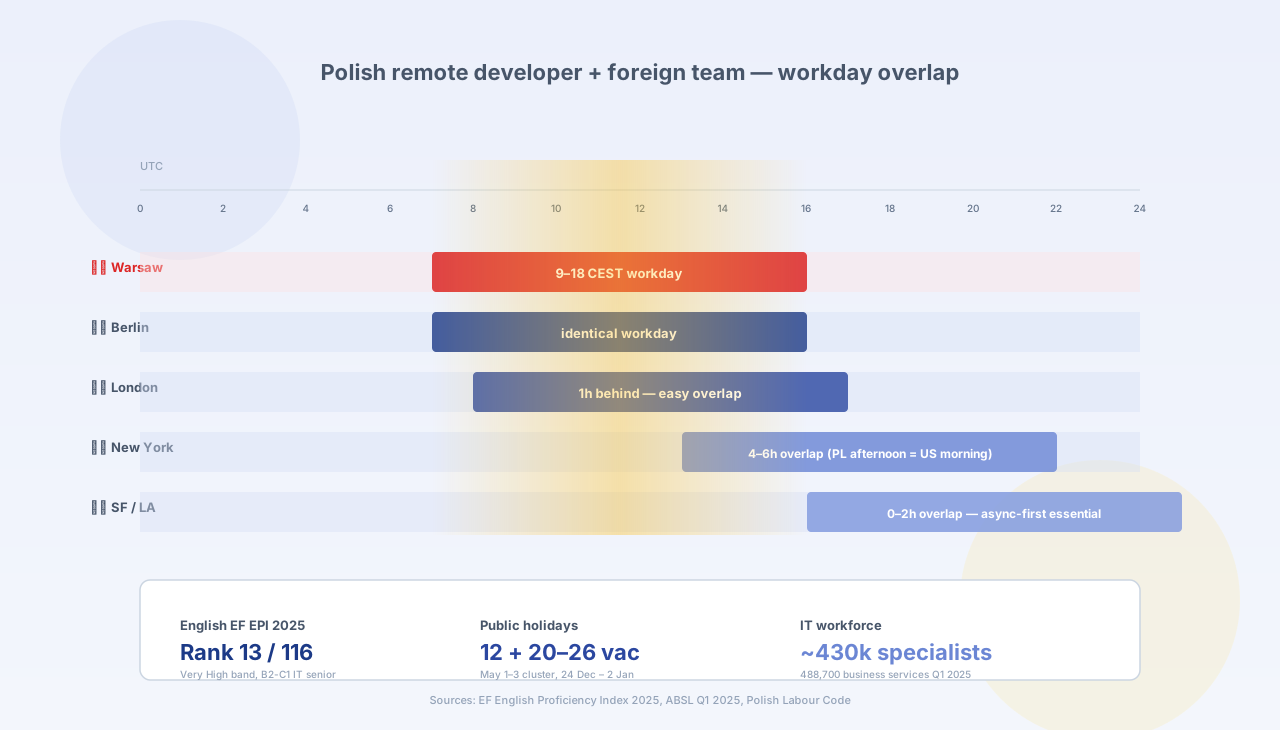
Poland sits in Central European Time (CET, UTC+1) in winter, CEST (UTC+2) in summer — identical to Germany, France, Netherlands, Belgium, Switzerland, Austria, and the Nordics. UK is 1h behind. US East Coast is 6h behind in winter, 5h in summer. US West Coast is 9h/8h behind.
The practical workday overlap matrix:
| Foreign team location | Overlap with Polish developer | Sync practicality |
|---|---|---|
| Berlin / Munich / Hamburg | Identical workday | Real-time pair-programming, daily standups, full sync workflow |
| Amsterdam / Rotterdam | Identical workday | Same as Germany |
| Stockholm / Oslo / Copenhagen | Identical workday | Same as Germany |
| London (winter) | 1h offset | Real-time overlap from London 9 AM = Warsaw 10 AM |
| Zurich / Vienna | Identical workday | Same as Germany |
| New York / Boston | 4-6h overlap (Polish afternoon = US morning) | Real-time standups + design reviews work; pair-programming benefits from concentrated overlap window |
| Toronto / Montreal | Same as New York | Same approach |
| San Francisco / LA / Seattle | 0-2h overlap (Polish early morning = US late afternoon) | Async-first essential; sync calls require trade-offs (Polish early or US late) |
For European foreign employers, the Polish developer's workday matches yours exactly. Code reviews submitted at 4 PM Berlin get reviewed by 5 PM by a Polish senior; the entire engineering rhythm runs identically. The "remote-first async-first" practices that originated in distributed teams across multiple time zones are optional, not required, for Poland-Europe pairings.
For US East Coast pairings, the overlap is concentrated in your morning and Polish afternoon — typically 9 AM-12 PM US East Coast = 3 PM-6 PM Polish. This window handles real-time work; outside of it, async takes over. Most US East Coast scale-ups working with Polish remote developers run a "core hours" pattern where the overlap window holds standups, planning, and sync work, with async filling the rest.
For US West Coast pairings, the overlap is brief — typically 9 AM-10 AM US West = 6 PM-7 PM Polish. Real-time sync work requires the Polish developer to extend their day or the US team to take very early calls. Async-first practices (decision logs, written kickoffs, recorded video updates) move from optional to essential.
The async-only constraint that applies to India (5h offset to Berlin), Latin America (5-7h offset), or Australia (8-10h offset) does not apply to Poland for European foreign employers. For US foreign employers, the async-first discipline that's common across remote-friendly companies (GitLab, Automattic, Buffer, etc.) translates well.
What English fluency can you expect from a Polish remote developer?
Poland ranks 13th of 116 countries on the EF English Proficiency Index 2025 — Very High band. In the Polish IT senior remote segment, B2-C1 is the dominant level. English is the de-facto working language of Polish tech.
The fluency picture across the Polish IT industry:
- Senior remote IT (working with foreign employers): B2-C1 majority, with a meaningful share at C2. Day-to-day communication is a non-issue.
- Mid-level IT (3-5 years experience): B2 majority, with senior-leaning candidates at C1. Strong written communication; speaking fluency varies.
- Junior IT (0-2 years): B1-B2 typical at university graduation, B2-C1 within 2 years of foreign-employer engagement. The gap closes fast under daily English exposure.
- Polish corporate IT (Polish company, Polish-only clients): lower aggregate fluency — but this segment doesn't typically end up on foreign-employer hiring shortlists.
City-level variation is mild for senior remote talent:
- Warsaw: largest Polish IT hub, deepest international employer presence, highest aggregate senior English fluency
- Krakow: second-largest IT hub, similar fluency profile to Warsaw, large international employer footprint (IBM, Google, Cisco, Motorola)
- Wrocław: third-largest, similar profile, strong German and Nordic foreign-employer presence
- Gdańsk / Tri-City: fourth-largest, similar senior fluency, strong maritime / oil and gas IT specialization
- Łódź / Poznań: smaller hubs, slightly less consistent fluency at junior-mid levels but senior remote talent matches Tier 1
The differentiation across cities is mild for senior remote candidates pre-screening as candidates for foreign-employer roles. The candidates who reach the screening stage have already self-selected by their willingness to work with international clients in English.
For technical writing specifically — design RFCs, post-mortems, architectural decision records — Polish senior IT delivers fluently. The cultural pattern is "write technical English well; speak conversational English with Polish accent" — the asymmetry rarely matters for engineering work. For client-facing roles where polished spoken English matters more than technical writing, screen in interviews accordingly.
How does Polish engineering culture differ from Western European or US norms?
Polish IT culture is direct, technically rigorous, and slightly more formal than the typical Bay Area startup norm. Senior Polish developers push back on ambiguous requirements, ask for clarification on technical trade-offs, and expect the foreign employer to have done some thinking before the kickoff call.
The cultural patterns that show up in Polish IT engagements:
Directness in technical discussions — Polish seniors will tell you if your architecture is wrong, if your API contract is fragile, or if your spec is missing edge cases. The directness is technical, not personal. American startup culture sometimes reads this as "blunt" or "negative" — recalibrate; it's quality assurance, not friction.
Code-review rigor — Polish technical universities (Politechnika Warszawska, AGH Krakow, Politechnika Wrocławska) emphasize correctness, edge cases, and theoretical foundations. This shows up in code reviews: thorough comments, named edge cases, suggestions on testing approach. Expect higher review depth than the US average; reciprocate.
Slight formality versus US startup norm — first-name basis is universal in Polish IT, but the overall communication tone is closer to "professional collaboration" than "casual chat." Slack messages tend toward complete sentences rather than fragments. Meetings start on time. The formality is not stiff — just calibrated.
Hierarchy flatter than corporate Polish, more present than US startups — Polish IT culture leans toward consensus on technical decisions but expects the engineering manager to make calls on priorities. The developer typically waits to be invited into product decisions rather than driving them unprompted. If you want a Polish senior to weigh in on a product question, ask explicitly.
Pair programming and async documentation strong — Polish IT culture has high tolerance for both synchronous pair work (extreme programming influence still detectable) and async written documentation (architectural decision records, RFCs). Engineering teams that lean heavily into either workflow get high engagement.
Cultural gap mapping versus your team:
- vs German engineering culture: small gap. Similar directness, similar rigor, similar respect for craft. Most German foreign employers report Polish onboarding as low-friction.
- vs Nordic cultures (Sweden, Norway, Denmark): small gap. Similar consensus-orientation, similar low formality without losing precision.
- vs Dutch culture: small gap. Similar directness, similar tolerance for honest feedback.
- vs UK culture: medium gap. Polish directness can feel "less polite" to British-cultural colleagues; recalibrate the politeness layer if needed.
- vs US Bay Area startup culture: medium gap. Polish IT culture has lower tolerance for vibes-driven product decisions and "we'll figure it out as we go" planning.
- vs US East Coast / Midwest corporate: smaller gap than Bay Area; Polish formality maps closer to East Coast professional norms.
None of these gaps are deal-breakers for senior Polish remote talent working with international employers — the candidates who reach senior remote roles have typically navigated these cultural differences before. The recalibration is on the foreign employer's side as much as on the developer's.
Hiring Polish specialists for remote roles?
HiddenJobs is a verified job board and matching service for international companies recruiting Polish remote talent.
What communication style works best with Polish developers?
Be direct, specific, and respectful of their time. Polish developers do well with concrete written specs and less well with vague verbal direction. Sync calls work for kickoffs, design reviews, and incident response; everything else benefits from written async.
The communication patterns that work:
Written specs over verbal direction — concrete written specifications (design docs, RFCs, well-formed Jira tickets with acceptance criteria) get high-quality work. Vague verbal direction ("yeah, just build something like X but better") gets clarification questions or partial output. Invest in spec-writing upfront.
Sync for decisions, async for everything else — sync calls work well for: kickoff meetings, architectural design reviews, sprint planning kickoffs, incident response, 1:1s. Async (Slack, written comments, RFCs) works well for: status updates, code reviews, design refinement, day-to-day questions. Default to async unless the conversation needs back-and-forth or carries decision weight.
Decision logs explicit, not implicit — Polish seniors expect the engineering manager to record decisions: "We chose X over Y because of Z, owner is N, deadline is D." Implicit decisions ("we sort of agreed on the call to do X") create ambiguity that surfaces 2 weeks later as scope friction.
Code reviews thorough in writing — Polish seniors leave detailed technical review comments and expect the same. Surface-level reviews ("LGTM") or comments-only-on-style miss the cultural beat. Engage technically on review comments; ask follow-up questions; iterate. This builds trust and reveals senior judgment.
Avoid:
- Micromanagement — Polish seniors with strong technical backgrounds bristle at being told how to implement something they've been hired to figure out. Direct on the what; let them choose the how.
- Daily check-in calls just for visibility — burns time, signals distrust, doesn't add value.
- Status meetings without decision agenda — Polish IT culture has low tolerance for meetings whose purpose is "alignment" without specific decisions on the table.
- High-context "read between the lines" communication — common in some US cultures, lands less well with Polish seniors. Be explicit.
Encouraged:
- Written kickoffs for any non-trivial work.
- Explicit decision logs with named owners.
- Structured 1:1s monthly (not weekly) covering blockers, growth, and longer-term context.
- Recorded async video updates for cross-team news that doesn't require synchronous discussion.
- Clear escalation paths for blockers — Polish seniors will surface blockers in writing if you give them a clear channel.
The communication style that works with Polish developers maps closely to what works with senior remote talent generally — the principles aren't Polish-specific. Polish IT culture just amplifies the cost of getting these wrong.
What Polish public holidays should be on your team calendar?
Twelve mandatory public holidays plus 20-26 days of paid vacation. The May 1-3 cluster and the 24 December - 2 January cluster disrupt release planning if ignored. Foreign employers running quarterly releases plan around them.
The Polish public holiday calendar:
| Date | Holiday | Pattern |
|---|---|---|
| 1 January | New Year's Day | Always |
| 6 January | Epiphany | Always |
| Easter Monday | Variable (March/April) | Always |
| 1 May | Labour Day | Always |
| 3 May | Constitution Day | Always |
| Pentecost Sunday + 1 day | Variable (May/June, 49 days after Easter) | Always |
| Corpus Christi | Variable (May/June, 60 days after Easter) | Always |
| 15 August | Assumption Day | Always |
| 1 November | All Saints' Day | Always |
| 11 November | Independence Day | Always |
| 25 December | Christmas Day | Always |
| 26 December | Boxing Day | Always |
Plus typical Polish IT-segment paid vacation: 20-26 days per year (varies by tenure and contract type — UoP employees get 20 days for first 10 years of work history, 26 days thereafter; B2B contractors negotiate vacation as part of the engagement).
Common Polish vacation patterns that affect foreign employers:
- May 1-3 cluster: Labour Day (1 May) and Constitution Day (3 May) bracket a "majówka" — the long weekend that most Polish IT teams take as a 5-9 day vacation. Plan releases for late May or April, not the May 1-3 stretch.
- Christmas + New Year cluster (24 Dec - 2 Jan): Polish IT teams typically operate at minimal capacity from Christmas Eve through New Year's Day. Foreign employers expect 2 weeks of reduced capacity here.
- Summer vacation (mid-July to mid-August): Polish IT culture takes 2-3 weeks of summer vacation, often clustered in late July or early August. Senior individual contributors often take a full month.
- Long weekends bridging mid-week holidays: Polish IT teams maximize "bridge days" — if a holiday falls on Tuesday, expect Monday off. If Thursday, expect Friday off.
Practical implications:
- Quarterly release calendar: avoid critical releases in early May, late December / early January.
- On-call rotation: ensure non-Polish team members cover the May 1-3 and 24 Dec - 2 Jan clusters; Polish on-call coverage during these periods is best-effort.
- Vacation approval policy for B2B contractors: B2B contractors don't have statutory vacation; specify in the contract that they communicate planned vacation 2-4 weeks ahead.
- Annual planning: build the Polish holiday calendar into your annual roadmap upfront. The pattern repeats every year; getting surprised is avoidable.
For comparison, Germany has 9-13 public holidays depending on Bundesland; France has 11; UK has 8; US federal has 11. Poland sits at the high end of European public holiday counts — match your planning accordingly.
How do you onboard a Polish remote developer effectively?
Treat onboarding identically to a domestic remote hire, with three Polish-specific additions: clear written welcome doc, kickoff call within 48 hours, Day 1 buddy pair with a senior IC. The first two weeks should yield merged code (small fixes, not the keystone PR) — Polish seniors don't want to be pampered through a "ramp-up" period.
The onboarding playbook that works:
Day -7 to Day 0 (pre-start preparation):
- Equipment shipped or budget approved (laptop, peripherals, ergonomic kit)
- SaaS tooling provisioned (GitHub, Slack, Linear, design tools, observability stack)
- Calendar invites for recurring meetings sent
- Welcome doc shared (covers team norms, communication channels, decision-making process, 90-day expectations)
- HR / contract paperwork completed and signed
Day 1 (first day on the engagement):
- 30-minute kickoff call with the engineering manager (welcome, team context, rough 90-day plan)
- Tooling check (can the developer access codebase, ticket tracker, CI, deploy infra)
- 30-minute pair with a senior IC (codebase tour, "here's how we ship a feature", "here's what's in production right now")
- Shipping their first small contribution by end of Day 2 — typo fix, dependency bump, small bug — to validate the full path from clone to deploy
Week 1:
- Daily 15-minute async check-in with engineering manager (what worked, what blocked, what's next)
- Buddy pair sessions on demand (2-3 per week typical)
- First small feature task assigned by end of Week 1, scoped for completion within Week 2-3
- First sprint planning meeting attended (introduces team's planning rhythm)
Week 2:
- First feature shipped to production (small, low-risk)
- First retrospective attended (introduces team's improvement rhythm)
- First 1:1 with engineering manager (60 minutes, broader context, growth, blockers)
Week 3-4:
- Larger feature or refactor task assigned
- Self-directed work begins to dominate over pair work
- First architectural design contribution (RFC or design doc on a small scope)
Beyond Week 4:
- Standard senior IC rhythm — 1-2 features per sprint, periodic design contributions, on-call rotation participation (where applicable)
Polish-specific onboarding nuances:
- Cultural expectation of clarity: Polish seniors expect the kickoff call to cover concrete information (tech stack walkthrough, current production state, 90-day priorities). A vague "welcome aboard, we'll figure out priorities together" lands less well.
- Equipment and SaaS provisioning before Day 1 is not optional: a Day 1 spent waiting for laptop or SaaS access burns cultural capital fast. Provisioning delays that are tolerable in some US startups erode trust quickly.
- Public holidays and time-off: clarify the company's vacation policy upfront, especially how it interacts with Polish public holidays.
- First-name basis explicit: the foreign employer team should adopt first-name basis from Day 1; the Polish developer will follow.
The first two weeks should yield merged code. Polish seniors don't want a 4-week ramp-up of meetings and reading. The pattern that works: small contributions early, growing scope by Week 3-4, full senior productivity by Week 6-8.
What are the most common foreign-employer pitfalls with Polish teams?
Five recurring pitfalls. None are deal-breakers; planning around them removes most friction.
The five patterns that cause friction:
1. Over-scheduling sync calls
Polish developers handle async work well — code reviews, written specs, asynchronous design refinement. Foreign employers, especially US-based, default to "let's hop on a call" reflexively. Each unnecessary sync call erodes trust ("they don't trust me to figure it out") and wastes time. Default to async unless the call has clear decision agenda.
2. Vague written specs
"Build the dashboard" or "improve the API" lose Polish seniors quickly. Concrete specs with acceptance criteria, edge cases enumerated, decision points named, deadline specified, get high-quality work. Investment in spec-writing pays back 3-5x in execution quality.
3. Holiday blindness
The May 1-3 and 24 December - 2 January clusters bite repeatedly. Foreign employers running quarterly release calendars plan around them; new foreign employers learn the hard way. Add the Polish public holiday calendar to your team calendar upfront.
4. "Just a contractor" mindset for B2B hires
Polish seniors on B2B want context — why this feature, who the customer is, how the metric moves. Treating them as task-execution machines without product context produces correct code but misses the senior-IC value (design judgment, edge-case identification, simplification suggestions). Share product and business context generously; the cost is low and the upside is significant.
5. Surprise scope creep
B2B contracts are scope-bounded. If you need the developer to expand into operational support, DevOps coverage, or project-management work outside the original scope, renegotiate the contract first. Surprise scope expansion ("hey, can you also handle this thing?") creates contract-vs-relationship friction. Most Polish seniors will say yes once or twice but resist if the pattern continues.
Each pitfall is avoidable. The difference between a smooth Polish remote engagement and one with friction is rarely cultural; it's usually operational discipline on the foreign-employer side.
Where do you go from here?
Working with Polish remote developers is operationally low-friction once you've built around the time zone, cultural directness, public holiday calendar, and async-first communication discipline. The first 90 days set the rhythm for the next 18-24 months.
For deeper guides on this site:
- Hiring decision — the founder's guide to hiring Polish IT specialists covers contract path selection (B2B, EOR, own entity)
- Cost detail — the Polish developer cost guide breaks down direct-hire economics
- B2B contract operational — the B2B contract guide covers JDG mechanics, payment flow, and the July 2026 PIP reform
- Country comparison — the Eastern Europe comparison covers when an alternative country fits better
- Outsourcing alternative — the outsourcing guide covers vendor-led delivery models
The short version of working with Polish remote developers: operationally low-friction for European foreign employers (identical time zone, strong English, similar engineering culture), mid-friction for US East Coast (4-6h overlap requires concentrated sync windows), higher-friction for US West Coast (async-first essential). Across all geographies, the patterns that work map closely to what works with senior remote talent generally — Polish IT culture just amplifies the cost of getting onboarding, communication, and holiday planning wrong.
To list a verified Polish role on HiddenJobs.eu, send the brief to hiddenjobs.eu or get in touch directly. Response within a day or two.
Frequently asked questions
What time zone do Polish developers work in?
Poland sits in Central European Time (CET, UTC+1) in winter and Central European Summer Time (CEST, UTC+2) in summer. This is identical to Germany, France, Netherlands, Belgium, Switzerland, Austria, and the Nordics. UK is one hour behind (GMT/BST). US East Coast is six hours behind in winter, five in summer; US West Coast is nine/eight hours behind. For European foreign employers, the Polish developer's workday matches yours exactly — 9 AM Berlin equals 9 AM Warsaw. For US East Coast pairings, real-time overlap is 4-6 hours daily (Polish afternoon = US morning). For US West Coast, the overlap is shorter (Polish morning briefly = US late evening), so async-first practices matter.
What English fluency can I expect from a Polish remote developer?
Poland ranks 13th of 116 countries on the EF English Proficiency Index 2025 — Very High band. In the Polish IT segment, B2-C1 is the dominant level for senior remote talent working with foreign employers. English is the de-facto working language of the Polish tech industry — code reviews, design RFCs, async documentation, sprint planning, all happen in English in the majority of senior Polish IT teams. The differentiation across cities is mild (Warsaw, Krakow, Wroclaw, Gdansk all strong), and senior remote candidates pre-screen well on first calls. For junior or mid-level talent in Tier 2 cities, fluency is more variable — the gap shows in writing, not speaking, and mostly affects technical writing rather than day-to-day communication.
How does Polish engineering culture differ from Western European or US norms?
Polish IT culture is direct, technically rigorous, and slightly more formal than the typical Berlin or San Francisco startup norm. Senior Polish developers will push back on ambiguous requirements, ask for clarification on technical trade-offs, and expect the foreign employer to have done some thinking before the kickoff call. Pair-programming and code-review culture is strong (Polish technical universities emphasize rigor). Hierarchy is flatter than Polish corporate culture but more present than typical Bay Area startups — first-name basis is universal but the developer typically waits to be invited into design decisions rather than driving them unprompted. The cultural gap with German engineering culture is small (similar directness, similar rigor); larger with US Bay Area culture (lower tolerance for vibes-driven decisions); negligible with Nordic cultures (similar consensus-orientation).
What communication style works best with Polish developers?
Be direct, specific, and respectful of their time. Polish developers do well with concrete written specs (design docs, RFCs, well-formed Jira tickets) and less well with vague verbal direction. Sync calls work for kickoffs, design reviews, and incident response; everything else benefits from written async. Code reviews in writing get high engagement — Polish seniors will leave thorough technical comments and expect the same in return. Avoid: micromanagement, daily check-in calls just for visibility, status meetings without decision agenda. Encouraged: written kickoffs, explicit decision logs, named owners on tickets, structured 1:1s monthly rather than weekly. The 'high-context' communication style common in some US cultures (read between the lines) lands less well; explicit, low-context communication wins.
What Polish public holidays should be on my team calendar?
Twelve mandatory Polish public holidays per year (more than Germany's 9-13 depending on Bundesland, comparable to France's 11). Key dates: New Year's Day (1 Jan), Epiphany (6 Jan), Easter Monday (varies, March/April), Labour Day (1 May), Constitution Day (3 May), Pentecost (varies, May/June, plus Corpus Christi 60 days after Easter), Assumption Day (15 Aug), All Saints' Day (1 Nov), Independence Day (11 Nov), Christmas Day and Boxing Day (25-26 Dec). Polish IT teams typically take 20-26 days of paid vacation annually on top, with the dominant pattern being 'long weekends' bridging mid-week public holidays (e.g., the May 1-3 stretch). Foreign employers should expect Polish developers to be largely offline 24 December to 2 January (Christmas + New Year cluster) and during the May 1-3 cluster. Plan critical releases accordingly.
How do you onboard a Polish remote developer effectively?
Treat onboarding identically to a domestic remote hire, with three Polish-specific additions. First, set a clear written welcome doc covering team norms, communication channels, decision-making process, and how to escalate. Second, schedule a kickoff call within the first 48 hours covering tech stack walkthrough, codebase tour, and 90-day expectations — a Polish senior expects this clarity. Third, plan a Day 1 buddy pair (typically with the team's senior IC, not the manager) for stack-specific questions. Beyond that, standard remote hire practices apply: laptop / equipment shipped or reimbursed, SaaS tooling provisioned before Day 1, calendar invites for all recurring meetings sent before start. The first two weeks should yield merged code (small fixes, not the keystone PR) — Polish senior developers don't want to be pampered through a 'ramp-up' period.
What are the most common foreign-employer pitfalls when working with Polish developers?
Five recur. First, time-zone fatigue from over-scheduling sync calls — Polish developers handle async well, so default to async unless the call has clear decision agenda. Second, unclear written specs — Polish seniors thrive on precision; vague tickets lose them. Third, ignoring public holidays in release planning (the May 1-3 and 24 Dec - 2 Jan clusters bite repeatedly). Fourth, treating the engagement as 'just a contractor' for B2B hires — Polish seniors want context (why this feature, who the customer is, how the metric moves) just like employees do. Fifth, surprise scope-creep — Polish B2B contractors are scope-bounded; if you need them to expand into operational support or DevOps, renegotiate the contract first. None of these are deal-breakers; they're the difference between a smooth engagement and one with friction.
Where do I find Polish remote developers open to foreign-employer engagements?
Three channels in parallel for the first hire: a curated foreign-only Polish IT job board (HiddenJobs.eu sits in this category, every listing verified for foreign-employer fit, contract path indicated upfront), large Polish-language IT job boards translated to English (NoFluffJobs, Bulldogjob, JustJoin.it reach the largest segment of senior Polish developers actively seeking B2B engagements with international companies), and LinkedIn outbound to senior individuals matching your stack. Concrete openers (role name, contract path, EUR rate range, time-zone expectation, one specific reason you're reaching out to this person) get 5-10x the response rate over generic templates.
Editorial note
This guide cites named sources for cultural and operational benchmarks: EF English Proficiency Index 2025 for fluency rankings, ABSL Q1 2025 Sector in Numbers for Polish IT workforce scale, Polish Labour Code for public holiday list, and the practical patterns I observe at foreign companies engaging Polish IT talent through HiddenJobs. Treat ranges as ranges — engineering culture varies by company, city, and individual; the post sketches the median Polish remote senior IT experience, not a universal rule. The post is informational and does not constitute HR or operational advice; build your specific onboarding playbook around your team's actual context.