Hiring Polish Python & Data Engineers in 2026: Specialty Talent Guide for Foreign Employers

If you run an international company building data-driven infrastructure — fintech in London, retail SaaS in Berlin, e-commerce in Amsterdam, AI tools in San Francisco — and you've decided to hire Polish Python or data engineering talent, you're entering one of Eastern Europe's deepest data engineering pools.
Poland's Python and data market in 2026 is anchored by three structural drivers: data platform engineering at international-scale Polish digital product companies (Allegro 10M+ DAU, CD Projekt Red telemetry, Synerise AI/ML platform, Brainly 350M+ users edtech, DocPlanner multi-language European healthcare data), Polish university Python adoption with strong data science programs at AGH Krakow and Warsaw University, and Polish enterprise data modernization driven by international banks and Polish enterprises moving to cloud data warehouses. This guide breaks down what Polish Python and data engineers actually cost, where talent concentrates, and how to source.
The post is for foreign founders, CTOs, data leaders, and analytics directors hiring senior Python engineers, data engineers, data scientists, analytics engineers, and ML engineers from Poland. For Polish AI/ML specialty (NLP, LLM, computer vision, MLOps), see the dedicated AI/ML hiring guide. For general Polish IT hiring, see the pillar guide.
Hiring Polish specialists for remote roles?
HiddenJobs is a verified job board and matching service for international companies recruiting Polish remote talent.
Table of contents8 sections
Is Poland actually strong on Python and data engineering in 2026?
Yes — three structural drivers stack: Polish digital product data scale, Polish university Python adoption with strong data science programs, and Polish enterprise data modernization driven by international banks and Polish enterprises moving to cloud data warehouses.
The structural drivers behind Polish Python/data strength:
1. Polish digital product data scale (the largest driver)
Polish digital product companies have built international-scale data platforms:
- Allegro Poznan — largest Polish e-commerce (~10M+ DAU), deep data warehouse + analytics platform, machine learning recommendation infrastructure, single largest Polish data engineering team
- CD Projekt Red Warsaw — game telemetry and analytics at AAA scale (Cyberpunk 2077, Witcher digital ecosystem)
- Synerise (Krakow + Warsaw) — AI/ML platform with deep data infrastructure, Polish-founded scaling internationally
- Brainly — edtech with 350M+ users globally, deep data analytics platform
- DocPlanner / ZnanyLekarz Warsaw — multi-language European healthcare data
- mBank Warsaw — mobile-first Polish banking with deep data analytics + ML
- Booksy data team — international booking platform analytics
- Polish gaming studios — Techland, 11 bit studios, People Can Fly all with game telemetry data engineering teams
- Polish startups exited internationally — Estimote, Synerise, Brainly, Booksy, DocPlanner all building data infrastructure at scale
The pattern: senior Polish data engineers in 2026 commonly have 2-3 production data platform stints at international-scale Polish digital companies — bringing data quality discipline, modern data stack fluency, and analytics maturity.
2. Polish university Python adoption with strong data science programs
Polish CS curricula universally adopted Python as the primary scripting language by 2018-2020, with several universities running dedicated data science programs:
- AGH University of Science and Technology Krakow (Polish: Akademia Gorniczo-Hutnicza) — one of Poland's strongest data science programs, deep Python data analytics
- Warsaw University of Technology (Polish: Politechnika Warszawska) — data engineering specialization in CS programs
- University of Warsaw (Polish: Uniwersytet Warszawski) — strong data science and computational mathematics
- Jagiellonian University Krakow (Polish: Uniwersytet Jagiellonski) — strongest pure mathematics program in Poland with applied data branches
- Wroclaw University of Science and Technology (Polish: Politechnika Wroclawska) — data engineering programs
- Poznan University of Technology (Polish: Politechnika Poznanska) — Allegro alumni feedback loop
- Gdansk University of Technology (Polish: Politechnika Gdanska) — data engineering specialization
The aggregate effect: Polish data science / data engineering graduate pipeline produces low thousands of qualified entry-level engineers annually, many of whom mature into senior data engineers via Polish digital product employers.
3. Polish enterprise data modernization
Polish banks and enterprises have driven data engineering demand pull through cloud data warehouse modernization:
- Citi Tech Polish — large data engineering practice across Warsaw + Krakow + Lodz
- JP Morgan Tech Polish — data + analytics + market data engineering
- Goldman Sachs Tech Warsaw — trading data engineering
- Credit Suisse / UBS Operations Wroclaw — financial data + .NET hybrid
- HSBC Operations Krakow — banking data
- mBank Warsaw — banking analytics, AWS-leaning data stack
- Santander Bank Polska — banking data
- Polish telecoms (Orange, Play, T-Mobile, Plus) — large internal data teams
The aggregate: Polish senior data engineer pool sits in the high single thousands, plus tens of thousands general Python pool, with a high-value senior data engineer + dbt + modern data stack sub-pool of low thousands.
What do Polish Python & data engineers cost on B2B in 2026?
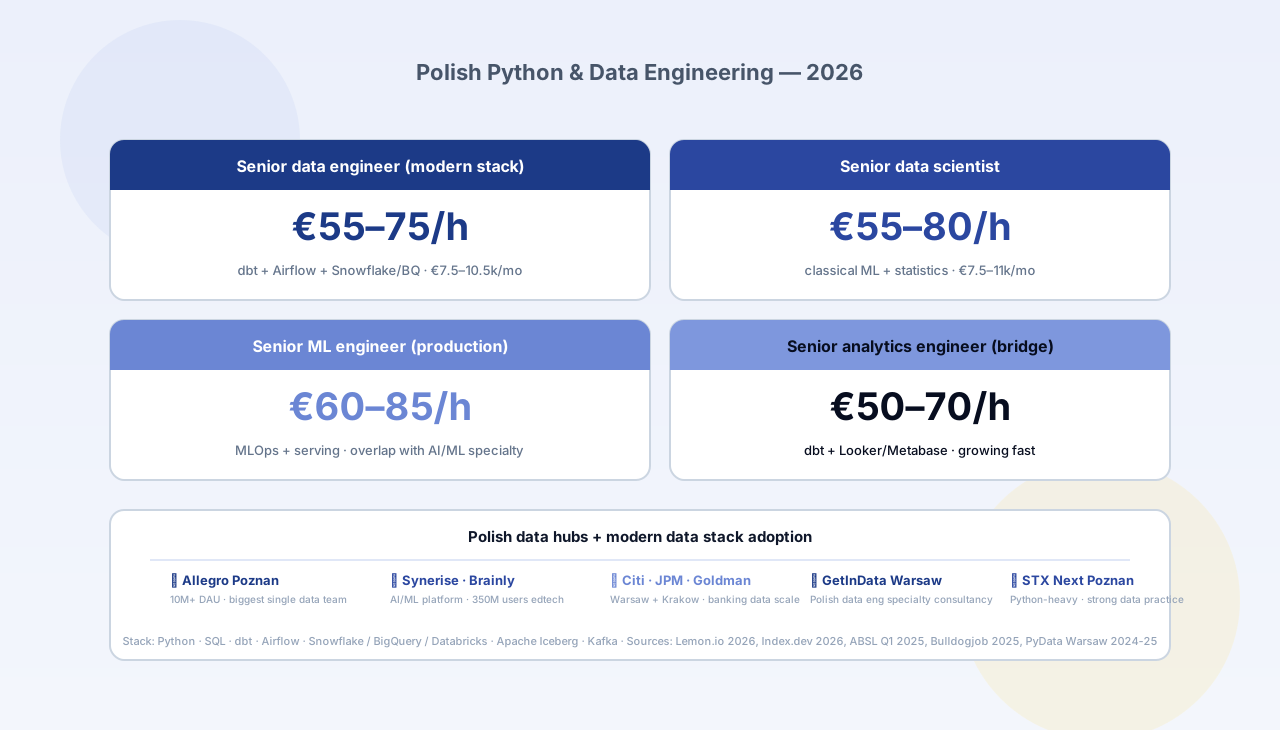
Senior Polish Python EUR 50-70/hour B2B in 2026 (general baseline). Senior data engineer EUR 55-75/h (modest specialty premium for modern data stack). Senior data scientist EUR 55-80/h. Senior ML engineer EUR 60-85/h (overlap with AI/ML specialty).
The Python / data rate stack:
Senior Python / data B2B hourly rates (2026):
- Junior Python engineer (1-3 yrs): EUR 30-45/hour
- Mid Python engineer (3-5 yrs): EUR 40-55/hour
- Senior Python engineer (5-8 yrs): EUR 50-70/hour
- Senior data engineer (modern data stack): EUR 55-75/hour
- Senior data scientist (Python + statistics + classical ML): EUR 55-80/hour
- Senior analytics engineer (dbt + SQL + BI): EUR 50-70/hour
- Senior ML engineer (production ML, MLOps): EUR 60-85/hour
- Senior data + dbt + Snowflake specialist: EUR 65-85/hour
- Senior streaming specialist (Kafka + Flink): EUR 60-85/hour
- Lead / staff data engineer: EUR 75-100/hour
- Principal data architect: EUR 90-115/hour
Translated monthly:
- Senior Python full-time B2B: EUR 7,000-9,500/month gross
- Senior data engineer: EUR 7,500-10,500/month
- Senior data scientist: EUR 7,500-11,000/month
- Senior ML engineer: EUR 8,000-12,000/month
- Lead / staff: EUR 10,500-14,000/month
Why data engineering has a modest specialty premium:
Data engineering has smaller Polish supply than general Python (modern data stack adoption — dbt + Snowflake/BigQuery/Databricks — only became standard 2020-2024). The market premium therefore is modest (10-15% over general Python baseline), reflecting:
- dbt depth — vast majority of senior data engineers have 2+ years of production dbt; junior pool is still building this
- Cloud data warehouse fluency — Snowflake / BigQuery / Databricks production experience is the senior signal
- Orchestration maturity — Airflow at scale, Dagster in modern teams
- Streaming specialty — Kafka + Flink for high-throughput teams
For comparison context:
- Lemon.io 2026 Polish rate calculator — broadly aligns with these ranges
- Index.dev European Developer Hourly Rates 2026 — Polish senior data engineer baseline matches
- Bytefront 2025 Stundensatz guide — German senior data engineer EUR 95-130/hour, Polish 35-50% cheaper
For German foreign employers specifically, Polish data engineers save roughly 35-45% on fully-loaded cost for comparable seniority — and the time-zone parity (CET) means same-day standups with London/Berlin/Amsterdam data teams without async overhead.
Hiring Polish specialists for remote roles?
HiddenJobs is a verified job board and matching service for international companies recruiting Polish remote talent.
What data stacks do Polish engineers cover in 2026?
Python universal, SQL universal at senior level. Snowflake / BigQuery / Databricks deep adoption. dbt dominant for transformation. Airflow dominant for orchestration with Dagster growing fast. Apache Iceberg growing for data lakehouse.
The data stack landscape for Polish engineers in 2026:
Languages:
- Python — universal at senior level. pandas universal for data manipulation, polars and duckdb growing for performance. PySpark common for big data.
- SQL — universal at senior level. PostgreSQL dialect dominant, Snowflake SQL fluency common, BigQuery SQL common.
- Scala — niche, Spark-heavy teams (especially Wroclaw / Warsaw banking).
- R — niche, declining for new projects (Python won), still common in pharma analytics.
- Java — overlap with general Java pool for Spark / Flink / Kafka Connect.
Cloud data warehouses (sub-pool depth in order):
- Snowflake — deep adoption among Polish enterprises and digital product companies. Most common cloud data warehouse for new projects.
- BigQuery — Google Cloud Polish team plus Polish startups using GCP. Strong overlap with ML teams (BigQuery ML).
- Databricks — growing fast, especially in ML-heavy teams. Lakehouse architecture appeal.
- Redshift — legacy, AWS-heavy enterprises. New projects mostly choosing Snowflake on AWS over Redshift.
- ClickHouse — niche but growing for analytics-heavy teams (especially observability and product analytics).
Modern transformation:
- dbt — dominant. Vast majority of senior Polish data engineers in 2026 have 2+ years of production dbt. dbt Core + dbt Cloud both common.
- SQLMesh — growing niche, dbt alternative.
- Stored procedures / scripts — legacy, declining.
Orchestration:
- Airflow — dominant. Many international employer Polish hubs run Airflow at scale (Allegro, banking, telecoms). Apache Airflow 2.x with TaskFlow API.
- Dagster — growing fast (especially in newer modern data stack teams).
- Prefect — niche.
- Argo Workflows — Kubernetes-leaning teams.
- Cron / scripts — legacy.
Streaming:
- Apache Kafka — universal at senior level. Kafka Streams + Kafka Connect common.
- Apache Flink — fintech and high-throughput teams.
- Spark Streaming — legacy, declining.
- Kinesis — AWS-specific.
- Pub/Sub — GCP-specific.
Data lake / lakehouse:
- Apache Iceberg — growing fast, especially with Snowflake and Databricks open table format adoption.
- Delta Lake — Databricks-leaning teams.
- Apache Hudi — niche.
- Parquet on S3 / GCS / ADLS — universal underlying storage.
Data quality + observability:
- dbt tests — universal in dbt-using teams.
- Great Expectations — common standalone.
- Soda — growing.
- Monte Carlo — enterprise observability.
- Datadog — observability for data pipelines.
BI tools (analytics engineer overlap):
- Looker — strong adoption among foreign-employer Polish teams.
- Metabase — open-source choice for Polish startups.
- Tableau — legacy enterprise.
- PowerBI — Microsoft-leaning enterprises.
- Sigma — growing in modern data stack teams.
- Hex — growing for collaborative analytics.
Polish senior data engineer typical CV:
A senior Polish data engineer in 2026 typically has: 5+ years of Python + SQL production, 2+ years of dbt, Snowflake or BigQuery production warehouse experience, Airflow production orchestration, Kafka production messaging exposure, AWS or GCP cloud platform fluent, basic ML awareness for cross-functional collaboration with data scientists. Variation is in stack depth (which warehouse, which orchestrator) rather than baseline coverage.
Data engineer versus data scientist versus analytics engineer versus ML engineer
Four distinct roles with different rate structures and hiring patterns. Foreign employers commonly mis-spec by asking for "data engineer" when they actually need analytics engineer (BI focus) or ML engineer (production ML focus). Get the role split right before opening the search.
Role-by-role breakdown for Polish market 2026:
Data engineer
- Rate: EUR 55-75/h B2B senior
- Pool size: high single thousands senior
- Owns: data pipelines, modern data stack (dbt, Airflow, Snowflake/BigQuery/Databricks), data quality, ingestion + transformation reliability
- Stack: Python + SQL + dbt + Airflow + cloud warehouse + Kafka
- What foreign employers should ask for: scale (TB+/day), modern data stack production experience, dbt depth, orchestration maturity
- Polish anchor employers: Allegro Poznan, Synerise, Brainly, mBank, Citi Tech, JP Morgan Tech, GetInData (Polish data consultancy specialist)
Data scientist
- Rate: EUR 55-80/h B2B senior
- Pool size: low thousands senior
- Owns: models, experiments, A/B testing infrastructure, classical ML (scikit-learn, statsmodels), Python + R + statistics
- Stack: Python + Jupyter + scikit-learn + statsmodels + experimentation platform + SQL
- What foreign employers should ask for: statistical thinking depth, A/B testing methodology, business outcome thinking
- Polish anchor employers: Allegro data science, mBank data science, Synerise (AI/ML platform), Brainly data science, DocPlanner data science, Polish banks (Citi, JPM data science)
Analytics engineer (bridge role, growing fast)
- Rate: EUR 50-70/h B2B senior
- Pool size: smaller (low single thousands), growing fast
- Owns: dbt models, BI tool fluency (Looker, Metabase, Tableau, Sigma), product analytics, transforms raw data into business-ready datasets
- Stack: dbt + SQL + BI tool + light Python + business communication
- What foreign employers should ask for: dbt depth, BI tool fluency, business stakeholder communication
- Polish anchor employers: Allegro analytics engineering, Polish digital product companies, Polish data consultancies
ML engineer (overlap with AI/ML specialty)
- Rate: EUR 60-85/h B2B senior
- Pool size: low thousands senior
- Owns: production ML deployment, MLOps fluency, model serving, monitoring, retraining pipelines
- Stack: Python + MLOps tools (MLflow, Weights & Biases, Kubeflow, SageMaker, Vertex AI) + cloud platform + Kubernetes
- What foreign employers should ask for: production deployment scale, MLOps maturity, observability discipline
- Polish anchor employers: Synerise (AI/ML platform), Brainly ML engineering, Polish AI/ML startups, international banks ML engineering hubs
For the AI/ML specialty deep-dive (NLP, LLM, computer vision, deep learning), see the Polish AI/ML hiring guide. The split: this guide covers data engineer / data scientist / analytics engineer / ML engineer (data-driven, OLAP, BI feed), the AI/ML guide covers AI/ML specialty (model-driven, NLP/LLM/CV/deep learning).
Common foreign employer mis-spec:
- "We need a data engineer" → often actually need analytics engineer (BI tool fluency)
- "We need a data scientist" → often actually need ML engineer (production deployment)
- "We need an ML engineer" → often actually need AI/ML specialty engineer (LLM, NLP)
- "We need everything in one person" → unicorn role, expect 30-50% premium and 2-3x longer search
Where does Polish Python / data talent concentrate?
Heavy concentration in Warsaw + Poznan + Krakow + Wroclaw, with meaningful Tri-City Gdansk and Lodz secondary. Allegro Poznan is the single largest Polish data engineering team. Warsaw financial services data hubs (Citi, JPM, Goldman) deep additional pool.
City-by-city breakdown:
Warsaw — financial services data epicenter:
- Citi Tech Warsaw data engineering — banking data at scale
- JP Morgan Tech Warsaw data + market data + analytics — large internal data team
- Goldman Sachs Tech Warsaw — trading data
- mBank Warsaw data analytics + ML
- Synerise Warsaw — AI/ML platform, deep data infrastructure
- DocPlanner Warsaw data team
- Booksy Warsaw data team
- Polish data consultancies — GetInData (Polish data engineering specialty), DataSentics, Xebia Polish
Poznan — Allegro main data engineering hub:
- Allegro Poznan — largest single Polish data engineering team (10M+ DAU e-commerce data warehouse + analytics + ML platform)
- Volkswagen IT Poznan — automotive data
- Roche IT Poznan — pharmaceutical data
- Poznan University of Technology data programs
Krakow — university-anchored data depth:
- Cisco Krakow data infrastructure
- Comarch Krakow product data
- Capgemini Krakow data practice
- AGH University Krakow data science graduate pipeline (one of Poland's strongest data programs)
- Synerise Krakow — AI/ML platform engineering
- Smaller Polish data startups
Wroclaw — banking + automotive data:
- Volvo IT Wroclaw data
- Credit Suisse / UBS Operations Wroclaw — financial data + .NET hybrid
- Capgemini Wroclaw data practice
- Wroclaw University data engineering programs
Tri-City Gdansk:
- Schibsted Tri-City data
- Intel R&D data infrastructure
Lodz — Citi shared services data:
- Citi Tech Lodz data operations
Tier 2 cities (Rzeszow, Lublin, Katowice, Bydgoszcz, Szczecin):
- Rzeszow — Asseco data products (pharma, banking)
- Katowice — mining and industrial data
- Smaller data presence at Asseco subsidiaries and consultancies
For foreign employers, sourcing from Warsaw + Poznan + Krakow + Wroclaw covers ~85% of the senior Polish data engineer pool. For specialty needs (modern data stack, dbt depth, ML engineering, streaming), targeted alumni outreach (Allegro / Synerise / Brainly / GetInData) is high-leverage.
What Polish companies employ the strongest Python & data engineers?
Three buckets: Polish digital product companies running large data platforms (Allegro, CD Projekt, Synerise, Brainly, DocPlanner, mBank, Booksy), international employer data engineering hubs in Poland (Citi, JPM, Goldman, Cisco, HSBC), and Polish IT consultancies with data practice (GetInData, STX Next, Netguru, Capgemini, Brainhub).
The three buckets:
Bucket 1: Polish digital product companies running large data platforms
- Allegro Poznan — anchor employer, largest single Polish data engineering team (10M+ DAU e-commerce data warehouse + analytics + ML platform)
- CD Projekt Red Warsaw — game telemetry + analytics at AAA scale
- Synerise (Krakow + Warsaw) — AI/ML platform with deep data infrastructure
- Brainly — edtech with 350M+ users globally, deep data analytics
- DocPlanner / ZnanyLekarz Warsaw — multi-language European healthcare data
- mBank Warsaw — banking analytics + ML
- Booksy data team — international booking platform analytics
- Polish gaming studios — Techland (Dying Light telemetry), 11 bit studios, People Can Fly
- Estimote — IoT + analytics platform
- PRACUJ.pl — recruitment market analytics
- OLX Polish — classifieds analytics
For foreign employers, candidates with 2+ years at these Polish digital product companies bring data quality discipline, modern data stack fluency, and analytics maturity that transfer directly.
Bucket 2: International employer data engineering hubs in Poland
- Citi Tech Polish — banking data engineering across Warsaw + Krakow + Lodz
- JP Morgan Tech Polish — financial data + analytics + market data Warsaw + Krakow
- Goldman Sachs Tech Warsaw — trading data
- Cisco Krakow — data infrastructure
- HSBC Operations Krakow — banking data
- Credit Suisse / UBS Operations Wroclaw — financial data + .NET hybrid
- ING Tech Poland — Dutch retail bank data
- Volvo IT Wroclaw — automotive data
- Schibsted Tri-City — media data
- Intel Polish R&D — data infrastructure
For foreign employers, candidates from international employer hubs bring production data engineering experience at financial-services scale plus regulatory data discipline (audit trails, data lineage, GDPR compliance).
Bucket 3: Polish IT consultancies with data practice
- GetInData Warsaw — Polish data engineering specialty consultancy, deep modern data stack expertise
- STX Next Poznan — Python-heavy with strong data practice
- DataSentics Warsaw — data + ML consultancy
- Xebia Polish — data + cloud
- Brainhub Gliwice — TypeScript-leaning but with data practice
- Netguru data team — data within full-stack agency
- Capgemini Polish data practice
- Sii Poland data practice
- EPAM Polish — international consultancy data team
- TietoEVRY Polish — Nordic-leaning consultancy
These consultancies attract senior data engineers who prefer client variety over single-employer depth. Engineers rotating out for direct foreign-employer engagements bring exposure to many data architectures.
How do you screen a Polish Python/data candidate?
Four screens stack: SQL fluency depth, Python data fluency, pipeline architecture trade-offs, foreign-employer comfort signal with statistical thinking test for data scientist roles.
The four-screen protocol:
1. SQL fluency depth
Pick a SQL optimization scenario and ask the candidate to walk through diagnosis. Examples:
- "Walk me through optimizing this slow query that joins 5 tables and filters with date ranges. The query plan shows a sequential scan on a 100M-row table."
- "Window functions vs self-joins: write the same query both ways and explain when you'd pick which."
- "We have a fact table with 5 billion rows partitioned by date. A query filtering by user_id is slow. Walk me through optimization."
- "Walk me through the trade-offs between materialized views, incremental dbt models, and pre-aggregated tables."
Strong candidates engage with concrete tools (EXPLAIN ANALYZE, indexes, partitioning, query rewriting, materialized views, columnar vs row storage trade-offs, clustering keys in Snowflake / BigQuery) and named pitfalls (correlated subqueries, NOT IN with NULLs, implicit casts, cartesian products from missing join conditions, data skew in distributed warehouses).
2. Python data fluency
Pick a Python data scenario:
- "Walk me through processing a 50 GB CSV that won't fit in memory."
- "Pandas is slow for this aggregation across 10M rows. What alternatives would you consider?"
- "We have a daily ETL that's started failing with OOM. Walk me through diagnosis and remediation."
- "Walk me through your testing approach for a complex data transformation."
Strong candidates discuss chunking, streaming, dask/polars/duckdb alternatives to pandas, columnar formats (Parquet, Arrow), memory profiling (memory_profiler, tracemalloc), data quality testing (Great Expectations, dbt tests), and explicitly distinguish development vs production tooling.
3. Pipeline architecture trade-offs
Pick a pipeline architecture scenario:
- "Design a daily ETL pipeline that ingests data from 3 SaaS APIs, transforms it via dbt, lands in Snowflake, and feeds a Looker dashboard. Walk me through the architecture choices."
- "We have a real-time fraud detection use case. Walk me through your streaming architecture choice."
- "How would you handle backfilling 2 years of historical data into a new pipeline without downtime?"
- "Compare Airflow vs Dagster vs Prefect for our use case (200 daily DAGs, 50 of which are dbt-heavy)."
Strong candidates discuss orchestration trade-offs (Airflow vs Dagster vs Prefect), idempotency, backfills, schema evolution, data quality testing (Great Expectations, dbt tests), incremental vs full refresh, exactly-once vs at-least-once delivery, fault tolerance — with explicit cost-quality-complexity trade-offs.
4. Foreign-employer comfort signal + statistical thinking test (for data scientist roles)
Ask about prior international employer experience. Specifically:
- Allegro / Synerise / Brainly / DocPlanner / mBank / Booksy / CD Projekt Red — Polish digital product alumni?
- Citi Tech / JP Morgan Tech / Goldman Sachs Tech / HSBC Operations — international banking alumni?
- GetInData / DataSentics / STX Next data — Polish data consultancy alumni?
- Active conference involvement (PyData Warsaw, PyCon Poland, Data Engineering Krakow meetup)?
- Open-source data tooling contributions (dbt, Airflow, Iceberg)?
For data scientist roles specifically, add a statistical thinking test: ask the candidate to walk through how they'd design an A/B test for a specific scenario, including sample size calculation, control vs treatment assignment, statistical test choice, and what they'd do if results are inconclusive after 2 weeks. Strong candidates engage with concrete statistical methodology — weak candidates rely on platform tooling without understanding underlying mechanics.
Candidates with 2+ years at Polish digital product companies or international banking data hubs ramp 3-4x faster on foreign data engagements.
Where do you find Polish Python / data engineers open to remote foreign-employer roles?
Three channels in parallel: curated foreign-only Polish IT job boards, large Polish IT job boards with data filters, and Polish data-specific communities. Plus LinkedIn outbound to alumni of Polish digital product data teams.
Channel mix for Polish Python / data hiring:
1. Curated foreign-only Polish IT job boards
- HiddenJobs.eu — verified foreign-employer listings, Python/Data category tagging, contract path indicated upfront
2. Large Polish IT job boards with data filters
- Bulldogjob — dedicated data engineering section + annual data salary survey
- NoFluffJobs — Python and data categories with strong filters by stack (Airflow, dbt, Snowflake) and seniority
- JustJoin.it — Python/data filter with stack breakdown
- Pracuj.pl — broader Polish job board
- theProtocol.it — Polish IT-focused job board
- inhire.io — invite-only Polish IT marketplace, strong senior data pool
3. Polish data-specific communities
The Polish data community is concentrated and active:
- Polish Data Science Society Warsaw — largest Polish data community
- Warsaw Python User Group — active monthly meetup
- Krakow Python User Group — active monthly
- Wroclaw Python
- Tri-City Python
- PyData Warsaw — annual flagship Polish data conference (~600-1000 attendees)
- PyData Krakow — annual conference
- PyCon Poland — Polish Python conference (annual)
- Data Engineering Krakow meetup — monthly meetup
- Polish Apache Airflow community Slack — Polish Airflow operators network
- GetInData community — Polish data engineering specialty consultancy community
- MLOps Polish community Slack
4. LinkedIn outbound to specific Polish digital product + banking + consultancy hubs
Targeting alumni networks for senior data engineers:
- "Allegro alumni" — broadest Polish digital product data pool (e-commerce platform scale)
- "Synerise alumni" — AI/ML platform deep data infrastructure
- "Brainly data alumni" — global edtech analytics platform
- "DocPlanner / ZnanyLekarz data alumni" — multi-language European healthcare
- "mBank data alumni" — banking analytics + ML
- "GetInData alumni" — Polish data consultancy specialist
- "Citi Tech Polish data alumni" — banking data at scale
- "JP Morgan Tech Polish data alumni" — financial data + analytics
- "DataSentics alumni" — data + ML consultancy
Concrete openers (specific role + data stack + monthly EUR rate range + time-zone + specialty depth) get 5-10x the response rate of generic templates.
To list a verified senior Polish Python / data role on HiddenJobs.eu, send the brief to hiddenjobs.eu — role title with data specialty (data engineer / data scientist / analytics engineer / ML engineer), stack expectations (warehouse, dbt depth, orchestrator), contract path (B2B or EOR), monthly EUR rate range, and one paragraph about your data context. Response within a day or two.
Where this guide goes from here
Polish Python and data engineering talent is one of Eastern Europe's deepest data pools in 2026 — anchored by Polish digital product data scale at Allegro, CD Projekt, Synerise, Brainly, and DocPlanner, with strong cloud data warehouse + dbt + Airflow modern data stack adoption. Foreign employers benefit from 35-50% rate savings vs Western Europe with CET time-zone parity for same-day collaboration.
For deeper guides on this site:
- AI/ML companion guide — the AI/ML hiring guide covers Polish AI/ML specialty pool (NLP, LLM, computer vision, deep learning) — distinct from data engineer / data scientist / analytics engineer covered here
- Frontend companion guide — the Frontend & React hiring guide covers Polish frontend specialty pool
- Java companion guide — the Java & Spring hiring guide covers Polish enterprise Java pool
- DevOps companion guide — the DevOps & cloud hiring guide covers Polish DevOps specialty
- General Polish IT hiring — the pillar guide covers all three contract paths
- Cost overview — the cost guide covers national cost stack
- City breakdown — the city salary guide covers per-city benchmarks (data engineering follows similar pattern with Poznan deepest single platform team due to Allegro)
- B2B contract operational — the B2B contract guide covers JDG mechanics and the July 2026 reform
The short version of Polish Python / data hiring 2026: deepest data engineering pool in Eastern Europe, senior Python EUR 50-70/h baseline, senior data engineer EUR 55-75/h (modest specialty premium for modern data stack), senior data scientist EUR 55-80/h, senior ML engineer EUR 60-85/h (overlap with AI/ML specialty), time-to-hire 3-6 weeks for senior with foreign-employer-relevant experience, four distinct data roles with different rate structures — get the role split right before opening the search.
To list a verified Polish Python / data role on HiddenJobs.eu, send the brief to hiddenjobs.eu or get in touch directly. Response within a day or two.
Frequently asked questions
Is Poland strong on Python and data engineering in 2026?
Yes — Poland has one of Eastern Europe's deepest data engineering pools, anchored by data platform engineering at Polish digital product companies. Three structural drivers stack. First, Polish digital product data scale: Allegro Poznan (10M+ DAU e-commerce, deep data warehouse + analytics platform), CD Projekt Red (game telemetry at AAA scale), Synerise (AI/ML platform, deep data infrastructure), Brainly (350M+ users edtech analytics), DocPlanner (multi-language European healthcare data), mBank (banking analytics). Second, Polish university Python adoption: Warsaw University, AGH Krakow, Wroclaw University, Jagiellonian University all run Python-first data science programs. Third, Polish enterprise data modernization: banks (Citi, JPM Tech, mBank, Santander) and Polish enterprises (Comarch, Asseco, telecoms) all hiring data engineers for cloud-warehouse modernization. Aggregate Polish senior data engineer pool sits in the high single thousands, plus tens of thousands general Python pool.
What do Polish Python and data engineers cost on B2B in 2026?
Senior Polish Python engineers run EUR 50-70/hour B2B in 2026 — at general senior backend baseline (per Lemon.io 2026 and Index.dev 2026). Senior data engineers (modern data stack: dbt, Airflow, Snowflake/BigQuery/Databricks) run EUR 55-75/hour — slight premium because modern data stack adoption is recent and senior pool is smaller. Senior data scientists run EUR 55-80/hour (Python + statistics + classical ML, distinct from AI/ML engineering covered separately). Senior analytics engineers (dbt + SQL + visualization) run EUR 50-70/hour. Senior ML engineers with overlap to AI/ML specialty (NLP, computer vision, deep learning) run EUR 60-85/hour. Lead / staff data engineer EUR 75-100/hour. Translated monthly: senior data engineer full-time B2B EUR 7,500-10,500/month gross. Compared to German seniors (EUR 95-130/h per Bytefront 2025), Polish data engineers save you 35-50% for comparable seniority — and time-zone parity (CET) means same-day standups with London/Berlin/Amsterdam data teams.
What data stacks do Polish engineers cover in 2026?
Strongest 2026 data stacks in Polish pool: Python universal, SQL universal at senior level. Cloud data warehouses: Snowflake (deep adoption among Polish enterprises and digital product companies), BigQuery (Google Cloud Polish team plus Polish startups using GCP), Databricks (growing fast, especially in ML-heavy teams), Redshift (legacy AWS-heavy enterprises). Modern transformation: dbt dominant (vast majority of senior Polish data engineers in 2026 have 2+ years production dbt), SQLMesh growing niche. Orchestration: Airflow dominant (many international employer Polish hubs run Airflow at scale), Dagster growing (especially in newer teams), Prefect niche, Argo Workflows in Kubernetes-leaning teams. Streaming: Kafka universal at senior, Kafka Streams + Kafka Connect common, Apache Flink in fintech and high-throughput teams, Spark Streaming legacy. Data lake: Apache Iceberg growing fast, Delta Lake on Databricks-leaning teams, Hudi niche. Polish senior data engineer typical CV: Python + SQL fluent, Snowflake or BigQuery production, dbt expert, Airflow production, Kafka production messaging, AWS or GCP cloud platform fluent.
What's the difference between Polish data engineer, data scientist, analytics engineer, and ML engineer in 2026?
Four distinct roles with different rate structures and hiring patterns. Data engineer (EUR 55-75/h B2B senior): builds and maintains data pipelines, owns the modern data stack (dbt, Airflow, Snowflake/BigQuery/Databricks), focuses on reliability, scale, and data quality. Senior pool: high single thousands. Data scientist (EUR 55-80/h B2B senior): builds models, runs experiments, owns A/B testing infrastructure, classical ML focus (scikit-learn, statsmodels), Python + R + statistics. Senior pool: low thousands. Analytics engineer (EUR 50-70/h B2B senior): bridge role, dbt expert, BI tool fluency (Looker, Metabase, Tableau, Sigma), close to product analytics, transforms raw data into business-ready datasets. Smaller pool, growing fast. ML engineer (EUR 60-85/h B2B senior): deploys ML models to production, MLOps fluency, overlaps with AI/ML engineering specialty (covered separately). Senior pool: low thousands. Foreign employers commonly mis-spec by asking for 'data engineer' when they actually need analytics engineer (BI focus) or ML engineer (production ML focus). Get the role split right before opening the search.
Where does Polish Python and data talent concentrate?
Heavy concentration in Warsaw + Krakow + Wroclaw + Poznan, with meaningful Tri-City Gdansk and Lodz secondary. Warsaw is the financial services data epicenter: Citi Tech Warsaw data engineering, JP Morgan Tech Warsaw data, Goldman Sachs Tech data, mBank data analytics, Synerise data platform, DocPlanner data team. Krakow has Cisco Krakow data infrastructure, Comarch product data, Capgemini data practice, AGH University Python data science graduate pipeline (one of Poland's strongest data programs). Wroclaw has Volvo IT data, Credit Suisse / UBS data + analytics, Wroclaw University data engineering programs. Poznan has Allegro Poznan (largest single Polish data engineering team at 10M+ DAU scale), Volkswagen IT data, Roche IT data, plus Poznan University strong data programs. Tri-City Gdansk has Schibsted Tri-City data, Intel R&D data infrastructure. Lodz has Citi Tech Lodz data operations. Tier 2 cities (Rzeszow, Lublin, Katowice) have smaller data presence at Asseco subsidiaries and consultancies.
What Polish companies employ the strongest Python and data engineers?
Three buckets in 2026. Polish digital product companies running large data platforms: Allegro Poznan (largest single Polish data engineering team, deep data warehouse + analytics platform serving 10M+ DAU e-commerce), CD Projekt Red Warsaw (game telemetry + analytics at AAA scale), Synerise Krakow + Warsaw (AI/ML platform with deep data infrastructure), Brainly (350M+ users edtech analytics), DocPlanner / ZnanyLekarz Warsaw (multi-language European healthcare data), mBank Warsaw (banking analytics + ML), Booksy data team. International employers running data engineering hubs in Poland: Citi Tech Polish (banking data engineering across Warsaw + Krakow + Lodz), JP Morgan Tech Polish (financial data + analytics + market data Warsaw + Krakow), Goldman Sachs Tech Warsaw (trading data), Cisco Krakow (data infrastructure), HSBC Operations Krakow (banking data), Credit Suisse / UBS Operations Wroclaw (financial data + .NET hybrid). Polish IT consultancies with data practice: Netguru data team, STX Next Poznan (Python-heavy with strong data practice), Brainhub Gliwice, GetInData Warsaw (Polish data engineering specialty consultancy), DataSentics Warsaw (data + ML consultancy), Xebia Polish (data + cloud), Capgemini Polish data practice, Sii Poland data practice.
How do you screen a Polish Python/data candidate for foreign-employer fit?
Run four screens. First, SQL fluency depth: 'Walk me through optimizing this slow query that joins 5 tables and filters with date ranges. The query plan shows a sequential scan on a 100M-row table.' Strong candidates engage with concrete tools (EXPLAIN ANALYZE, indexes, partitioning, query rewriting, materialized views, columnar vs row storage trade-offs) and named pitfalls (correlated subqueries, NOT IN with NULLs, implicit casts, cartesian products from missing join conditions). Second, Python data fluency: 'Walk me through processing a 50 GB CSV that won't fit in memory.' Strong candidates discuss chunking, streaming, dask/polars/duckdb alternatives to pandas, columnar formats (Parquet, Arrow), memory profiling. Third, pipeline architecture: 'Design a daily ETL pipeline that ingests data from 3 SaaS APIs, transforms it via dbt, lands in Snowflake, and feeds a Looker dashboard. Walk me through the architecture choices.' Strong candidates discuss orchestration (Airflow vs Dagster), idempotency, backfills, schema evolution, data quality testing (Great Expectations, dbt tests), incremental vs full refresh. Fourth, foreign-employer comfort: prior international employer experience (Allegro, Synerise, Brainly, Citi Tech, JP Morgan Tech all count) plus statistical thinking test for data scientist roles.
Where do you find Polish Python data engineers open to remote foreign-employer roles?
Three channels work in parallel. First, curated foreign-only Polish IT job boards (HiddenJobs.eu) with explicit Python/data category tagging. Second, large Polish IT job boards with data filters (Bulldogjob has dedicated data engineering section + annual data salary survey, NoFluffJobs has Python and data categories, JustJoin.it filter by stack including Python/data + seniority). Third, Polish data-specific communities: Polish Data Science Society Warsaw (largest Polish data community), Warsaw Python User Group, Krakow Python User Group, PyData Warsaw conference (annual flagship), PyData Krakow, PyCon Poland, Data Engineering Krakow meetup, Polish Apache Airflow community Slack, GetInData community. Plus LinkedIn outbound to alumni of Polish digital product data teams (Allegro data alumni, Synerise alumni, Brainly data alumni, DocPlanner data alumni, mBank data alumni, GetInData alumni — Polish data consultancy specialist) — concrete openers (specific role + data stack + monthly EUR rate range + time-zone) get 5-10x the response rate of generic templates. Polish data community is small enough that senior practitioners often know each other.
Editorial note
This guide cites named public sources for every concrete number: Lemon.io 2026 rate calculator (Poland) and Index.dev European Developer Hourly Rates 2026 for senior Python/data B2B rates including specialty premium, ABSL Q1 2025 Sector in Numbers for Polish IT workforce, Bulldogjob IT Community Survey 2025 data engineering section, PyData Warsaw 2024-2025 attendance signal. Currency conversion ~$1.06 = €1, PLN/EUR ~4.27 (May 2026). Treat ranges as ranges — actual data engineering rates vary by data stack mix (Snowflake vs BigQuery vs Databricks fluency), dbt depth, ML engineering crossover, and individual negotiation. The post is informational and does not constitute legal, tax, or HR advice; consult a Polish IT-specialized recruiter before locking your offer band for a senior data engineer hire.